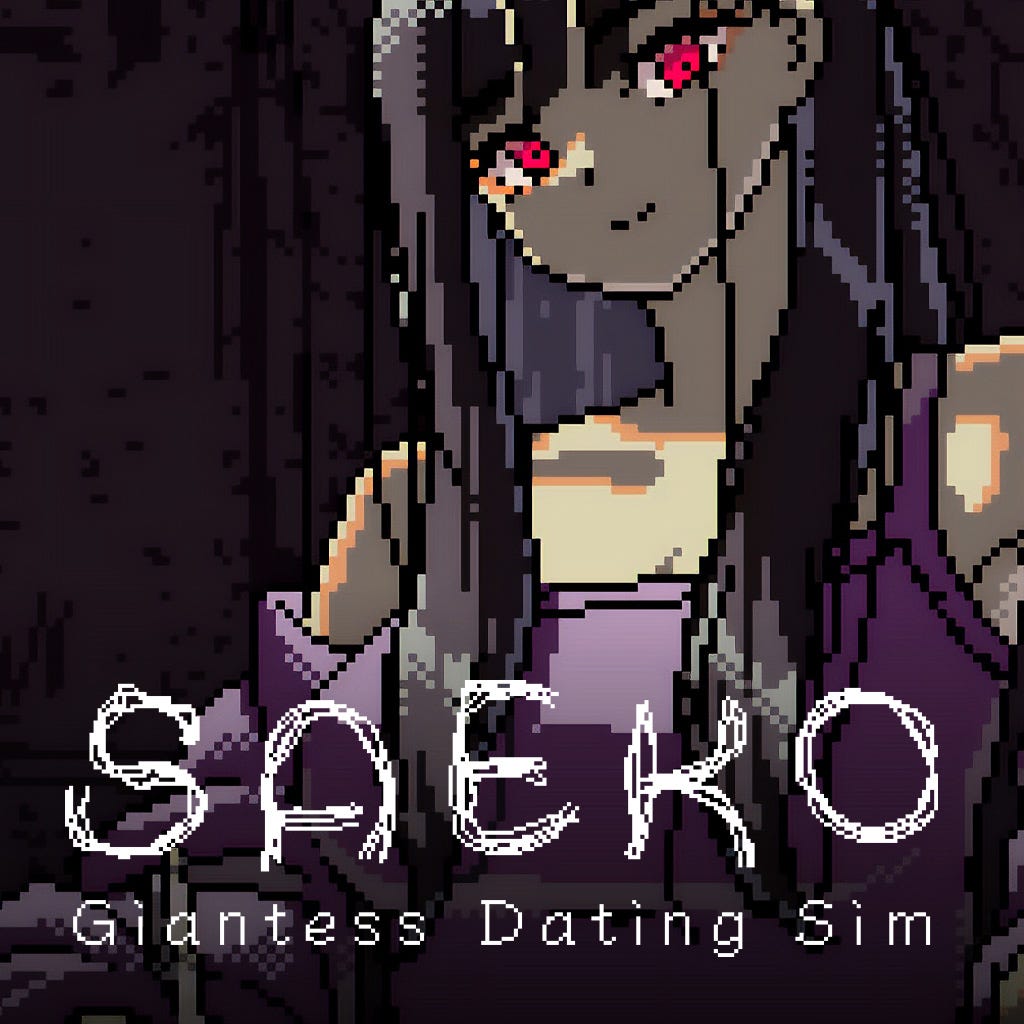
The indie scene has never shied away from unusual ideas, but every so often a game arrives that defies categorisation. SAEKO: Giantess Dating Sim is one of those rare releases. Its title immediately grabs attention, often for reasons that have little to do with what the game actually offers. On the surface, it sounds like a niche visual novel built around a bizarre gimmick. Spend even a short time with it, however, and it quickly becomes clear that this is something far more ambitious.
Developed by Safe Havn Studio, SAEKO is a psychological horror adventure wrapped in the framework of a visual novel. It explores themes of loneliness, obsession, control, and survival through a premise that keeps players off balance. Rather than relying on jump scares or grotesque monsters, it creates fear through human behaviour and emotional unpredictability. The result is a game that feels intimate, uncomfortable, and fascinating in equal measure. It is not always an easy experience to play, but it certainly leaves a lasting impression.
A Story Built on Unease
The story follows Rin, a young man who awakens with no memory of how he came to be in his current situation. Confusion quickly gives way to horror when he discovers he has been shrunk to the size of a thumb. Worse still, he is not alone. Several other miniature people share his fate, all trapped inside the desk drawer of a university student named Saeko.
The drawer serves as both prison and home. By day, the tiny residents try to survive, ration resources, and make sense of their bizarre circumstances. By night, they face the terrifying reality of their captor. Saeko is neither a straightforward villain nor a sympathetic hero. She exists somewhere between those extremes, making her one of the most compelling characters to emerge from the indie horror scene in recent years.
What makes the narrative so effective is its refusal to offer simple answers. Saeko can be kind one moment and horrifying the next. She is lonely, insecure, curious, and frighteningly unpredictable. Every interaction with her carries an undercurrent of danger because neither Rin nor the player can ever be completely certain how she will react.
This uncertainty becomes the driving force behind the entire experience. Rather than asking whether you can survive another monster encounter, SAEKO asks whether you can survive another conversation.
Life Inside the Drawer
The daytime sections focus on exploration and resource management within the confines of Saeko’s desk drawer. Presented through charming pixel-art environments, these sequences introduce the other miniature inhabitants and allow players to learn more about their personalities and circumstances. What initially appears to be a relatively safe refuge gradually reveals itself as a fragile ecosystem built on fear and desperation.
Conversations with fellow captives provide some of the game’s strongest writing. Each character responds differently to their imprisonment, creating a believable social dynamic among people who know their lives could end at any moment. Some remain optimistic despite overwhelming odds, while others embrace cynicism or self-preservation. These interactions ground the story and lend emotional weight to the difficult choices players must make.
The gameplay itself is relatively straightforward, focusing on gathering food, interacting with objects, and preparing for the events that unfold after dark. Yet even these quieter moments carry a lingering sense of tension. Every crumb collected and every conversation held feels meaningful because survival depends on careful planning and an understanding of the fragile relationships within the drawer.
What truly elevates these sections is how effectively they establish a sense of vulnerability. You are never allowed to forget how small and powerless Rin really is.
Conversations More Terrifying Than Combat
When night falls, the tone shifts dramatically. Rin is removed from the drawer and brought face to face with Saeko. These sequences form the emotional and psychological core of the game, transforming what could have been a traditional visual novel into something far more distinctive.
The conversations operate under real-time constraints. Players must respond to Saeko’s questions and comments within a limited window, creating immediate pressure in every exchange. Unlike many narrative games, there is rarely an obvious correct answer. Saeko does not simply reward agreement or punish disagreement. Instead, her reactions are shaped by mood, context, and her deeply flawed worldview.
This creates a fascinating psychological balancing act. Players must learn to read subtle cues and understand what Saeko truly wants from each conversation. Sometimes she seeks validation. Sometimes she wants honesty. Sometimes she simply wants attention. The challenge lies in recognising the difference before it is too late.
These moments are incredibly effective because they transform ordinary dialogue into a source of genuine fear. There are no weapons to wield and no enemies to defeat. Survival depends entirely on understanding another person’s emotions. Few horror games manage to create tension through conversation alone, yet SAEKO succeeds remarkably well.
A Distinctive Visual Identity
Visually, SAEKO stands out immediately thanks to its dual pixel-art approach. The drawer sections employ a bright, expressive retro aesthetic that highlights the miniature world inhabited by Rin and the other captives. Despite the grim circumstances, these environments have a certain warmth that makes them strangely inviting.
The contrast becomes striking whenever Saeko enters the scene. The art style shifts to emphasise her immense presence and emotional complexity. Her facial expressions are beautifully animated, conveying subtle shifts in mood that prove vital during conversations. A slight smile, a hesitant glance, or a lingering stare can communicate more than entire paragraphs of dialogue.
This artistic contrast reinforces the game’s themes perfectly. The tiny characters exist within a world that feels manageable and familiar, while Saeko herself remains an overwhelming force that dominates every room she enters. The difference in scale is not merely visual. It becomes a constant reminder of the imbalance at the heart of the story. The attention to detail throughout the presentation helps create a world that feels both surreal and believable.
Sound Design That Gets Under Your Skin
The soundtrack deserves special recognition for its role in building atmosphere. Drawing on breakcore, ambient electronic music, and future garage, the score creates an unsettling backdrop that perfectly complements the narrative.
Rather than relying on loud stingers or traditional horror cues, the music operates on a more subtle level. Tracks often begin with gentle melodies before introducing distorted rhythms and uneasy textures. This creates a sense that something is always slightly off, even during moments of apparent calm.
Environmental audio is equally impressive. Small details such as creaking furniture, distant footsteps, and the sounds of objects shifting within the room reinforce the player’s tiny perspective. The world beyond the drawer feels enormous, unpredictable, and impossible to control. Together, the visuals and audio create an atmosphere that remains consistently engaging throughout the experience.
Not Without Frustrations
As impressive as Saeko is, it has a few shortcomings. The biggest issue stems from the dialogue system. While unpredictability is central to the game’s themes, there are moments when Saeko’s reactions feel overly arbitrary. Certain responses can trigger failure states without providing enough context for players to understand what went wrong.
This occasionally turns compelling psychological tension into simple trial and error. Repeating lengthy conversations because of a single unexpected response can be frustrating, particularly in later sections of the game. The issue never completely undermines the experience, but it does create moments when the mechanics feel less refined than the surrounding writing.
The interface can also be awkward at times. Some text and menu elements are difficult to read against darker backgrounds, which becomes noticeable during fast-paced dialogue exchanges. While these issues are relatively minor, they are worth mentioning given how important communication is to the overall experience.
Final Verdict
SAEKO: Giantess Dating Sim is one of the boldest and most memorable indie releases of 2026. It takes a premise that could easily have become a shallow novelty and transforms it into a thoughtful, unsettling exploration of power, vulnerability, and emotional manipulation. The writing is consistently strong, the atmosphere exceptional, and the central relationship between Rin and Saeko compelling from beginning to end.
Its occasional mechanical frustrations and occasionally opaque dialogue outcomes prevent it from reaching absolute perfection, but they do little to diminish the overall impact of the experience. This is a game that understands horror does not always come from monsters or violence. Sometimes it comes from being completely dependent on someone you can never fully understand.
For fans of psychological horror, narrative adventures, and experimental indie storytelling, SAEKO: Giantess Dating Sim is an experience well worth seeking out. Strange, haunting, and deeply uncomfortable in all the right ways, it is a journey that lingers long after the final conversation ends.