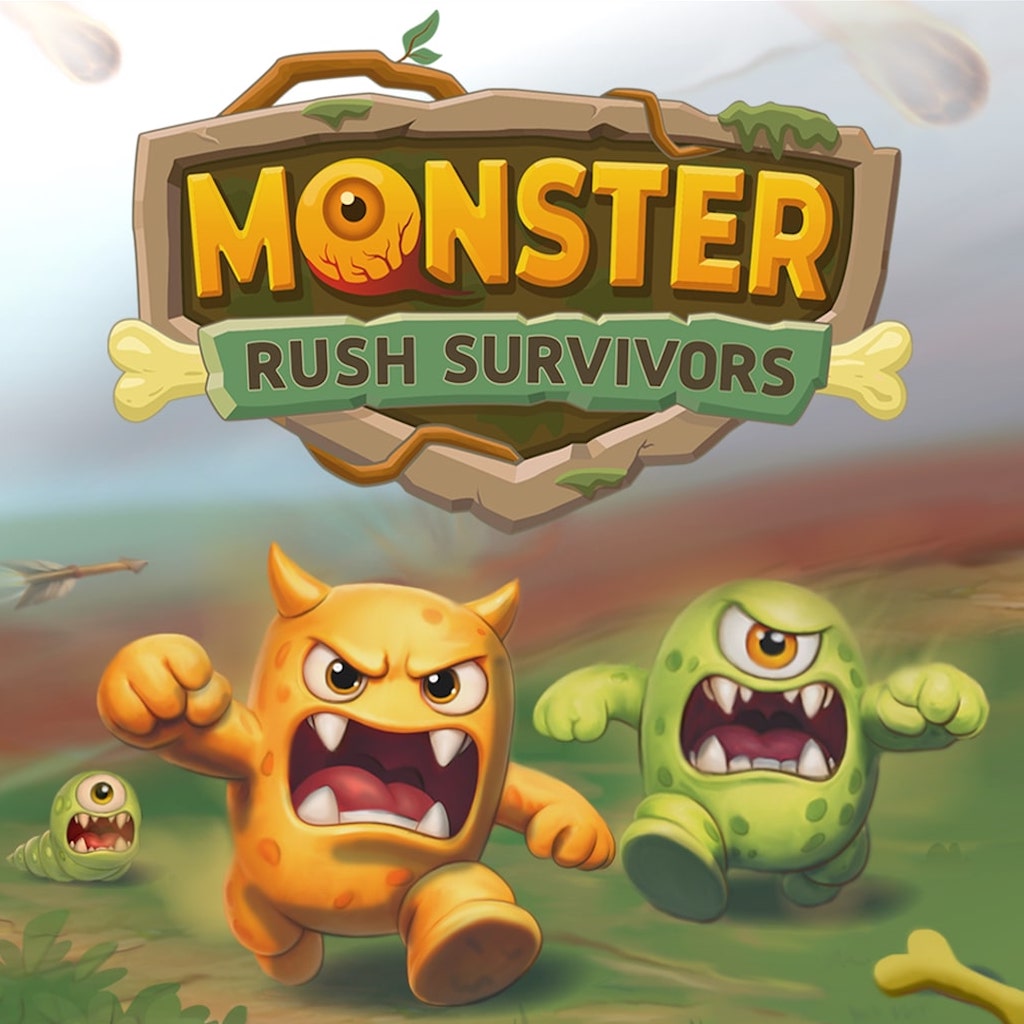
Monster Rush Survivors wastes no time in showing you exactly what it is. From the opening seconds of a run, the screen fills with enemies, movement becomes a constant necessity, and survival quickly shifts from cautious positioning to controlled chaos. This is a game built around pressure, where thousands of enemies are not a spectacle so much as a baseline expectation. The moment-to-moment gameplay is deliberately simple to execute but layered in consequence, as every movement decision determines whether your build will scale fast enough to survive what is coming next.
At its heart, the game follows the familiar bullet-hell auto-attacking survival formula, but it distinguishes itself through tempo control and build escalation. Runs begin at a manageable pace, giving you time to establish early upgrades and understand your character’s identity. Then, almost without warning, the intensity ramps up until the screen becomes a shifting storm of damage numbers, enemy bodies, and ability effects. What keeps this from becoming pure visual noise is how progression feeds directly into survivability. You are not just reacting to chaos; you are actively shaping how much chaos you can withstand.
Characters and Build Identity
One of the strongest pillars of Monster Rush Survivors is its roster of 13 unique characters, each with a distinct starting identity and ability set. These are not purely cosmetic variations but meaningful shifts in how you approach each run. Some characters lean into aggressive, dash-based mobility, slicing through hordes with precision bursts, while others focus on survivability or elemental scaling that turns the battlefield into a sustained damage zone. This initial choice matters more than it first appears, as it shapes your early survivability and influences how you interpret item drops and upgrades.
The real depth, however, emerges when these character identities merge with the game’s expansive item and gem systems. What starts as a simple archetype can quickly evolve into something far more chaotic and personalised. A defensive build can slowly become a regeneration-powered juggernaut, while an elemental-focused character might spiral into screen-wide chain reactions that erase entire waves in seconds. The game constantly encourages experimentation, and even when builds fall short, they rarely feel like wasted runs because progression still feeds into future attempts.
Item Systems and Progression Depth
Where Monster Rush Survivors truly expands beyond standard genre expectations is in its itemisation system. With hundreds of equippable items across multiple rarity tiers, the game fosters a sense of constant discovery. Every run offers the possibility of stumbling upon a combination that dramatically shifts your power curve. The inclusion of item evolution and gem slot mechanics adds another layer of depth, encouraging players to think not only about individual upgrades but also how those upgrades interact over time.
The progression system is structured to reward long-term engagement without overwhelming new players. Early runs feel approachable, with straightforward stat increases such as attack, defence, and health forming the foundation of your build. As you progress, however, the system reveals its complexity through cooldown manipulation, critical scaling, elemental modifiers, and synergy-based item combinations. This gradual reveal of systems ensures that the game grows with the player rather than dumping everything at once.
That said, the sheer breadth of systems can occasionally lead to imbalance. Certain stat combinations, particularly those focused on regeneration or high-burst elemental damage, can overshadow more nuanced builds. When a synergy clicks, it can feel like you have broken the game in the best possible way, but it also exposes the fact that not all options are equally viable at higher difficulty levels.
Worlds, Difficulty, and Enemy Design
The game spans 6 distinct worlds, each with 5 difficulty levels that steadily ramp up the intensity and complexity of encounters. These environments provide enough variety to keep progression feeling fresh, even if the core gameplay remains consistent. Each world introduces its own pacing challenges and enemy behaviours, culminating in boss encounters that serve as sharp difficulty spikes. These bosses are less about pattern memorisation and more about survival under pressure, testing whether your build has reached a sufficient level of efficiency.
The difficulty curve is one of the game’s defining traits. It does not ease you into comfort for long, instead pushing you towards adaptation and experimentation. This makes each successful run feel earned, especially when you push through higher difficulty tiers, where enemy density becomes almost absurd. The game thrives in these moments of controlled overload, where survival depends on both mechanical awareness and build optimisation.
Flow, Speed Control, and Player Agency
One of the more interesting design additions in Monster Rush Survivors is its speed-control mechanic, allowing players to accelerate or slow the pace of gameplay. This feature subtly reshapes the rhythm of each run. Early stages can be sped up to reach meaningful decisions sooner, while later chaotic moments can be slowed to regain clarity during overwhelming encounters. It is a simple addition on paper, but it significantly improves accessibility and control over pacing.
This mechanic reinforces the idea that, while the game is chaotic, it is not uncontrollable. You are given tools to manage intensity rather than simply endure it. It also helps mitigate one of the genre’s common frustrations, where early-game pacing can feel slow compared with late-game escalation. Here, the player has some agency over that curve, which keeps engagement more consistent throughout an entire run.
Critiques and Limitations
Despite its strengths, Monster Rush Survivors does not fully escape the structural constraints of the bullet heaven genre. Its core loop remains closely aligned with established templates, and while it refines and expands on them, it rarely redefines them. Players expecting a radical departure from genre conventions may find it familiar to a fault. It is more evolution than reinvention.
Balance is another area where the game shows occasional inconsistency. Certain builds scale significantly better than others, particularly those that prioritise regeneration or high-damage elemental effects. This can lead to situations where optimal strategies become obvious over time, reducing experimentation at higher levels of play. While the variety of systems encourages creativity, the meta eventually nudges players towards a narrower set of effective combinations.
Final Verdict
Monster Rush Survivors is a fast, chaotic, and deeply replayable roguelite that understands exactly what makes bullet-hell games so addictive. It builds on familiar foundations, enhancing them with a robust item system, meaningful character differences, and a satisfying sense of progression that carries through every run. While it does not fully break free from genre expectations, it enriches them enough to stand confidently within the space.
At its best, it delivers those rare runs when everything clicks, the screen becomes a controlled chaos, and your character evolves into something wildly overpowered in real time. At its weakest, it can feel slightly constrained by balance issues and genre familiarity. Even so, it remains a compelling and energetic experience that rewards experimentation and keeps you coming back for just one more attempt to perfect the build.