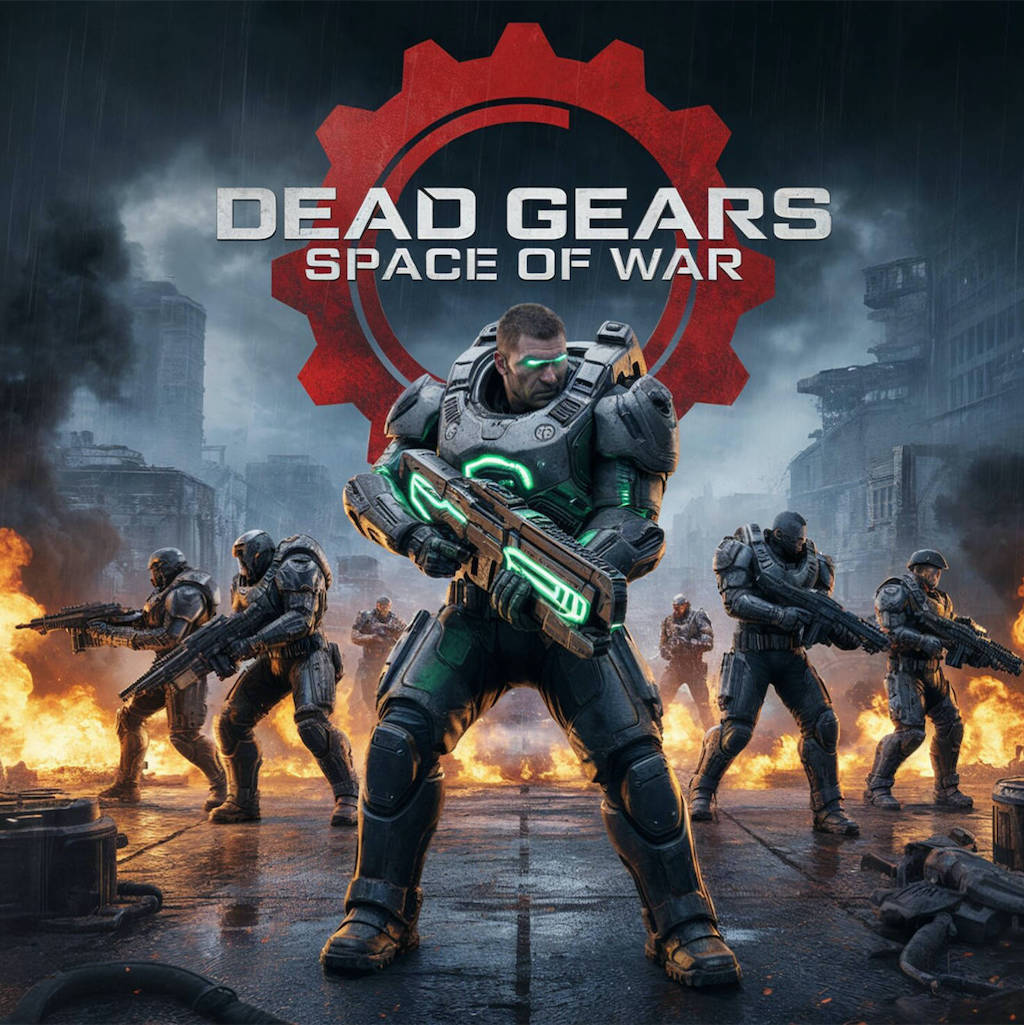
On paper, Dead Gears – Space of War presents itself as a tense sci-fi survival mission set on the doomed colony world of Virelia. You play as Captain Darius Vex, an elite operative sent to investigate a biomechanical infection that has swallowed an entire civilisation. The setup gestures towards familiar territory, echoing well-known space horror and military action franchises, but it never develops anything resembling its own identity. Instead, it leans heavily on recycled ideas, familiar terminology, and aesthetic cues chosen more for recognition than coherence.
The narrative framing struggles to generate any sense of mystery or dread. Logs scattered across the environments hint at catastrophe, but they read like generic filler rather than meaningful storytelling fragments. There is no rhythm to the world-building, no escalation that feels earned. Everything is presented at the same flat intensity from start to finish, which robs the premise of any real tension. The more the game tries to suggest a collapsing, infected world, the more it feels like a static backdrop.
Gameplay That Never Evolves
At its core, Dead Gears is a third-person shooter that attempts to blend stealth, energy manipulation, and direct combat, yet none of these systems ever achieves a meaningful depth. Movement feels stiff, aiming lacks precision, and encounters rarely require anything beyond basic forward progression and shooting. Enemy behaviour is especially disappointing, with hostile units often charging in predictable straight lines or standing idle until triggered. What should be tense, reactive combat ends up feeling like a series of disconnected shooting galleries.
The promised energy system, which should have been the game’s defining mechanic, is reduced to a shallow set of abilities that rarely matter in practice. Absorbing and redirecting energy to power shields or disable enemies sounds engaging in theory, but in practice it lacks meaningful feedback or strategic consequence. Most encounters can be resolved without ever engaging with these systems in a deliberate way. As a result, the gameplay loop quickly devolves into repetition, with little variation to break the monotony of corridor combat.
Environments Without Atmosphere
One of the most striking issues is how lifeless the world of Virelia feels despite its supposedly catastrophic premise. The game’s environments consist of repetitive corridors, boxy industrial rooms, and generic outdoor zones that lack any visual storytelling. There is no sense of decay, no environmental detail that suggests history or consequence. Everything feels assembled from pre-existing asset packs without meaningful adjustment or artistic direction.
Lighting and sound design fail to compensate for this visual emptiness. Instead of building tension, the audio mix is sparse and unmemorable, with ambient effects that do little to establish mood. In a genre that thrives on oppressive atmosphere and environmental storytelling, Dead Gears offers only emptiness. Even key set-piece moments fail to land because the world itself never feels real enough to support them.
A Case Study in Market Saturation
Beyond its mechanical shortcomings, Dead Gears – Space of War has become a focal point in wider criticism of digital storefront curation. Its presentation leans heavily on visual references that echo major science fiction franchises, seeking to capture attention through familiarity rather than originality. This includes marketing materials that mimic well-known design motifs from established series, creating confusion about what the game actually is.
Critics have noted that this approach contributes to a broader issue in modern digital marketplaces, where low-effort titles can exploit algorithmic visibility and consumer recognition. While not every inexpensive game deserves dismissal, Dead Gears stands out as an example of how far presentation can be stretched without substance. It is less a singular failure and more a symptom of a system struggling to distinguish between inspiration and imitation
Technical Shortcomings and Lack of Polish
Even by modest standards, the technical execution of Dead Gears is difficult to defend. Animation is stiff, collision detection is inconsistent, and performance instability is frequent, even in simple combat scenarios. Weapons lack satisfying feedback, with impacts feeling detached from their targets. This further weakens the already fragile combat loop, making each encounter feel less like an action sequence and more like a functional exercise in pressing buttons.
There is also a noticeable lack of refinement in basic interaction systems. Opening doors, interacting with objects, and navigating environmental triggers often feel unreliable. These issues compound over time, creating frustration that stems more from unfinished implementation than from challenge design. The result is a game that never achieves mechanical trust between player and system.
Final Verdict
Dead Gears – Space of War is not merely a flawed game. It is fundamentally hollow, built from familiar parts without the cohesion, intent, or craftsmanship needed to make them matter. Its attempts to evoke established sci-fi action franchises only highlight how far it falls short, both mechanically and artistically. What could have been a modest, low-budget experiment instead becomes an exercise in imitation without understanding.
Countless smaller games succeed despite limited resources because they commit to a clear idea. This is not one of them. Dead Gears feels assembled to exist rather than to be played, and that distinction defines the entire experience. In a crowded marketplace, it is unlikely to linger in memory for long, and in this case, that may be the most telling criticism of all.