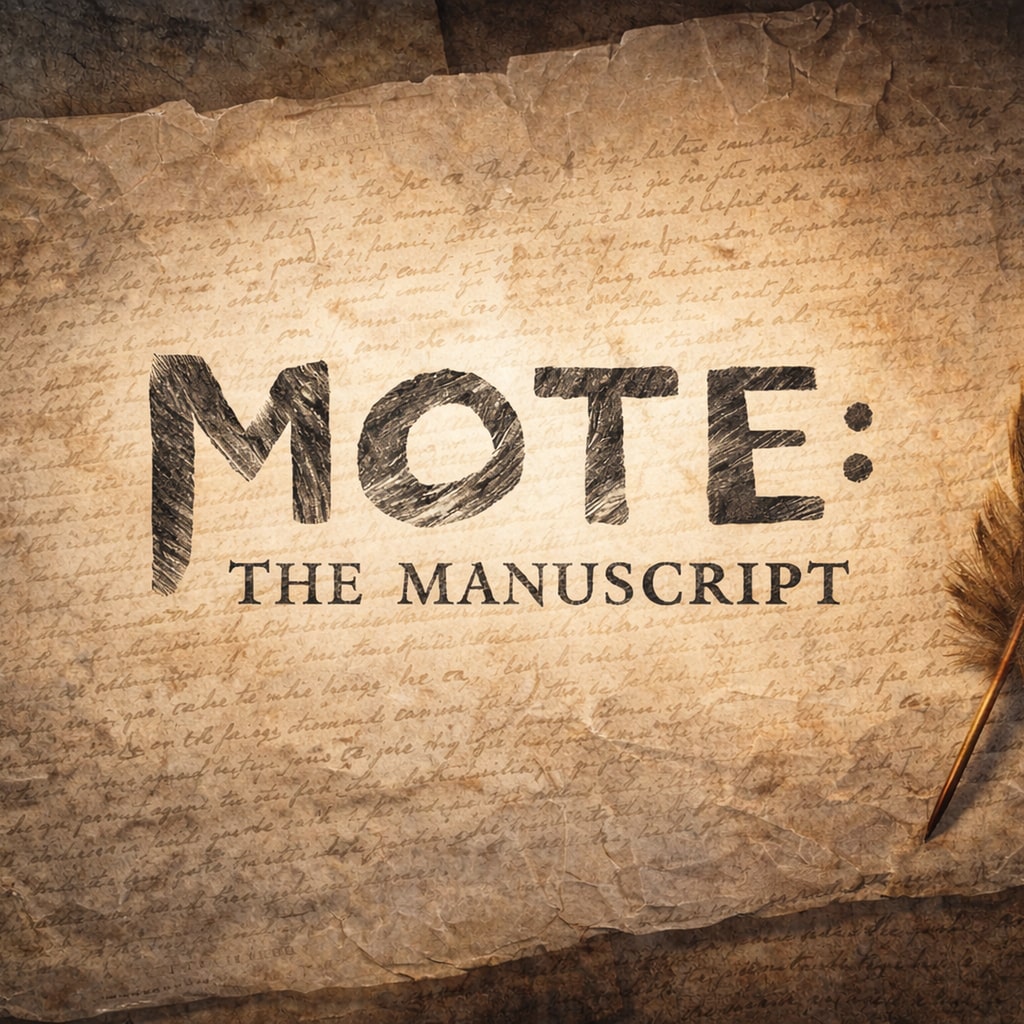
Writer’s block is a distinct fear, experienced mainly by writers, artists, and dreamers. Unlike fears of monsters or darkness, it is a subtle terror of confronting something incomplete and realising you no longer understand your own thoughts. A blank page can seem more daunting than a nightmare, and a crossed-out sentence can seem to symbolise collapse. MOTE: The Manuscript builds its entire identity around that sensation.
Developed by CraePlay, with Velvet Bites contributing to certain versions, and published by GGMUKS INC., this third entry in the MOTE series, following MOTE: The Old Office and Mote: Workshop, and arrived on PlayStation this month, bringing a distinctly different kind of horror. There are no elaborate combat systems. No towering monsters chase you through scripted corridors. Instead, MOTE: The Manuscript traps players in the decaying mental landscape of a struggling writer whose thoughts are tearing themselves apart. What unfolds is less a traditional game and more an interactive descent into creative ruin. While its ambitions occasionally exceed its mechanical depth, the atmosphere it creates is undeniably haunting.
A World Made of Thought Fragments
The game opens with disorientation rather than explanation. You are placed in a surreal first-person labyrinth where paper, ink, scribbles, and discarded drafts form the architecture of the world itself. The three primary environments, Scribbles, Blank Pages, and Crumpled Paper, feel less like locations and more like emotional states.
Scribbles is chaotic and claustrophobic, packed with fractured writing and warped geometry that constantly shifts at the edge of your vision. Blank Pages is quieter and somehow even more unsettling, a vast white emptiness that feels suffocating despite its openness. Crumpled Paper twists the environment into uneven corridors and distorted pathways, as though the world itself has been crushed in frustration and thrown away.
The environments are simple on a technical level, yet emotionally effective because of the game’s commitment to its central metaphor. You are not exploring a building. You are walking through a collapsing creative process. That idea alone carries much of the experience.
Horror Through Atmosphere
MOTE: The Manuscript understands that silence can often be more frightening than noise. The sound design throughout the game is exceptional for its restraint.
Distant scratching echoes through corridors like frantic pencil marks on paper. Pages crinkle somewhere in the darkness. Whispers drift in and out so subtly that you question whether you heard them at all.
There are moments when the game becomes almost oppressively quiet, forcing you to focus on your own footsteps and breathing. Then, suddenly, a violent audio distortion or visual shift tears through the calm without warning. Importantly, the game rarely relies on cheap jump scares. Its horror comes from instability, the feeling that reality itself is losing coherence around you.
The post-processing effects deserve enormous credit here. Hallways bend unnaturally. Ink bleeds across walls in impossible patterns. The screen warps and fractures as if the game itself is struggling to remain intact. At times, it genuinely feels like you are walking through an unfinished thought. It creates a psychological discomfort that lingers long after individual moments pass.
Minimalism as Design Philosophy
Mechanically, MOTE is extremely simple. You walk, observe, listen, and occasionally solve small environmental puzzles. There are no complex inventory systems or elaborate interactions. The game deliberately strips away anything that might distract from immersion. That simplicity works both for and against the experience.
On the one hand, the minimalist approach beautifully reinforces isolation. The lack of intrusive UI elements allows the environments and soundscape to fully dominate your attention. Every small interaction feels deliberate because there are so few.
On the other hand, players seeking deeper gameplay systems may leave disappointed. The puzzles are functional but rarely memorable. Most revolve around finding pathways, manipulating environmental triggers, or deciphering subtle visual clues. They serve the atmosphere rather than challenging the player intellectually. In truth, MOTE is less interested in testing your problem-solving abilities than in maintaining emotional tension.
Storytelling Through Fragments
The narrative unfolds through scattered audio logs and environmental storytelling rather than direct exposition. You piece together the unseen writer’s story from fragmented recordings, incomplete thoughts, and visual symbolism hidden within the labyrinth. This fragmented style suits the premise perfectly. The writer’s mental state is deteriorating, and the narrative itself mirrors that collapse.
Some audio logs are painfully intimate. You hear exhaustion, self-doubt, obsession, and isolation bleeding into every word. The writing avoids melodrama surprisingly well, which helps the emotional weight land more naturally. There is a sadness beneath the horror that gives the experience its soul.
The game quietly suggests that the true antagonist is not some supernatural force but the destructive spiral of creative paralysis itself. That idea gives MOTE an emotional resonance many indie horror games fail to achieve.
Still, the fragmented storytelling will not work for everyone. Some players may find the narrative too vague or interpretive. The game often prioritises mood over clarity, leaving major details intentionally unresolved. Whether that ambiguity feels profound or frustrating depends heavily on the player.
Visual Simplicity, Emotional Impact
Technically, MOTE: The Manuscript is not an especially advanced game. Environments are relatively sparse, and some textures lack detail up close. Yet the visual presentation succeeds by embracing strong artistic direction over realism.
The monochromatic palette, heavy shadows, and surreal paper textures create a consistent visual identity. Every environment feels handmade in the best possible way, like stepping into someone’s unfinished sketchbook.
Lighting also plays a major role in shaping the mood. Certain hallways are swallowed by darkness, while others glow with harsh, white emptiness that feels equally threatening.
The PS5 version runs smoothly throughout, allowing the environmental distortions and visual effects to remain fluid without technical distractions.
When the Illusion Weakens
For all its atmospheric strength, MOTE occasionally struggles to maintain momentum throughout its runtime. The limited gameplay variety becomes increasingly noticeable in the latter stages of the experience.
There are stretches when exploration begins to feel repetitive, particularly in maze-like areas that intentionally disorient the player. While confusion is clearly part of the intended emotional design, there is a fine line between psychological unease and simple frustration.
Some players may also wish the game pushed its ideas further mechanically. The premise is fascinating, but at times the systems surrounding it feel underdeveloped. The result is an experience that feels emotionally complete while still feeling mechanically slight.
Final Verdict
MOTE: The Manuscript is not interested in traditional horror thrills. It is interested in discomfort, isolation, and the terrifying fragility of creative thought. Through minimalist gameplay, oppressive sound design, and a deeply effective atmosphere, it transforms writer’s block into something genuinely unsettling.
The puzzles in the game are straightforward, and its mechanics are limited, which may not appeal to everyone. However, once it fully embraces its surreal identity, it leaves a lasting impression. This psychological horror focuses on emotion and mood rather than spectacle, creating a deeply immersive experience.