There is a long tradition in action games of pitting a lone warrior against an overwhelming tide of darkness. Sometimes that warrior is a grizzled soldier. Sometimes a mystical knight. Sometimes a reluctant survivor who never asked for the role. In Kyra The Hunter, the formula is stripped back even further, leaving what remains almost elemental. A sword. A mission. A world that has already begun to rot at the edges.
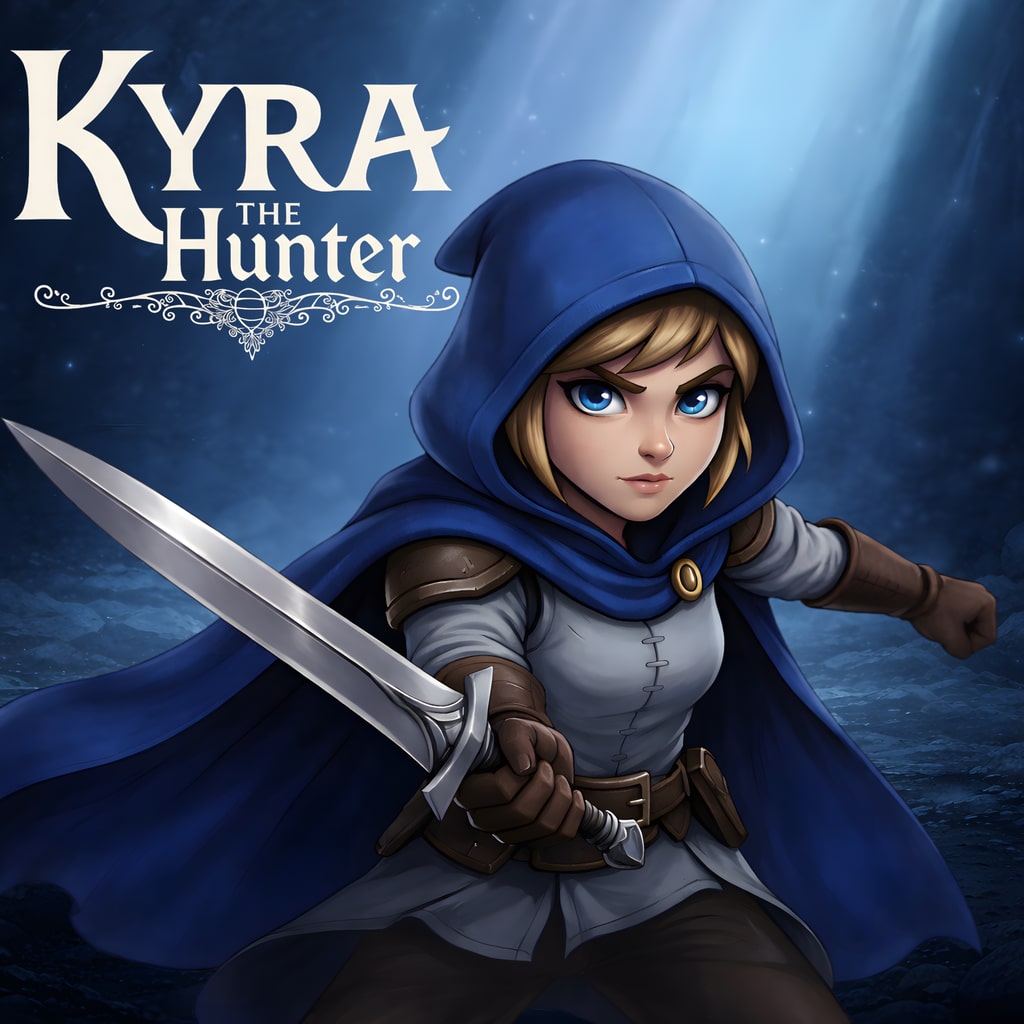
Developed by Magnific Studios and published by y-zo studio, this top-down action adventure arrived on PlayStation in April 2026 with little fanfare and a surprisingly sharp sense of identity. It is a compact experience, yet one that knows exactly what it wants to be. You play as Kyra, a golden-haired hunter in a blue cape, cutting through corrupted lands in search of something resembling restoration. It does not waste time on elaborate introductions. Within minutes, you are already fighting, already moving, already learning the rhythm of its world.
The Rhythm of Steel
At its core, Kyra The Hunter is about momentum. Combat unfolds in fast, readable bursts, where positioning matters as much as timing. Enemies swarm in groups, forcing you to constantly adjust your angle of attack while staying aware of your surroundings.
Kyra’s sword is your primary tool, and it feels intentionally weighty without becoming sluggish. Each swing carries a subtle sense of impact, making even simple encounters feel grounded. The game does not overload you with complex combos or sprawling skill trees. Instead, it refines a smaller set of mechanics until they feel clean and responsive.
What emerges is a combat system that rewards discipline. Rush in without thinking, and you will be overwhelmed. Wait too long, and you will be surrounded. The balance sits between aggression and restraint, encouraging you to read enemy patterns rather than simply react.
Later abilities add slight variations to this rhythm. Short bursts of enhanced strikes, area attacks, and precision-based counters gradually expand your options. However, the game never drifts far from its core philosophy of clarity over complexity. There is a confidence in that restraint.
Lands That Feel Already Lost
Exploration in Kyra The Hunter carries a quiet melancholy. The world is not expansive in the traditional sense, but it is carefully segmented into distinct regions, each with its own visual identity and enemy types.
You move through broken forests, desolate plains, and ruined settlements that feel like echoes of something once stable. These environments lean towards stylisation rather than realism. Shapes are simplified, colours are muted yet deliberate, and lighting is used to suggest atmosphere rather than overwhelm it.
The result is a world that feels slightly distant, as though you are always arriving after the fact. Something has already gone wrong here. Your presence is not discovery but correction. That tone carries through the entire experience. Even moments of relative calm feel temporary, as if the world is waiting for you to leave so it can collapse again.
Progression Without Bloat
One of the more surprising aspects of Kyra The Hunter is how efficiently it manages progression. There is no sense of grinding for the sake of padding runtime. Instead, advancement comes in steady, meaningful increments that reinforce your sense of movement through the world.
New regions introduce subtle mechanical twists rather than entirely new systems. Enemies become more aggressive, patterns more layered, and environmental hazards play a larger role in combat encounters. It is not about reinventing the experience at every turn, but about gradually increasing pressure. This approach keeps the pacing tight. The game respects your time in a way many larger titles struggle to match. It also contributes to a sense of continuous motion. You are always improving, but never in a way that feels artificially inflated.
Accessibility as Design Philosophy
One of the most widely discussed aspects of Kyra The Hunter has little to do with combat or exploration. Instead, it is the game’s remarkable accessibility framework.
The entire experience has been designed to be playable without imposing physical strain or complex input sequences. There are no required rapid button presses, no awkward simultaneous inputs, and no reliance on motion controls. This makes the game unusually approachable without diluting its mechanical identity.
Far from feeling like an afterthought, this accessibility layer is integrated into the design itself. It reinforces the idea that challenge in Kyra The Hunter comes from positioning, awareness, and timing rather than mechanical dexterity. It is a thoughtful approach that broadens the audience without compromising the experience.
Style Over Scale
Visually, the game embraces a stylised simplicity that works in its favour more often than not. Character designs are clean and legible, with Kyra herself standing out through her distinctive silhouette and colour palette. The blue cape becomes a visual anchor in combat, helping you track movement even in crowded encounters.
Enemy designs follow a similar philosophy. Monsters are not overly detailed or grotesque. Instead, they are abstract enough to be instantly recognisable while still maintaining a sense of menace.
This restraint extends to animation as well. Movement is fluid and intentional, avoiding unnecessary flourish in favour of clarity. Every action feels deliberate, which helps maintain readability during intense fights.
There are moments when the simplicity borders on repetition, particularly in later environments, but the overall cohesion of the visual style keeps the experience consistent.
The Question of Length
Perhaps the most divisive aspect of Kyra The Hunter is its brevity. This is not a long adventure, nor does it try to be. It is structured more like a focused arc than an expansive journey.
For some players, this will feel refreshing. There is no filler, no unnecessary detours, no stretched content designed purely to extend the runtime. The experience begins, develops, and concludes without overstaying its welcome.
For others, especially those expecting a more traditional action RPG structure, the short duration may feel limiting. There is a sense that the world could support more depth if given the chance.
Yet it is difficult to argue that the game squanders what it has. Every encounter feels purposeful, every region serves a clear function, and every upgrade contributes meaningfully to your progression. It is a compact design rather than an incomplete one.
Final Verdict
Kyra The Hunter is not trying to be a sprawling epic or a genre-defining experiment. It is a focused, tightly constructed action-adventure that recognises its limitations and works within them with surprising confidence.
Its combat is clean and responsive, its world understated yet atmospheric, and its progression system free of unnecessary clutter. While its short length and restrained scope may not satisfy players seeking a longer commitment, there is real value in its clarity of purpose.
This is a game about movement, precision, and quiet persistence in the face of decay. It does not try to overwhelm you. It simply asks you to keep walking forward, blade in hand, until the work is done.