There is a particular kind of platformer that does not demand attention in loud bursts, but instead earns it through repetition, failure, and the slow sharpening of player instinct. The Little Things sits firmly in that space. It does not try to overwhelm you with spectacle or narrative excess. Instead, it builds its identity around control, timing, and the quiet satisfaction of finally understanding a space that once felt impossible.
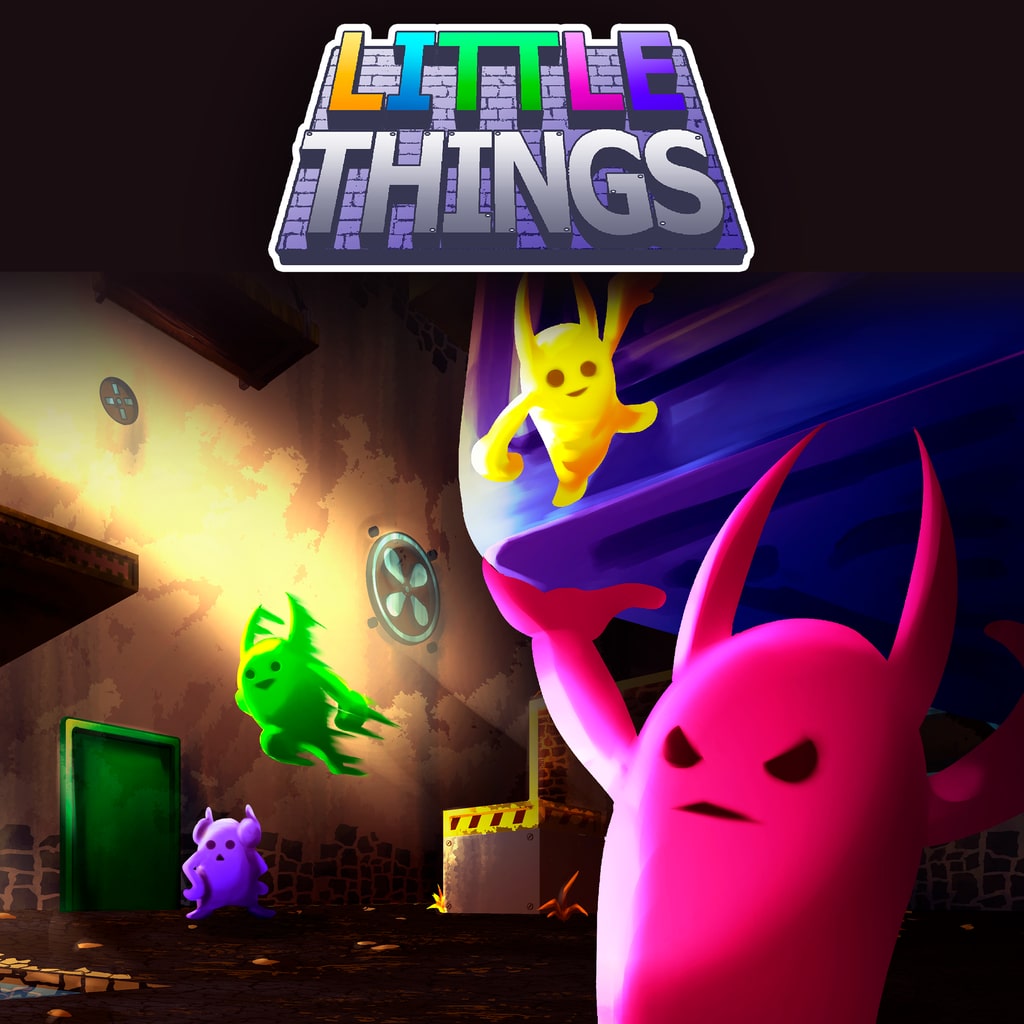
You play as Whis, a small, almost fragile creature navigating surreal, dungeon-like environments that feel less like constructed levels and more like shifting logic puzzles given physical form. The goal is never in doubt. Reach the end. Survive the structure. But how you do that is constantly in flux, shaped by gravity manipulation, colour-based abilities, and the game’s central obsession with rethinking what “movement” actually means.
When Gravity Stops Being Fixed
The defining mechanic in The Little Things is its Gravity Flip system. At first, it feels like a novelty. You invert the world, walk along ceilings, and use the reversed orientation to access platforms that would otherwise be out of reach. It is clever, yet familiar enough to be immediately readable. Then the game starts to combine it with everything else.
Colour states begin to alter environmental rules. Certain platforms exist only under specific conditions. Some hazards vanish entirely depending on your current alignment. The result is a system in which movement is never just horizontal or vertical, but conditional. You are constantly thinking not only about where you are going, but also about which version of the world you need to be in to get there. It is here that The Little Things becomes more than a platformer. It becomes a spatial reasoning exercise performed at speed.
Learning Through Collapse
The difficulty curve in The Little Things is not subtle. Early levels ease you in, teaching mechanics in isolation and giving you room to experiment without pressure. Then, around the midpoint, the game stops offering safety nets.
Precision becomes the expectation rather than the exception. Pixel-perfect jumps, timed flips, and multi-step sequences stack on top of each other until execution matters as much as understanding. Failure is constant but never especially punitive. Instant restarts keep the rhythm tight, encouraging repetition without leaving you to sit in frustration for long.
What makes this system work is how quickly it trains recognition. You stop reacting and start anticipating. Levels that once felt chaotic slowly reveal themselves as structured patterns. The satisfaction does not come from surviving a challenge but from realising you had already internalised the solution before your hands caught up.
The Language of Minimalism
Visually, The Little Things is deliberately restrained. Environments are built from high-contrast shapes and sharply defined colour zones. Hazard areas are not concealed by visual clutter. They are immediate, readable, and often starkly aesthetic. This is not a world that wants to trick you visually. It wants you to succeed through clarity, not guesswork.
That clarity becomes essential as complexity increases. When levels demand rapid shifts between gravity states and colour conditions, readability is what prevents the experience from collapsing into confusion. You always know what is happening, even when you are struggling to execute it. There is a quiet confidence in this design philosophy. It trusts the player to handle difficulty as long as the rules remain fair and visible.
Movement as Problem Solving
Whis does not fight enemies. There is no combat system, no health bar, and no external threat beyond the architecture itself. The world is the obstacle, and every solution is mechanical.
This creates a very specific kind of tension. You are never reacting to aggression. You are negotiating space. A missed jump is not punishment but miscalculation. A failed sequence is not a narrative failure but a failure of understanding.
The later stages of the game lean heavily into this philosophy. Entire sections are built around chaining mechanics together in ways that require both memory and improvisation. You are not just learning how to move through a level. You are learning how the level thinks.
Where It Fractures
For all its precision, The Little Things is not always forgiving in how it escalates difficulty. There are moments when the shift from challenging to punishing feels abrupt, particularly in late-game sections that demand near-perfect execution over extended sequences.
While instant respawns mitigate frustration, they do not fully erase the strain of repeated failure in high-intensity segments. Some players will find this exhilarating. Others will likely feel worn down.
There are also occasional moments when overlapping mechanics create visual ambiguity. Although rare, certain combinations of colour states and gravity shifts can momentarily obscure intent, especially during faster sequences. It never breaks the game, but it briefly interrupts its otherwise surgical clarity.
The Satisfaction of Mastery
Despite its spikes in difficulty, The Little Things succeeds because it understands what mastery feels like. It is not loud or celebratory. It is quiet recognition. A moment when your hands execute what your mind has already rehearsed. A level that once took dozens of attempts is now cleared in a single fluid run. That transformation is the core reward. Not completion, but fluency.
By the time you reach the final stretch of its 80 levels, the game has reshaped how you think about movement. You are no longer solving puzzles step by step. You are reading entire sequences as a single idea.
Final Verdict
The Little Things is exactly what its name suggests, yet also its opposite. It is built on small mechanical decisions, precise inputs, and incremental understanding. Yet those elements combine into something far larger than the sum of their parts.
It is demanding without being unfair, minimalist without being empty, and repetitive in a way that constantly sharpens rather than dulls engagement. Not every player will stay with it through its most punishing moments, but those who do will find a tightly constructed platformer that respects precision above all else.