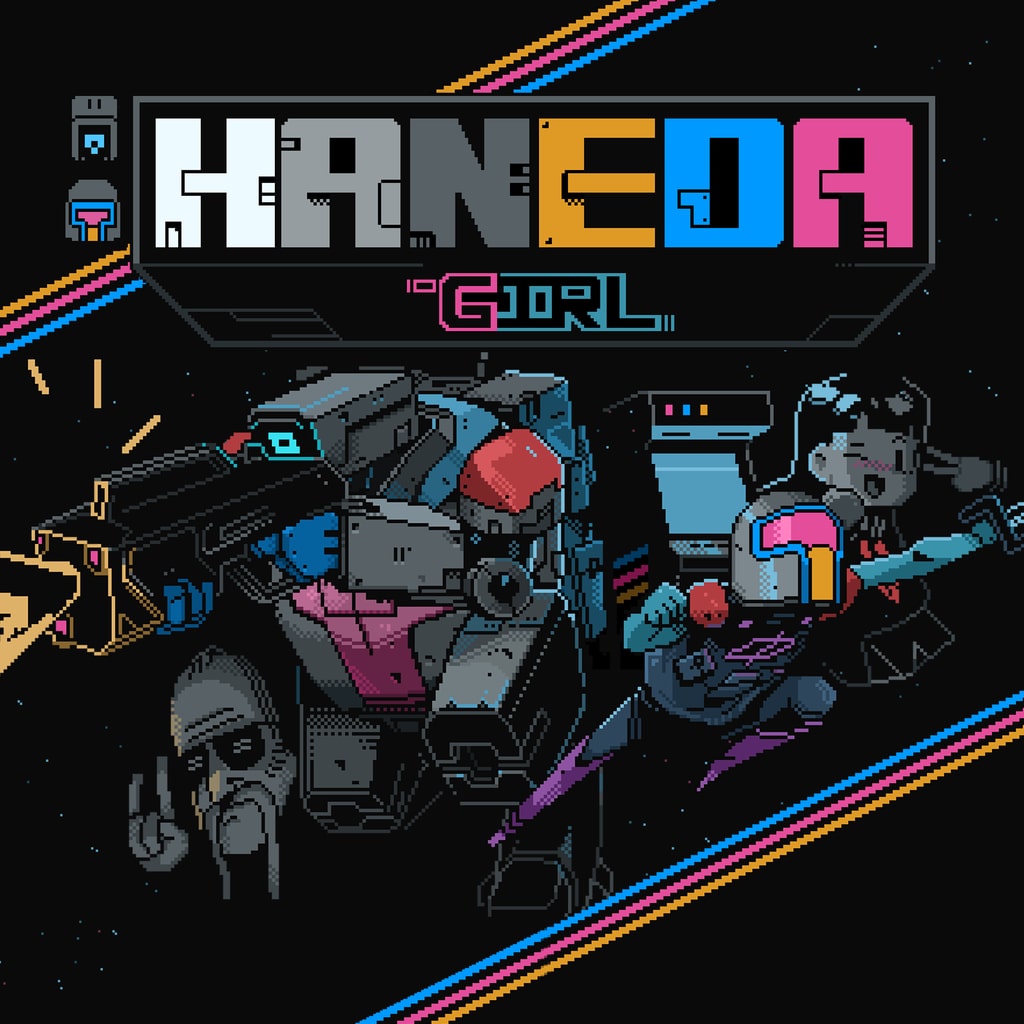
There are games that ask you to settle in, to learn their rhythms slowly, and there are games that grab you by the collar and dare you to keep up. Haneda Girl is firmly in the second camp. It moves with the confidence of something that knows exactly how fast it wants you to think, react and adapt, and it rarely gives you permission to stand still long enough to second-guess it.
Coming from Studio Koba, best known for Narita Boy, this is a noticeable shift in tone and structure. Where that earlier game leaned into atmosphere and mythic storytelling, Haneda Girl strips things down to pure motion, reflex and repetition. What remains is a sleek, cyber-infused action platformer that feels built around one question: how far can mastery be pushed before it turns into instinct? The answer, at least here, is quite far.
Two Bodies, One Flow State
At the core of Haneda Girl is its swapping mechanic. You control Chichi Wakaba, a student pulled into a digital war within the Data Empire, but she is not alone. Alongside her is M.O.T.H.E.R., a heavily armed combat mecha that serves as both shield and hammer. The brilliance lies in how differently these two play and how often the game expects you to switch between them without hesitation.
Haneda is fast, fragile and lethal in the simplest possible way. She is an instant-kill character, meaning a single mistake ends her run through any given segment. That sounds punishing on paper, but in practice it pushes you into a mindset of precision rather than caution. Every jump, dash and strike becomes deliberate.
M.O.T.H.E.R., by contrast, is about weight and firepower. It absorbs pressure, clears space and turns crowded screens into controlled chaos. It is not just a backup option but an essential half of the puzzle. The game constantly asks you to think about positioning, threat types and timing, then rewards those who can fluidly switch between elegance and brute force without breaking rhythm. When it clicks, it really clicks. You stop thinking in terms of characters and start thinking in terms of flow.
Levels Built for Momentum
Each stage in Haneda Girl is designed less like a traditional platforming level and more like a tightly constructed combat route. Enemy placement, environmental hazards and movement tools are arranged to encourage forward motion. Standing still is rarely an option, and hesitation is often more dangerous than speed.
There is a clear emphasis on replayability. Levels are short but dense, and the scoring system encourages repeated runs. Medallions and hidden lore pieces are tucked into harder routes, rewarding players who push beyond safe completion into more experimental play.
The structure will feel familiar to fans of score-attack design, but what makes it work here is how little friction there is between failure and retry. Death is immediate, but restarts are just as fast. That loop creates a strange momentum in which frustration rarely has time to settle. Instead, you are pushed back into action almost immediately, slightly sharper each time. It is not a forgiving game, but it is a fair one.
A World of Clean Chaos
Visually, Haneda Girl embraces a neon-soaked, cyber aesthetic that feels sharp without becoming overwhelming. Data Empire is not a sprawling open world but a fragmented digital space, more symbolic than literal. Environments shift between industrial grids, abstract digital corridors and glitching arenas that feel as if they are being actively overwritten as you move through them.
There is a clear identity here, even if it does not always prioritise narrative clarity. The story of Chichi Wakaba being pulled from an arcade into a real digital conflict is deliberately light, almost playful in tone. Characters speak in short bursts, often leaning more into personality than exposition.
That choice works in the game’s favour. It keeps the focus on momentum rather than lore, allowing the mechanics to carry emotional weight through repetition and escalation rather than dialogue.
Sound, Speed and Pressure
If there is one element that ties everything together, it is the soundtrack. Pulsing techno runs through nearly every encounter, not just as background but as a structural guide. It sets the tempo, builds pressure and subtly reinforces shifts in pacing during combat peaks.
The effect is subtle yet powerful. You begin to associate beats with movement windows, enemy waves and switching opportunities between Haneda and M.O.T.H.E.R. It becomes less about reacting and more about anticipating the rhythm. That rhythm is where the game lives.
Difficulty That Teaches Through Failure
There is no pretending Haneda Girl is gentle. It demands precision and rewards repetition. Early on, this can feel overwhelming, especially when switching between two radically different control styles under pressure. Mistakes are frequent, and success often feels earned only after multiple attempts.
But the game is built around learning rather than punishing. Each failure teaches something small. A better timing window. A safer swap point. A more efficient route through a hazard cluster. Over time, those small lessons accumulate into confidence.
This design philosophy will not appeal to everyone, particularly those who prefer more forgiving action platformers. But for players willing to lean into repetition, it offers a satisfying sense of progression that is less about upgrades and more about personal improvement.
Final Verdict
Haneda Girl is not trying to be expansive or narratively heavy. It is focused, sharp and intentionally repetitive, building mastery through rhythm and recall. Its dual-character system gives it a strong identity, and its level design supports experimentation without overwhelming the player with unnecessary complexity.
It does not always soften its edges, and some players will be put off by its difficulty spikes or minimal storytelling. But for those who connect with its pace, it becomes more of a reflex test than a traditional platformer. A game about movement, memory and momentum, where success feels less like progression and more like instinct finally catching up.