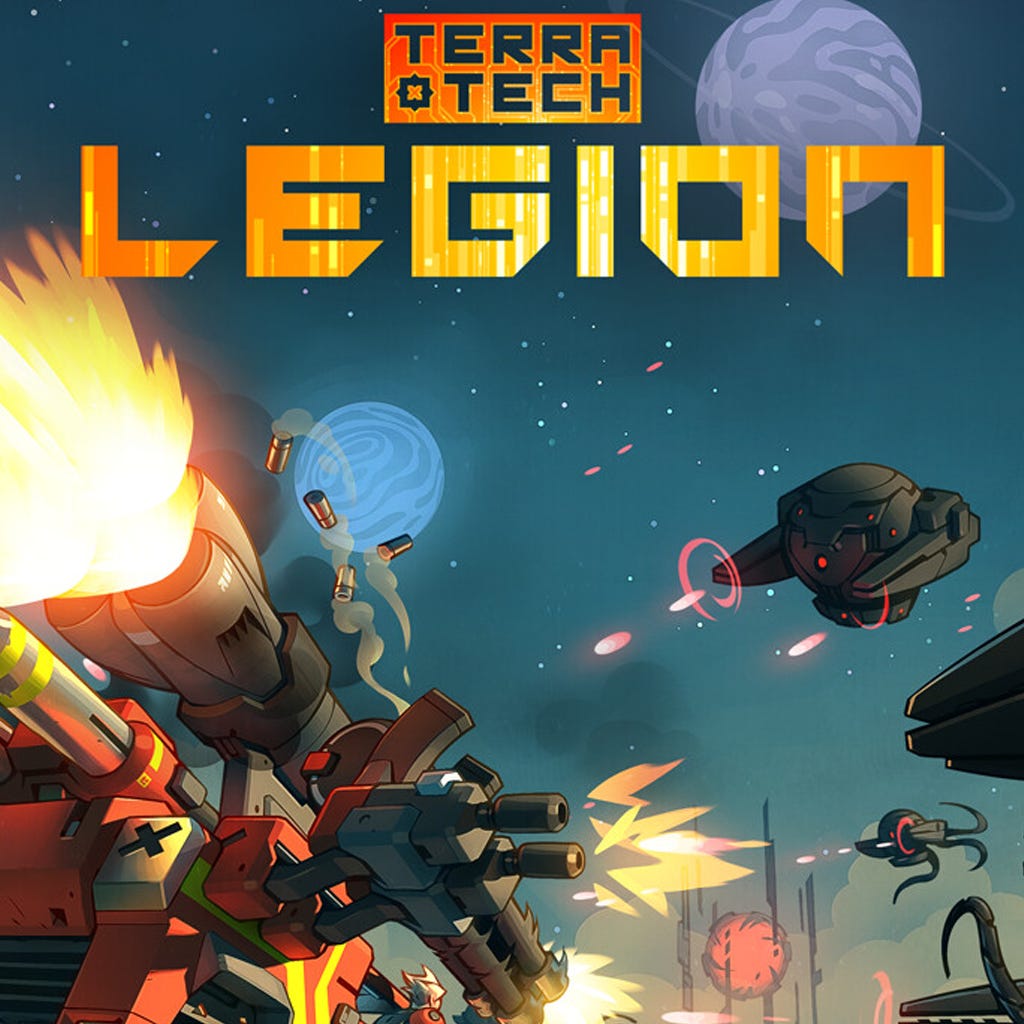
Developed by Payload Studios and published by Mythwright, TerraTech Legion was released in April 2026 as a bold spin-off from the original TerraTech. Where that game leaned into open-ended sandbox construction, Legion strips things down to a focused roguelite bullet-hell experience built around speed, survival, and improvisation.
The premise is simple but dramatic. Across the galaxy, planets are under assault from an overwhelming swarm of AI bots. Entire worlds are being stripped, assimilated, and turned into machine-controlled wastelands. You play as a Tech jockey, an improvised engineer-warrior tasked with pushing back the tide using whatever machinery you can assemble in real time.
The hook is immediate. You are not just piloting a vehicle. You are building it while everything around you tries to tear it apart.
Gameplay
At its core, TerraTech Legion is about creation under pressure. Each run begins with a modest starting Tech, built from a chosen character loadout and faction identity. From there, you are thrown into sprawling planetary arenas filled with swarms of enemies, resource drops, and escalating threats. The twist is that your build is not static. It evolves mid-run as you collect blocks and bolt them onto your machine on the fly.
The block system is where the game truly differentiates itself from other survival-like titles. Over 200 modular components are available, spanning weapons, propulsion systems, armour, and utility tools. You are not just picking upgrades. You are physically assembling your war machine piece by piece while still in combat.
This creates a constant push and pull between survival and creativity. Do you stop to reconfigure your layout for better balance, or do you keep moving and risk building something unstable? Weight distribution matters. Weapon placement matters. Even something as simple as where you attach a booster can determine whether your Tech handles like a controlled weapon platform or a drifting disaster.
Combat itself is fast and relentless. The screen quickly fills with enemy bots, environmental hazards, and projectile fire. Success depends on how well your build handles sustained pressure. A well-designed Tech can carve through swarms with satisfying efficiency, while a poorly balanced one can collapse under its own design flaws.
The four playable characters add further variation. Jean Pierre is all about raw impact, encouraging aggressive ramming and sustained pressure. Mikela leans into randomness, manipulating drops and outcomes to chase rare and powerful builds. Sam focuses on precision and critical hits, rewarding timing and positioning. Cepheid offers a more fluid, evasive style, leaving trails of destruction as she moves through the battlefield.
Each character changes not just how you fight, but how you think about building. A stable gun platform for one may be a fragile, high-risk experiment for another.
Structure and Progression
TerraTech Legion is structured around four distinct planets, each a self-contained biome with escalating difficulty. These worlds are not merely visual variations. They introduce different enemy types, environmental hazards, and shifts in pacing that force you to adapt your builds continuously.
Each run builds towards a planetary boss encounter. These fights are among the most memorable moments in the game, demanding both mechanical skill and thoughtful construction. It is not enough to deal damage. You need to survive long enough for your design to matter.
Between missions, progression comes in the form of skill upgrades and new block unlocks. These systems are straightforward yet effective, giving you just enough incentive to keep experimenting with different builds without overwhelming you with complexity.
The real hook, however, is the endless mode. Here, there is no structure, no narrative progression, and no escape. It is just survival against escalating waves of Legion bots and bosses, designed purely for score chasing and build testing. It is here that the game’s systems either shine or break, depending entirely on how well you understand its mechanical depth.
World and Presentation
Visually, TerraTech Legion prioritises clarity over spectacle, a smart choice given the on-screen chaos. Enemy swarms are dense yet readable, and your own Tech remains visually distinct even as it becomes increasingly complex.
The game’s design language is built around modularity. Everything looks like it can be taken apart and rebuilt, reinforcing the core gameplay loop. There is a satisfying sense of physicality to the world, even when things are happening at high speed.
Sound design plays a crucial role in maintaining readability during combat. Weapon fire, explosions, and movement effects are distinct enough to help you track what is happening, even in the most chaotic moments. The audio feedback also reinforces the impact of your builds, making heavy constructions feel appropriately powerful.
Friction and Learning Curve
TerraTech Legion is not immediately intuitive. The transition from building in a calm sandbox environment to constructing in real-time combat can be overwhelming at first. Early runs often feel like controlled chaos at best and an uncontrolled disaster at worst.
Understanding weight distribution, stability, and weapon synergy involves a learning curve. The game does not always explain these systems clearly, instead expecting players to learn through experimentation and failure.
For some, this will be part of the appeal. For others, it may feel like friction that slows the early experience.
Final Verdict
TerraTech Legion succeeds because it refuses to separate creativity from pressure. It takes the freedom of vehicle construction and fuses it with the intensity of a bullet-hell roguelite, creating something that feels both chaotic and deliberate.
It is not always smooth. The learning curve can be steep, and early runs may feel overwhelming until the systems click into place. But once they do, the game opens up in a deeply satisfying way.
There is a genuine thrill in watching a machine you built mid-fight tear through an entire screen of enemies, only to realise it is barely holding together. That tension between brilliance and collapse defines the entire experience. It is messy, ambitious, and often brilliant in motion.