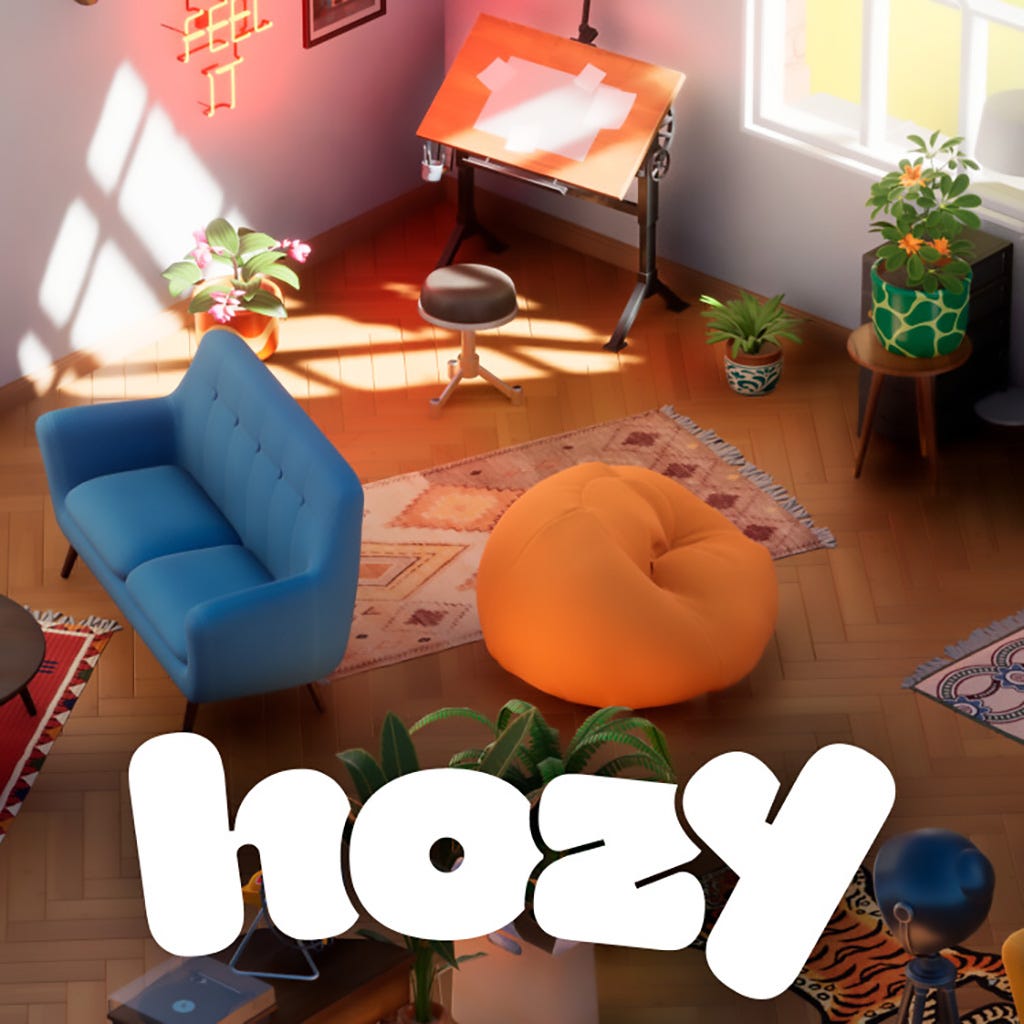
Hozy begins with a familiar yet emotionally powerful premise: you leave behind the noise of the big city and return to a small hometown that has gradually fallen into stillness. What follows is not a story of dramatic reinvention or survival, but something much more restrained—a personal rediscovery through restoration.
From the start, it’s clear that Hozy is not interested in pressure or optimisation. There are no timers, no scores, no failure states. Instead, the game presents itself as a slow return to care: for spaces, for objects, and indirectly, for yourself. It is a renovation simulator, yes, but one devoid of urgency and reimagined as a meditative practice.
That design philosophy shapes everything that follows.
The Core Loop: Restoration as Ritual
At its core, Hozy focuses on interacting with space at a detailed level. You clean windows until they shine, repaint faded walls, reposition furniture, and gradually breathe new life into abandoned interiors. Each action is deliberately simple, but the tactile feedback elevates it beyond just routine tasks.
Wiping a dusty surface creates a gentle visual change. Painting a wall offers smooth, satisfying coverage that visually eradicates neglect. Even placing objects—books on shelves, lamps on tables, cushions on sofas—feels impactful through subtle animations and sound design.
This emphasis on physicality is vital. Instead of abstract menus or complex construction systems, Hozy keeps you grounded in direct manipulation. You are always doing, never merely assigning tasks.
The result is a loop that feels less like traditional gameplay and more like organised relaxation. There is repetition, but it is purposeful repetition—the kind that promotes flow rather than mastery.
Design Philosophy: No Pressure, No Failure
One of the most distinctive features of Hozy is its complete rejection of traditional game pressure. There are no penalties for mistakes, no time limits, and no rigid objectives beyond “make the space feel better.”
This design choice shapes how players engage with the experience. For some, it is liberating, removing the anxiety of optimisation and allowing pure creative expression. For others, it might feel directionless or somewhat hollow.
However, it’s essential to understand what Hozy aims to accomplish. It is not a challenge-based simulator. Instead, it resembles an interactive calm space, where progress is measured not by efficiency but by emotional satisfaction.
The lack of failure fosters a particular kind of engagement: you are never pressured, only invited.
Spaces That Tell Quiet Stories
Across its nine locations, Hozy presents a series of environments that feel gently lived-in and emotionally resonant. These are not blank canvases but abandoned stories waiting to be reinterpreted.
A childhood home carries the weight of memory. An artist’s workshop feels frozen mid-creation. A forgotten café hums with the suggestion of conversations long since ended. Even more dreamlike spaces—such as a seaside home tied to a father’s long-held wish—lean into emotional ambiguity rather than explicit narrative.
What’s impressive is how much storytelling is embedded in environmental detail. You are not given long dialogues or cutscenes. Instead, meaning emerges through objects: a half-finished painting, a worn armchair positioned facing a window, shelves filled with mismatched books.
Restoration becomes a form of interpretation. How you choose to arrange a room subtly reflects how you understand its past.
The Joy of Curation
One of Hozy’s most intelligent design choices is its curated approach to furniture and décor. Instead of overwhelming players with large catalogues, each level offers a carefully chosen set of items that naturally complement the environment.
This prevents the paralysis often seen in traditional renovation or building sims. You’re not scrolling through hundreds of options—you’re working with a consistent visual language designed specifically for each space.
Despite this curation, the game still grants freedom in placement. Items can be rotated, repositioned, and combined imaginatively, allowing each room to feel unique. There is no “wrong” arrangement, only different interpretations of comfort and style.
The result is a surprisingly elegant balance between guidance and independence. You are gently guided, but never restricted.
Atmosphere and Sensory Design
If Hozy excels in anything, it is in its atmosphere. The sound design is especially effective: the gentle scrape of cleaning tools against glass, the muffled thud of furniture being placed, the ambient wind drifting through open windows.
The visual design complements this perfectly. Dust particles drift through sunbeams, light shifts naturally across surfaces, and the transformation from “neglected” to “lived-in” feels gradual and convincing.
There’s a strong sense of sensory harmony here. Everything seems deliberately tuned to promote calm. Even small actions—lighting a candle, opening a window, switching on a projector—carry emotional weight because of how carefully they are presented.
This is a game that truly understands the value of small pleasures.
Pacing and Player Engagement
Hozy’s pacing is deliberately slow, which influences its long-term engagement. The early stages are very satisfying, as each transformation feels purposeful and visually impressive. Watching a dirty, abandoned space become clean and welcoming is always rewarding.
However, because the mechanics stay relatively simple throughout, the experience can start to feel structurally similar over time. New locations bring fresh aesthetics and layouts, but not significantly new systems or challenges.
This is not necessarily a flaw — it reflects the game’s philosophy. But it does mean engagement depends heavily on mood rather than progression. If the atmosphere resonates, the experience stays engaging. If not, the simplicity can become limiting.
Final Verdict
Hozy is a thoughtfully designed renovation simulator that prioritises calm, tactile interaction over challenge or complexity. It excels at creating a meditative space where cleaning, arranging, and restoring feel genuinely soothing and emotionally grounding.
Its greatest strength—its lack of pressure—is also what defines its limitations. Players seeking systems-driven depth, progression, or mechanical challenge may find it too restrained. But for those who want a slow, intentional experience focused on atmosphere and creative flow, it offers something genuinely distinctive.