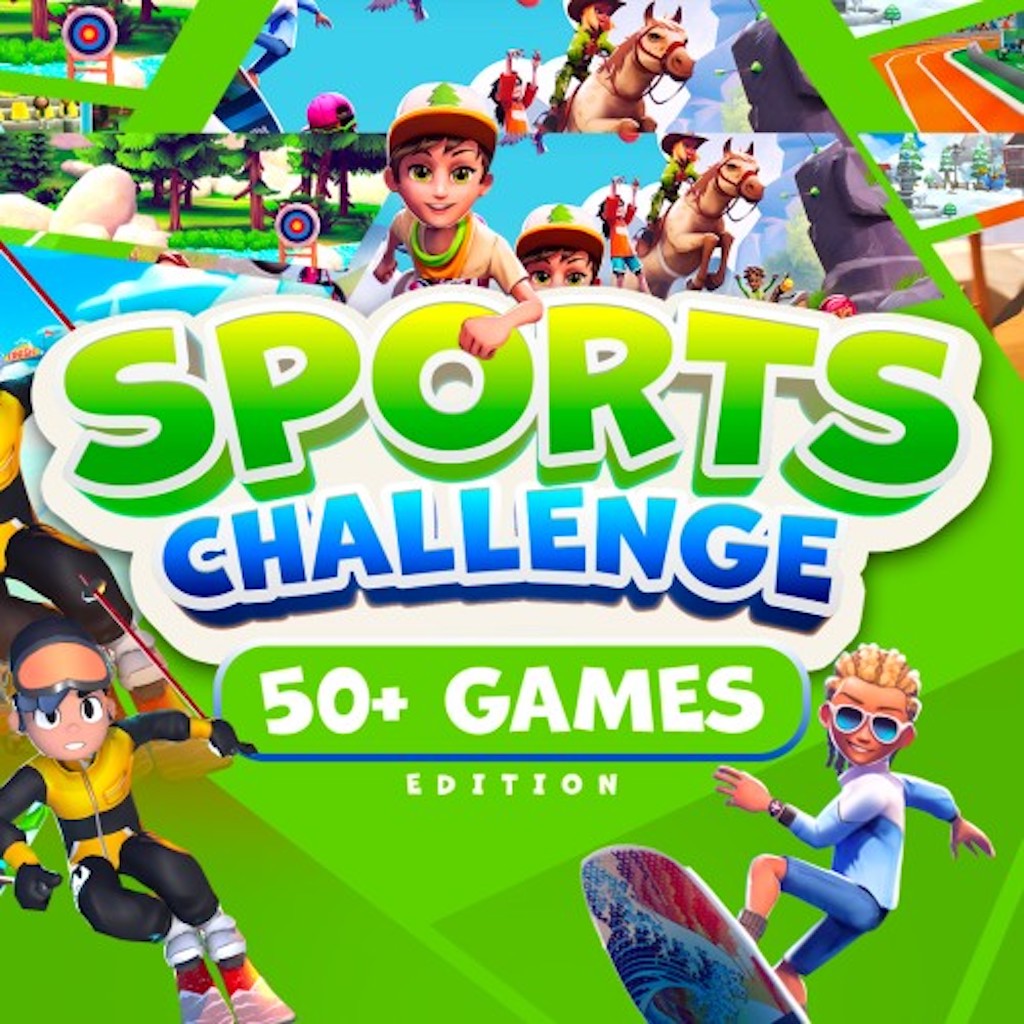
Party games have always relied on one simple measure: how quickly they can transform a room full of people into either laughter or chaos. With Sports Challenge: 50+ Games Edition, developer and publisher Plug In Digital aims to deliver exactly that—an accessible, motion-control-driven collection of over 50 mini-games designed for local multiplayer on Nintendo Switch and the newly launched Switch 2.
Positioned as a successor to last year’s Sports Challenge: 65 Games Edition, this version reduces the sheer volume slightly in favour of a more curated selection of activities, combining Sports Camp, Instant Sports, and its seasonal spin-offs. The promise is clear: a versatile, family-friendly sports party package capable of entertaining up to eight players on a single console.
The reality? It’s a bundle that delivers moments of chaotic fun but struggles to maintain consistency across its extensive range.
Quantity Meets Variety—But Not Always Quality
At first glance, Sports Challenge: 50+ Games Edition appears overwhelming in scope. The multitude of activities—ranging from recognisable sports like football, tennis, and basketball to more novelty-driven mini-games—suggests endless replayability.
And in a sense, it delivers. There is always something new to try, and the fast-paced nature of the mini-games means players rarely spend too long on any one activity before becoming fatigued.
However, the breadth comes at a cost. Not all games are equal. Some feel polished and responsive, while others seem like prototypes stretched into full experiences. This inconsistency becomes more apparent the longer you play, especially when cycling through several modes within a single session.
The best mini-games capture that immediate, intuitive joy—grab a Joy-Con, swing, and grasp the objective within seconds. The weaker ones depend on vague motion inputs or unclear feedback, leading to moments of confusion instead of competition.
Motion Controls: Accessible, but Inconsistent
The core of the experience is its motion control system. Like many Switch party games, Sports Challenge relies heavily on physical gestures—swinging, tilting, flicking—to mimic sports actions.
When it functions properly, it performs well. Tennis rallies feel responsive, bowling has a satisfying weight, and certain arcade-style challenges translate motion into action with impressive accuracy.
However, consistency remains problematic. Some mini-games interpret movement loosely, leading to unpredictable results. Others require a level of precision that conflicts with the casual, party-oriented design philosophy.
This inconsistency creates an uneven rhythm. Players may feel confident and competitive during one game, only to feel disconnected in the next. For a party game, where accessibility is crucial, this can occasionally disrupt the flow of group sessions.
Multiplayer Mayhem: The Game’s True Strength
Where Sports Challenge: 50+ Games Edition undeniably excels is in its multiplayer design. Supporting up to eight players locally, it is clearly crafted with group play as its main focus.
The Tournament mode is particularly effective. It enables players to assemble a custom series of mini-games, creating a structured competition that mimics the vibe of a sports day or party playlist. This introduces a layer of continuity that the standalone mini-games occasionally lack.
In suitable settings—with friends, family, or even mixed-ability groups—the game flourishes. Its simplicity becomes a strength, lowering the barrier to entry and fostering spontaneous participation.
There is a kind of organised chaos to these sessions. Scores fluctuate wildly, victories appear unpredictable, and the focus shifts from mastery to shared enjoyment.
However, this strength also highlights one of the game’s weaknesses: solo play is considerably less engaging. Without the social energy of multiplayer, the mini-games can seem repetitive and somewhat superficial.
Presentation and Audio Design
Visually, Sports Challenge features a bright, cartoonish look that emphasises clarity over detail. Characters are stylised, environments are colourful, and animations are exaggerated to ensure visibility during fast-paced gameplay.
It is more functional than impressive. There is little here that strains the hardware, even on the Switch 2, but it doesn’t need to. The focus is on accessibility, and the visual design supports that aim effectively.
Audio design follows a similar approach. Upbeat music loops and cheerful sound effects create a lively atmosphere, though repetition becomes noticeable during longer play sessions.
There is a certain charm in the presentation, but it lacks the distinctive personality that marks the best party games in the genre.
Structure and Progression
Progression in Sport Challenge is quite light. Unlockables, score tracking, and minor rewards offer some motivation to continue playing, but the game does not heavily rely on long-term progression systems.
Instead, it emphasises instant gratification. Each session is self-contained, designed to be picked up and played without requiring a long-term commitment.
This approach works well for casual players, but it also restricts the game’s longevity for solo players or those looking for a deeper experience. Without a strong progression loop, motivation to return often depends on whether other players are available.
The Bundle Format: Strength and Redundancy
By combining Sports Camp, Instant Sports, and seasonal variants, the game offers a broad range of content. However, this bundling method also causes some redundancy.
Some mini-games feel like slight variations of others, differentiated only by theme or minor rule tweaks. This can create a sense of repetition beneath the surface variety.
At the same time, the bundle ensures players are unlikely to run out of content quickly. It’s a trade-off between uniqueness and abundance, with the game favouring the latter.
Final Verdict
Sports Challenge: 50+ Games Edition is a classic example of a party game that understands its audience but struggles with consistency. It offers moments of genuine fun, especially in multiplayer settings where its chaotic energy and accessibility stand out.
However, its uneven motion controls, varying mini-game quality, and lack of depth in solo play prevent it from reaching the top tier of the genre.
It is not a party essential, but in the right setting, it can certainly liven up an evening.