
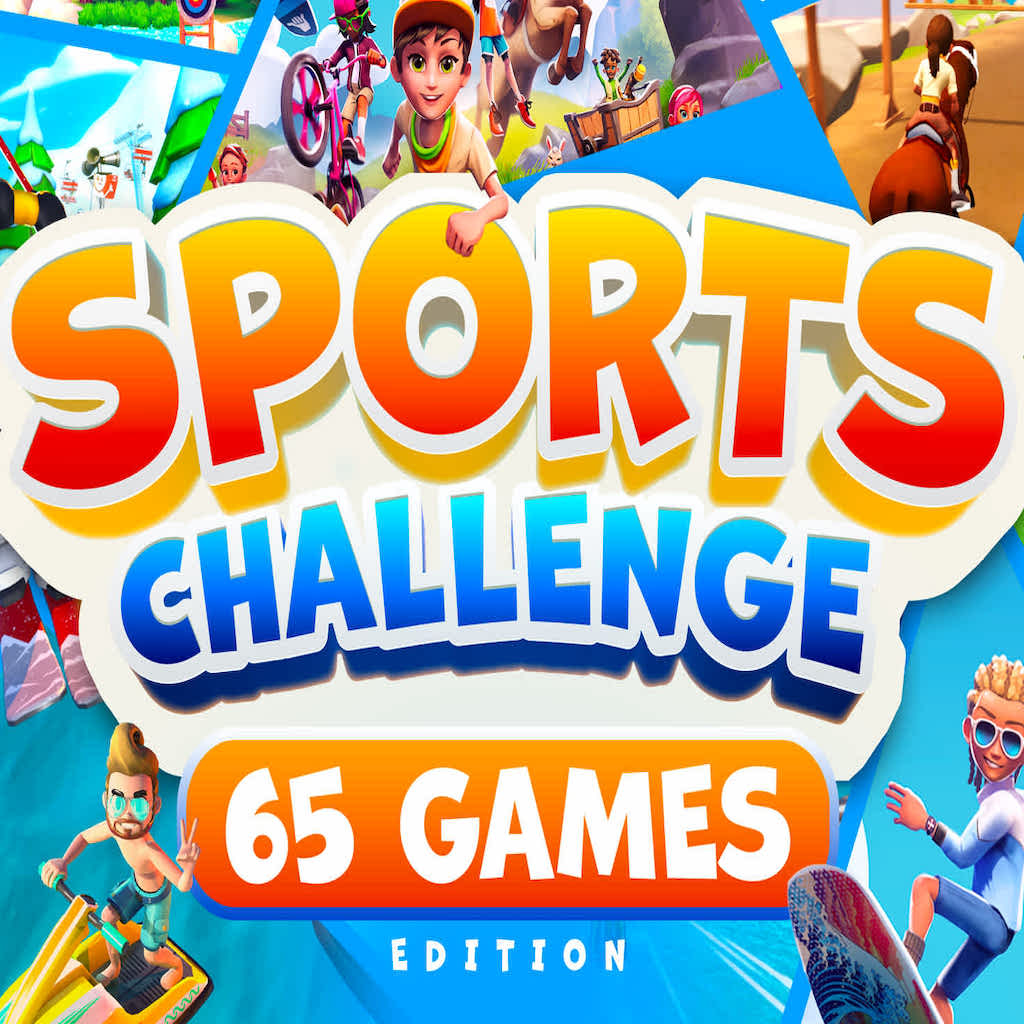
Sports Challenge: 65 Games Edition sets itself an ambitious and immediately attention-grabbing goal: to deliver a vast collection of sports-themed mini-games within a single, accessible package. On paper, the promise of 65 playable activities suggests variety, value, and party-ready appeal—particularly on a platform like the Nintendo Switch, where local multiplayer and pick-up-and-play experiences thrive.
In practice, Sports Challenge: 65 Games Edition is very much a game defined by its scope rather than its refinement. It is a compilation that prioritises breadth over depth, accessibility over authenticity, and casual engagement over mechanical mastery. For some audiences, particularly families and younger players, that balance will be sufficient. For others, the lack of polish and consistency will be difficult to ignore.
Structure and First Impressions
From the outset, Sports Challenge positions itself as a light-hearted, arcade-style experience rather than a simulation. Menus are bright, straightforward, and easy to navigate, with minimal onboarding required. Players can quickly select a game type, choose a control method, and jump into action with little friction.
This immediacy is one of the game’s strengths. Sports Challenge does not demand commitment or learning investment; instead, it encourages experimentation. Trying a new activity carries little risk or time cost, reinforcing the compilation’s casual design philosophy.
However, this ease of entry also sets expectations that the game struggles to maintain. While the sheer number of activities is impressive, the quality and depth of those activities vary significantly.
Gameplay Variety and Design Philosophy
The 65 included games span a wide range of loosely interpreted sports and physical challenges. Traditional concepts such as football, tennis, archery, and bowling sit alongside more abstract or novelty-style competitions that resemble party mini-games more than recognisable sports.
Mechanically, most activities are built around a single core interaction—swinging, aiming, timing, or button tapping. Controls are intentionally simplified, often relying on basic motion input or single-button actions. This makes the games approachable, but it also limits mechanical depth.
Many activities feel interchangeable once the novelty wears off. While visual themes and scoring conditions differ, the underlying interactions frequently overlap. As a result, the sense of discovery fades faster than the game’s extensive list might suggest.
Motion Controls and Input Responsiveness
On Nintendo Switch, motion controls are a central component of Sports Challenge: 65 Games Edition. Some games benefit from this approach, particularly those that translate well to gesture-based input, such as bowling or throwing challenges. In these moments, the game captures a playful physicality that aligns with its party-game ambitions.
However, motion tracking is inconsistent. Inputs are not always interpreted reliably, leading to moments where success or failure feels disconnected from player intent. This inconsistency undermines competitive play and can frustrate players seeking precision or fairness.
For players who prefer traditional controls, button-based alternatives are available for many activities, but these often feel underdeveloped, offering little more than simplified timing mechanics.
Visual Presentation and Consistency
Visually, Sports Challenge adopts a clean, cartoon-like aesthetic that favours clarity over detail. Characters are generic, environments are sparse, and animations are functional rather than expressive. This approach ensures readability across a wide range of activities but also contributes to a sense of sameness.
There is little visual identity tying the compilation together beyond its interface style. Individual games rarely leave a strong impression, and environments are often reused with minimal variation. While this is understandable given the scope, it reinforces the perception of Sports Challenge as a collection of prototypes rather than fully realised experiences.
Performance on Switch is generally stable. Frame rates remain consistent, and loading times are short, supporting the game’s quick-session structure.
Audio Design and Feedback
Sound design is serviceable but unremarkable. Effects provide basic feedback for actions and scoring, but rarely add personality or excitement. Music loops are short and repetitive, designed to fade into the background rather than energise play.
This restraint avoids distraction but also limits emotional engagement. There are few audio cues that heighten tension, celebrate success, or differentiate activities. Over longer sessions, the lack of audio variety becomes noticeable.
Multiplayer and Social Play
Sports Challenge: 65 Games Edition is clearly designed with local multiplayer in mind. Many activities support multiple players, and the simplified controls make it easy for participants of varying skill levels to compete.
In this context, the game is at its best. The low skill ceiling ensures that no single player dominates consistently, and the novelty of rapid game switching helps maintain energy during group sessions. Laughter and improvisation often come from unexpected failures rather than competitive mastery.
However, the absence of deeper progression systems, tournaments, or meaningful statistics limits replayability once the novelty fades. There is little incentive to improve beyond casual enjoyment.
Progression and Longevity
Progression in Sports Challenge is minimal. There are few unlockables, no meaningful skill trees, and limited tracking of long-term performance. While this aligns with the game’s casual focus, it also shortens its lifespan.
Players looking for sustained engagement will likely exhaust the game’s appeal quickly. Once favourite activities are identified, the remaining content may feel redundant rather than enticing.
This is a compilation designed to be revisited occasionally, not mastered.
Target Audience and Limitations
Sports Challenge: 65 Games Edition is best suited to families, younger players, or social groups seeking a low-pressure, accessible experience. It succeeds as a “pick any game and play” title that requires little explanation and minimal commitment.
For players seeking depth, mechanical refinement, or competitive balance, the game will feel shallow. The lack of polish and consistency across activities prevents it from standing alongside stronger party-game collections on the platform.
Final Verdict
Sports Challenge: 65 Games Edition delivers exactly what its title promises: a large collection of sports-inspired mini-games designed for casual play. Its strengths lie in accessibility, quantity, and ease of use rather than depth or refinement.
While the uneven quality, limited mechanical complexity, and lack of long-term progression prevent it from leaving a lasting impression, it succeeds as a lightweight, family-friendly option for short play sessions.
This is not a definitive sports compilation, nor is it a competitive showcase. It is a modest, approachable package that values inclusivity and immediacy over finesse.













[…] as a successor to last year’s Sports Challenge: 65 Games Edition, this version reduces the sheer volume slightly in favour of a more curated selection of […]