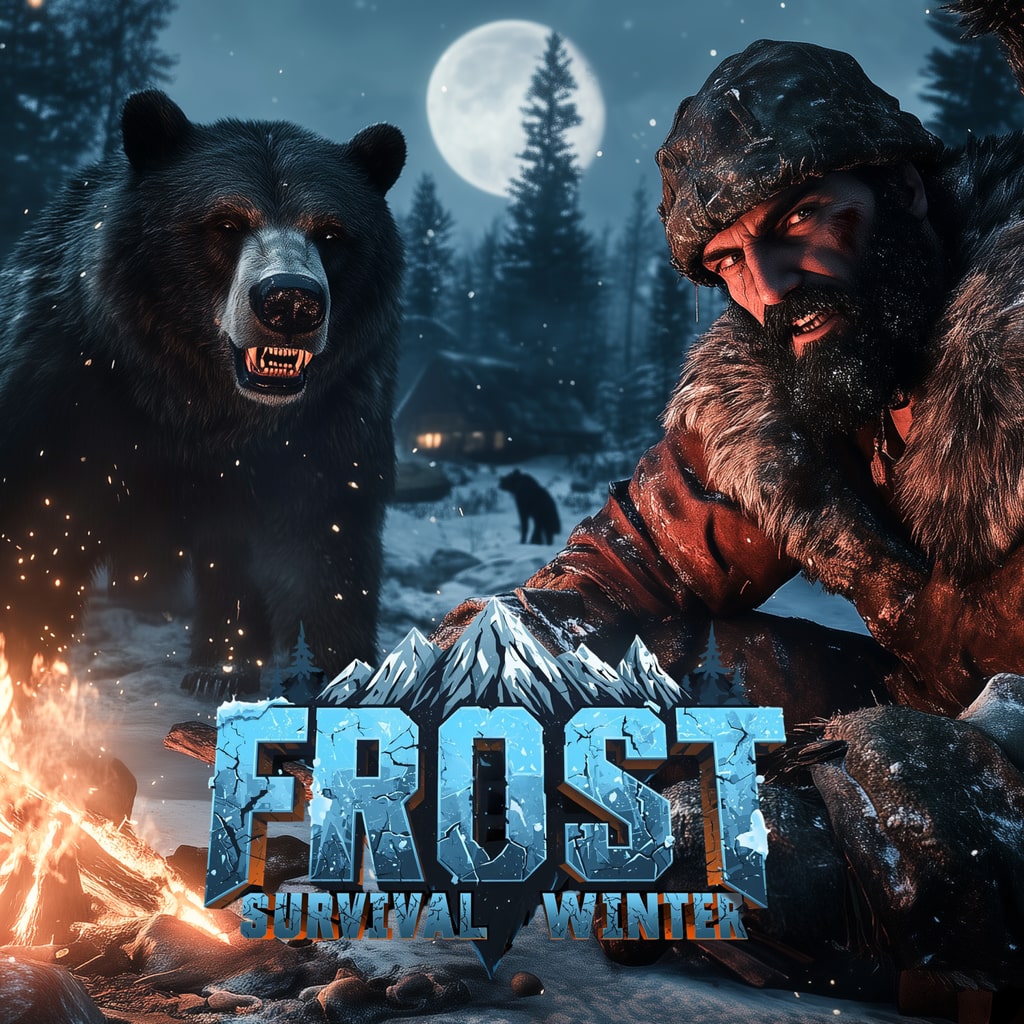
There’s a particular type of quiet that only survival games truly capture—the kind that feels less like peace and more like absence. Frost Survival – Winter builds its entire identity around that silence. Developed by GreenWookland Games and published on PlayStation by Goose Game Ltd, it belongs to a genre already defined by giants like The Long Dark and Green Hell.
What it offers, however, isn’t scale or spectacle—but isolation, fragility, and a slow, creeping psychological unease that distinguish it.
Survival Stripped Back to Its Bones
At its core, Frost Survival – Winter is about enduring. There are no grand narratives pushing you forward, no companions to share the burden. You are alone, dropped into a frozen wilderness where survival is not a goal—it’s a constant negotiation.
The fundamentals are familiar. You manage hunger, body temperature, and stamina while scavenging for resources, crafting tools, and building shelter. Fire is life. Food is fleeting. Shelter is never quite enough.
What the game does particularly well is pacing. Everything takes time. Gathering wood, starting a fire, cooking meat—these are deliberate actions, not background tasks. The result is a survival loop that feels grounded and, at times, unforgivingly slow.
That slowness won’t appeal to everyone. But for those willing to engage with it, it creates a strong sense of presence. Every decision carries weight because every action costs something—time, energy, or safety.
The Cold as an Enemy
Many survival games feature environmental hazards, but Frost Survival – Winter makes the cold its primary enemy.
Temperature isn’t just a meter to monitor—it’s an ongoing threat that influences every choice. Venturing too far from shelter can quickly become a deadly mistake, especially when sudden snowstorms arrive. Visibility diminishes, wind picks up, and what was once a manageable journey turns into a frantic struggle for warmth.
There’s a real tension in simply existing within this world. You’re not dominating the environment—you’re bargaining with it, moment by moment.
The game stands out in how it communicates this danger. Audio plays a significant role: the howl of wind, the crunch of snow underfoot, the eerie silence after a storm passes. It’s immersive in a way that relies on subtlety rather than spectacle.
The Sanity System: Where Things Get Interesting
What truly sets Frost Survival – Winter apart from its competitors is its Sanity system.
Isolation, exhaustion, and prolonged exposure to the cold gradually impact your mental state. Initially, the signs are subtle—visual distortions, faint sounds that may or may not be real. But as your sanity declines, the game becomes increasingly unreliable.
You might perceive figures in the distance. Hear footsteps behind you. Experience environmental changes that don’t quite add up.
This is never explicitly explained, and that ambiguity is essential. Are these hallucinations? Memories? Something entirely different? The game offers no answers, and that uncertainty heightens the tension.
Mechanically, this introduces a new layer to survival. Managing your mental health becomes just as crucial as tending to your physical needs. Rest, shelter, and routine help you stabilise—neglect them, and the game starts to turn against you in unpredictable ways.
It’s an inventive system, even if it occasionally feels underdeveloped. There are moments when its effects seem more atmospheric than mechanically significant, and it doesn’t always reach its full potential.
Nevertheless, it’s enough to give the game a distinctive character.
Exploration Without Comfort
The world itself is vast, but not in the usual open-world way. It’s more about endurance than discovery.
You’ll travel through snow-covered forests, frozen lakes, and dark cave systems, each holding resources—and dangers. Wildlife offers food and materials, but hunting remains risky and often unproductive. Predators present another threat, requiring you to weigh aggression against caution.
A subtle narrative runs through environmental storytelling. Notes, abandoned camps, and remnants of previous survivors hint at stories that remain unfinished. It’s understated but effective.
However, exploration can become repetitive over time. While the environments feel atmospheric, they lack the variety needed to keep long-term interest. Much of the landscape merges together, emphasising the theme of isolation but sometimes sacrificing diversity.
Crafting and Progression
Progression in Frost Survival – Winter relies on knowledge rather than traditional levelling. You unlock new crafting options by discovering notes and experimenting with resources.
It’s a fitting system for the game’s tone—learning feels earned rather than given. Each new recipe or upgrade marks a small victory against an overwhelming environment.
Crafting itself is straightforward, emphasising practicality over complexity. Tools, weapons, clothing, and shelter upgrades all serve clear purposes, with little unnecessary clutter.
That said, the system can feel somewhat limited. Once you’ve established a stable routine, the sense of progression slows, and the game runs the risk of becoming cyclical rather than evolving.
Presentation and Performance
Visually, Frost Survival – Winter embraces minimalism. The environments are stark and often bleak, but consistently immersive. Lighting is vital, especially during storms or at night, where visibility becomes an important gameplay element.
On Nintendo Switch, performance remains stable but modest, with some visual sacrifices. The PlayStation 4 version performs better, providing smoother gameplay and slightly enhanced fidelity.
Neither version is groundbreaking, but the art direction supports the experience. The game doesn’t need to look spectacular; it just needs to evoke cold, emptiness, and oppression. And it does.
Where It Falls Short
Despite its strengths, Frost Survival – Winter has its flaws.
The main issue is repetition. Once you’ve mastered the core loop—gather, craft, survive—the game doesn’t introduce enough new challenges or systems to stay consistently engaging.
The Sanity system, while interesting, feels like it could have been developed further. Its potential is evident, but its execution remains somewhat limited.
There’s also a lack of accessibility. The game offers very little guidance, leaving players to figure things out through trial and error. While this suits the tone, it might put off those new to the genre.
Final Verdict
Frost Survival – Winter is a slow, deliberate, and often unforgiving survival experience that emphasises atmosphere over accessibility. It doesn’t reinvent the genre, but it refines it in subtle, meaningful ways—particularly through its focus on isolation and psychological strain.
Its Sanity system adds an intriguing twist, even if it doesn’t fully realise its potential, and its commitment to pacing fosters a level of immersion that few survival games achieve.
However, its repetitive structure and limited long-term progression prevent it from reaching true greatness.
For players who value atmosphere, patience, and a more contemplative approach to survival, this is a deeply absorbing experience. For others, it may feel too sparse, too slow, and too unforgiving.