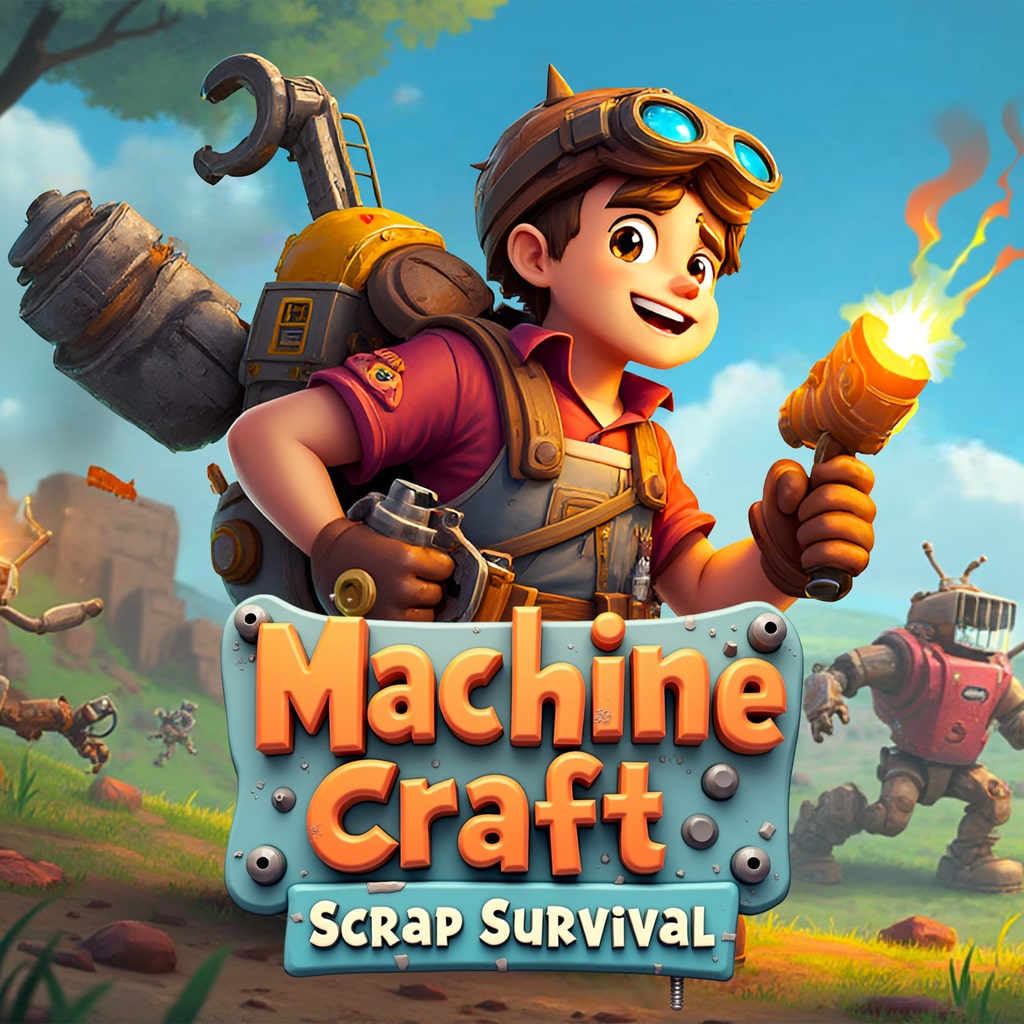
Released on 12 March 2026, Machine Craft: Scrap Survival is a sandbox survival game that blends engineering creativity with resource management and defensive tactics. Developed and published by Play Games LTD, the game takes players to a mechanical wasteland where ingenuity is crucial for survival.
Drawing on elements from sandbox building games, physics-based construction, and wave-based survival mechanics, Machine Craft: Scrap Survival aims to balance open-ended creativity with clear gameplay objectives. Instead of solely building machines for fun, players must apply their engineering skills to solve puzzles, traverse difficult terrain, and defend their base against increasingly formidable robotic enemies.
The game provides a surprisingly engaging gameplay loop for those who enjoy experimentation, although it occasionally falls short in terms of polish and pacing.
A World Built from Scrap
The world of Machine Craft: Scrap Survival is filled with rust, decay, and scattered technology.
Players begin their journey in a vast mechanical landscape dotted with abandoned structures, damaged machinery, and hostile robotic units wandering the area. The setting resembles a forgotten industrial frontier where technology once thrived but has now fallen into disrepair.
Amidst this chaos, the player establishes a small base called Scrap Haven — a secure spot to store resources, craft machines, and set up defences.
Although the game doesn’t focus heavily on narrative storytelling, the environment hints at a world that has unraveled after years of mechanical conflict. Abandoned factories, broken drones, and rusted vehicles tell the story without the need for lengthy explanations.
Rather than following a scripted storyline, the player’s adventure revolves around survival and technological innovation.
Building Machines That Actually Matter
The defining feature of Machine Craft: Scrap Survival is its physics-based engineering system.
Players have access to a wide range of mechanical parts that can be assembled into vehicles, automated machines, or creative contraptions. Wheels, motors, pistons, connectors, and structural components allow players to experiment with complex mechanical designs.
Unlike many sandbox builders where structures are purely decorative, machines in Machine Craft serve practical purposes.
Players must construct vehicles capable of navigating difficult terrain, lifting heavy scrap materials, or crossing hazardous environments.
For example, reaching certain areas may require building a climbing vehicle or a mobile crane capable of transporting resources back to base.
This focus on functional engineering gives the building system a satisfying sense of purpose.
Engineering Puzzles and Exploration
Beyond basic construction, the game features a range of environmental puzzles that encourage creative problem solving.
Certain areas contain obstacles that cannot simply be bypassed. Players might need to build machines to lift debris, create bridges, or activate mechanical switches scattered throughout the terrain.
These puzzles introduce variety into the exploration cycle. Instead of just gathering resources, players are continuously challenged to invent new machines that address specific problems.
The environments themselves are varied enough to keep exploration engaging. From open scrapyards to mountainous regions filled with broken industrial equipment, each area presents new challenges requiring different engineering solutions.
The Scrap Economy
Resources in the game revolve around a single main currency: scrap.
Scrap is collected from destroyed robots, abandoned machinery, and environmental debris. This material forms the basis of the game’s progression system.
Players utilise scrap to research new technologies, unlock better machine parts, and upgrade their base facilities.
The research tree gradually expands the player’s engineering options, introducing more advanced mechanical components and defensive tools.
This progression system ensures that early constructions stay simple, while later machines become increasingly complex.
Defending Scrap Haven
While exploration and engineering form the core of the experience, Machine Craft: Scrap Survival also includes a base defence aspect.
As night falls, waves of hostile robots attack the player’s base. These mechanical enemies differ in size and behaviour, requiring players to prepare carefully before each night cycle.
Defensive strategies often involve automated turrets, traps, and reinforced structures designed to slow or eliminate the attacking forces.
Players can also take part in combat directly using weapons crafted from salvaged parts.
The base defence sequences create moments of tension that nicely contrast with the slower pace of exploration and building.
A Companion in the Wasteland
An interesting addition to the gameplay loop is the presence of a robotic companion that accompanies the player throughout the adventure.
This partner can be upgraded using scrap resources, gaining new abilities that assist in both exploration and combat.
The robot serves as both a narrative companion and a practical gameplay tool, helping players gather resources or defend against smaller threats.
Although the character itself is quite simple, its presence adds a sense of companionship to an otherwise lonely world.
Creative Freedom with Structure
Many sandbox building games struggle to balance freedom with guidance.
Machine Craft: Scrap Survival aims to address this by offering clear objectives alongside open-ended construction tools.
Players always have objectives to pursue — gathering scrap, researching technology, or defending their base — but the ways to achieve those objectives remain adaptable.
This structure encourages experimentation whilst still giving players a sense of progression.
However, the game sometimes suffers from pacing issues when resource gathering becomes monotonous.
Visual Style and Performance
Visually, the game features a stylised industrial aesthetic.
Rust-coloured landscapes, metallic debris, and scattered machinery largely define the environment. The art style is practical rather than spectacular, but it fits well with the game’s mechanical theme.
Machines and vehicles stand out visually. Watching your custom-built contraptions come alive as they move across the terrain is genuinely rewarding.
Performance on PlayStation hardware generally remains steady, though occasional physics glitches can happen when machines become overly complex.
These glitches are usually harmless but can sometimes disrupt carefully crafted builds.
Pros & Cons
Pros
- Deep physics-based building system
- Creative engineering puzzles
- Strong base defense mechanics
- Meaningful progression through scrap upgrades
- Encourages experimentation and problem solving
Cons
- Resource gathering can become repetitive
- Occasional physics glitches
- Visual presentation is somewhat basic
Final Verdict
Machine Craft: Scrap Survival succeeds in delivering a sandbox experience where creativity and practicality go hand in hand.
By focusing on engineering solutions rather than purely decorative building, the game provides players with meaningful reasons to design complex machines. The blend of exploration, puzzle-solving, and base defence creates a rewarding gameplay loop that encourages experimentation.
Although the game’s visuals and occasional technical quirks prevent it from matching the polish of larger sandbox titles, the core mechanics remain engaging for those who enjoy building and problem solving.
For those who love engineering challenges and survival mechanics, Machine Craft: Scrap Survival offers a surprisingly compelling mechanical playground.
Sometimes the best way to survive the wasteland is simply to build a better machine.