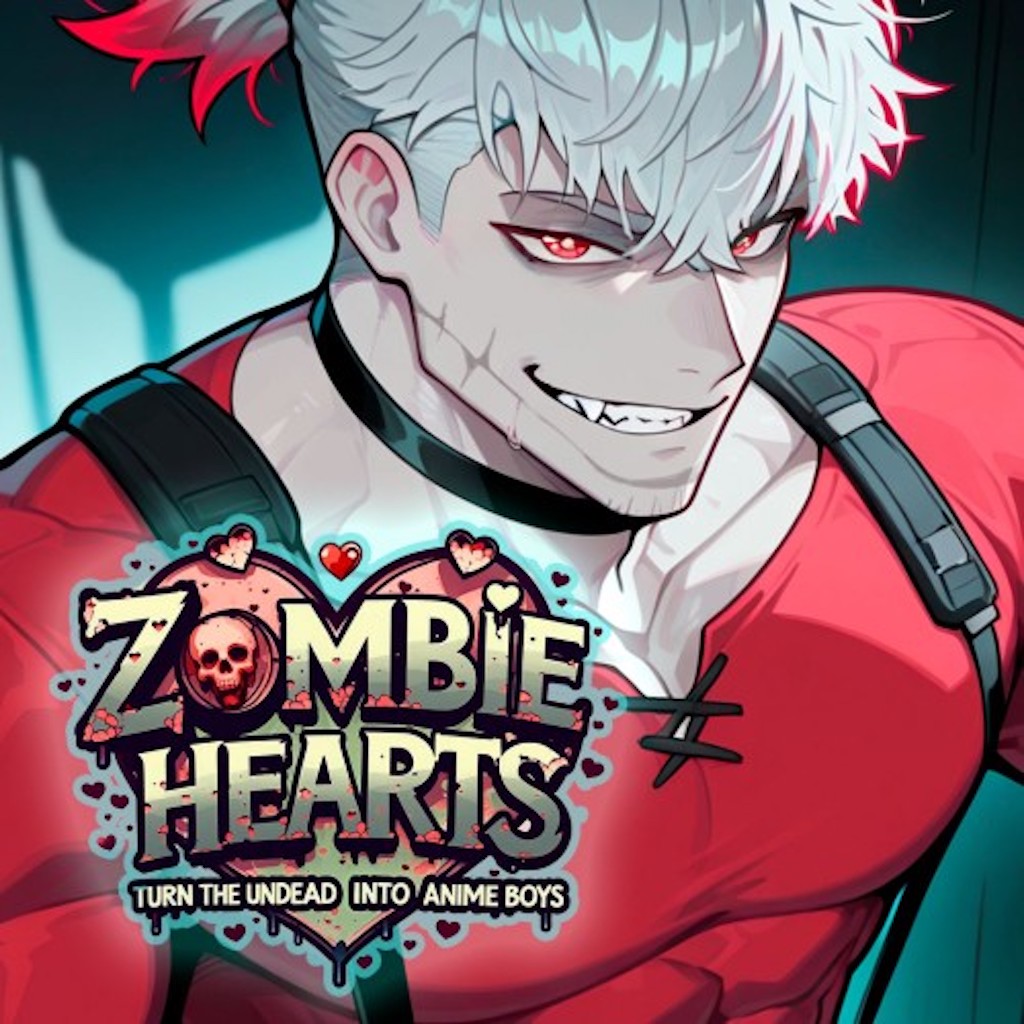
There are games that treat absurdity as decoration, and then there are games like Zombie Hearts: Turn the Undead into Anime Boys, which build their entire identity around it and refuse to soften the edges. It is a hybrid action RPG and simulation system wrapped in a premise that is intentionally strange, but mechanically more grounded than it first appears.
Developed and published by Red Fables, this April 2026 release sets players in a world overrun by the undead, where survival is only part of the loop. The real focus is on reclaiming defeated enemies and transforming them into anime styled companions who can be recruited, developed, and carried forward into future encounters.
What initially sounds like a novelty hook gradually reveals itself as a structured gameplay cycle built around combat efficiency, resource management, and long term character progression. The tone may be chaotic, but the systems underneath are surprisingly methodical.
Combat That Extends Beyond Defeat
Moment to moment gameplay takes the form of real time action RPG combat. You explore infected zones, engage enemies in fast but readable encounters, and gradually push through escalating resistance. Controls are simple, with an emphasis on positioning, timing, and ability usage rather than complex input systems.
Where the design begins to differentiate itself is in how combat outcomes are handled. Defeating enemies is only part of the equation. Weakened zombies can be reclaimed and transformed, shifting them from hostile entities into recruitable characters with retained fragments of their original identity.
This changes how encounters feel. Even standard fights carry additional weight because the outcome is not just elimination, but potential conversion. Every enemy becomes a possible long term asset, which subtly alters the way you approach risk and engagement.
The loop is repetitive by design, but it is reinforced by a consistent sense of progression tied directly to what you choose to recover rather than simply what you defeat.
A System Built on Reuse and Reinvention
The transformation mechanic sits at the core of the entire structure. Reclaimed characters are not cosmetic additions. They become fully integrated party members with progression paths, abilities, and narrative fragments tied to their origin as enemies.
This creates a feedback loop between combat and collection. Success in battle directly feeds into roster expansion, while roster composition influences how future encounters are approached.
At its best, this system gives even familiar combat scenarios a sense of forward momentum. You are not just clearing space. You are building continuity between encounters.
However, the reliance on repeated combat structures means that long term variety can begin to flatten. Enemy patterns and zone layouts eventually show familiarity, and while the transformation system adds motivation, it does not fully prevent structural repetition from becoming noticeable over time.
Tone That Refuses to Stay in One Place
One of the most distinctive aspects of Zombie Hearts is its tonal instability. The game frequently shifts between absurd humour and moments of unexpected sincerity, often without warning.
The idea of transforming undead enemies into anime styled characters is played with varying degrees of seriousness depending on context. Some scenes lean fully into comedic exaggeration, while others pause to explore themes of identity, memory, and what remains after transformation.
This inconsistency can be disorienting, but it also contributes to the game’s personality. It never fully commits to a single emotional register, instead existing in a space where parody and sincerity coexist. The result is a tone that feels unpredictable, but deliberately so.
Exploration and Structural Familiarity
Environmental design is functional, built around clear combat spaces and progression paths rather than expansive exploration. Zones are visually distinct but mechanically consistent, reinforcing the game’s reliance on repetition as structure.
Progression follows a predictable rhythm of exploration, engagement, conversion, and return. While this loop supports the core systems effectively, it does not evolve significantly over time.
This means that long term engagement depends more on character collection and build experimentation than environmental variation. The world serves the systems, rather than expanding beyond them.
Characters as Function and Fragment
Reclaimed characters occupy a dual role within the experience. Mechanically, they function as party members with distinct abilities and progression trees. Narratively, they retain fragments of their previous existence, expressed through dialogue and behavioural traits.
This creates an interesting tension between function and identity. Characters are both tools for gameplay and remnants of prior encounters, which reinforces the game’s transformation theme at a structural level.
However, the depth of individual characterisation varies, with some figures feeling more mechanically defined than narratively developed. This unevenness does not undermine the system, but it does affect emotional consistency across the roster.
Final Verdict
Zombie Hearts: Turn the Undead into Anime Boys is built around a single central idea and commits fully to exploring it through both combat and progression systems. Its transformation loop is the strongest element of the experience, tying together action, collection, and long term development in a clear and consistent structure.
Its strengths lie in that cohesion. Every system feeds back into the core idea of reclaiming and repurposing enemies, giving even repetitive encounters a sense of purpose. Its weaknesses emerge over time, particularly in environmental repetition and predictable encounter design, where structural variety does not always match the creativity of its premise.
Even so, it maintains a strong identity throughout. It is confident in tone, consistent in systems, and clear in what it wants to be, even when its mechanical depth does not always expand at the same pace as its concept. It may not always surprise, but it rarely loses focus.