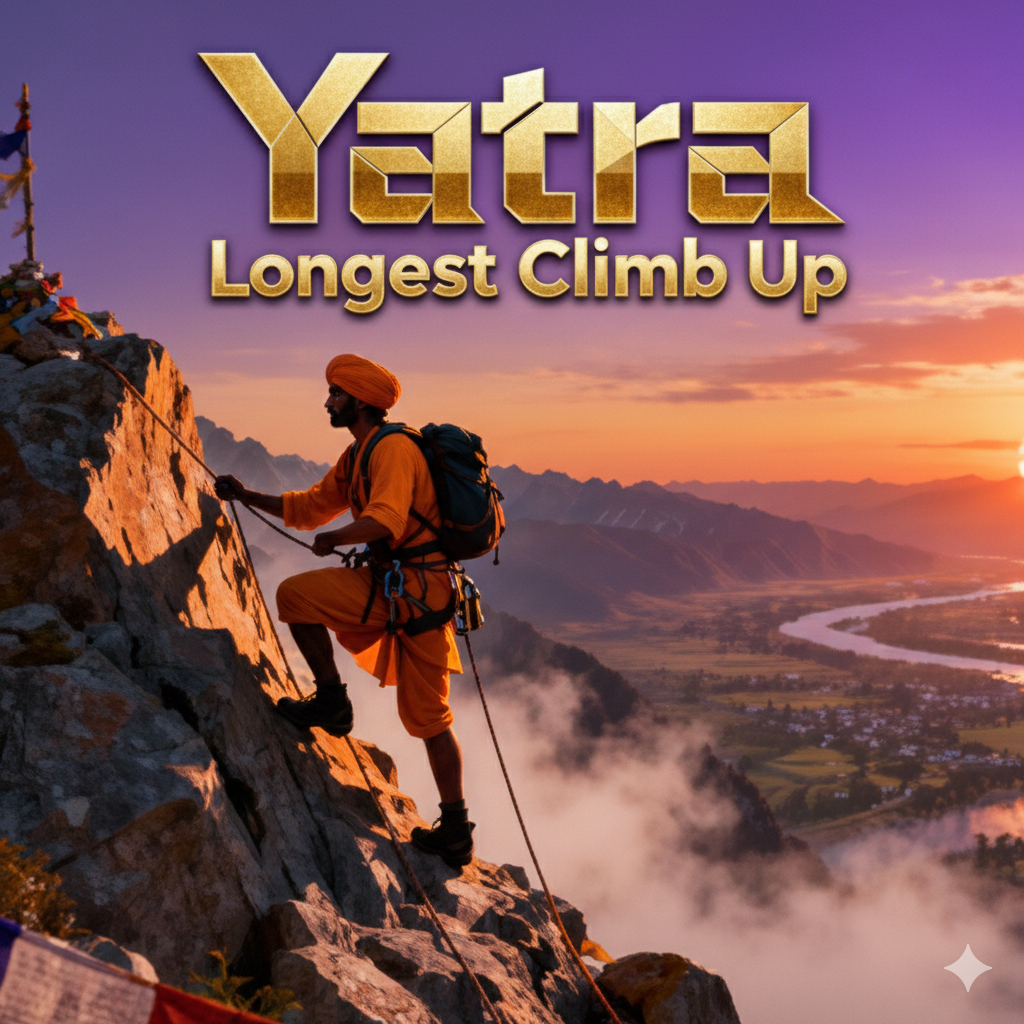
Climbing games often focus on meticulous movement and environmental challenge: think of titles where every handhold matters and each step forward feels like a small victory. Yatra – Longest Climb Up takes this concept and expands it into a complete journey — one that is as much about reflection as it is about physical endurance and strategic survival.
“Yatra” means “journey” in several South Asian languages, and that’s exactly what this game is: a journey up a vast mountain range, filled with shifting weather, changing terrains, and poignant vignettes that comment on what it means to ascend in both body and spirit. It’s an experience that captures the quiet solitude of the climb, the exhilaration of reaching new heights, and the introspective calm that comes with weathering adversity.
But this isn’t a narrative-heavy spectacle with bombastic cutscenes. Instead, Yatra uses its world itself to tell its story — listen to the wind, watch the sunrise creep over snowy ridges, and pay attention to the subtle echoes of past climbers. In doing so, it crafts a meditative, challenging, and visually striking adventure that rewards patience as much as skill.
Core Gameplay: A Test of Patience and Precision
At its heart, Yatra – Longest Climb Up is a third-person climbing and exploration game. The core mechanics revolve around navigating vertical terrain — from rocky outcrops and snow-covered ledges to sheer icy cliffs and narrow ridge lines.
Traversal and Controls
Movement is intentionally deliberate. The control scheme ties closely to the character’s stamina, grip strength, and environmental conditions. Every climb, jump, latch, and rappel must be considered, as missteps drain stamina and increase the chance of failure. This slows pacing relative to action games, but it enhances the sense of accomplishment when progress is made.
Key traversal systems include:
- Grip and stamina management: Hands and feet must find secure holds; resting spots are limited
- Environmental cues: Familiar textures and shapes hint at climbable surfaces
- Tool use: Ice axes, ropes, and other gear expand traversal options and tactical freedom
The controls are intuitive but layered. Basic climbs are accessible, but mastering nuance — like conserving stamina on long vertical sections or chaining movements fluidly — requires practice and awareness.
Environmental Storytelling and World Design
Where Yatra truly shines is in its world design. Rather than dividing the game into discrete levels, it presents one vast, continuous mountain range, broken only by natural ridges, weather events, and narrative waypoints.
Every section feels purposeful:
- Base camps become brief respites where you can gather resources and reflect
- Wind-whipped ridges test your endurance and sharpen your focus
- Snowy caverns and crevasses offer both danger and unexpected beauty
Visual storytelling is subtle. Scattered gear, abandoned campsites, and broken ropes suggest prior expeditions without ever spelling out details. These environmental cues invite interpretation rather than explanation, which deepens immersion.
The lighting and weather systems add dynamic mood shifts. A gentle dawn bathes the slopes in warm light; afternoon snow squalls reduce visibility to near zero; nightfall brings a bone-chilling quiet interrupted only by distant wind. This variety keeps exploration fresh and reinforces that Yatra is as much about atmosphere as mechanics.
Survival Elements: Strategy in the Snow
Unlike purely narrative exploration games, Yatra integrates survival mechanics that influence pacing and decision-making. Players must manage:
- Stamina: Linked to movement, resting, and grip strength
- Cold and weather exposure: Proper shelter and timing matter
- Inventory and gear durability: Tools and clothing wear over time
These systems complement the climbing mechanics rather than overwhelm them. You’re not constantly fighting for survival in the way hardcore survival games demand; rather, these elements create a framework that adds weight to your decisions.
Should you press on through an incoming blizzard to reach a promising solstice viewpoint, or retreat to shelter and wait it out? Certain high-altitude zones may offer spectacular vistas but risk fatigue and resource depletion. These choices are never trivial.
Visuals and Audio: A Symphony of Solitude
Yatra’s visual design is one of its strongest selling points. Its world is rendered with an evocative mix of realism and artistic stylisation.
- Textures: Snow, rock, ice, and foliage are detailed and tactile
- Lighting: Real-time shifts in sun position and atmospheric density create breathtaking vistas
- Animation: Subtle character movements — shivers, careful foot placement, wind reactions — enhance realism
But it’s not just about how the world looks; it’s about how the world feels. Leaning into strong winds, squinting against snow, and resting at a ledge to watch a sunset all contribute to a sensory narrative that dialogue alone could never achieve.
The audio design reinforces this world exceptionally well. A sweeping ambient soundtrack, punctuated by natural sound cues — wind gusts, distant avalanches, crunching snow underfoot — facilitates immersion. There’s a powerful interplay where silence becomes as meaningful as sound, enhancing moments of isolation and reflection.
Narrative and Emotional Pace
The storytelling in Yatra is minimalist but evocative. Rather than traditional cutscenes or heavy dialogue, the narrative emerges from:
- Visual metaphors scattered across the environment
- Brief character reflections triggered at key moments
- Object placements that evoke memory and presence
This subtle narrative approach may not satisfy players who prefer explicit stories and character arcs, but it excels for those who enjoy finding meaning in context and consequence rather than exposition.
Themes of perseverance, solitude, ambition, and quiet resilience emerge without heavy handedness. The mountain isn’t just terrain — it’s a metaphor for personal challenges and the many invisible forces that shape our paths.
Accessibility and Learning Curve
Yatra – Longest Climb Up rewards patience, but it also demands it. Controls are responsive, but mastery requires practice. Survival systems add nuance without punishing novices too harshly, but there is a learning curve — especially around stamina and gear management.
Tutorials are present, but they are concise and contextual rather than intrusive. New players may feel a slight overwhelm initially, especially during times of sudden weather change or complex climb sections. However, the game’s generous checkpoints and forgiving progression ensure that missteps are learning opportunities rather than frustration traps.
For players less familiar with survival or exploration sims, the pacing may feel slow at first, but the rhythm quickly becomes meditative once the systems are understood.
Replayability and Longevity
Yatra isn’t a game built for traditional replay value — there are no branching endings, levelling systems, or extensive modes beyond the main ascent. But longevity comes from depth of experience:
- Exploring alternative paths up the mountain
- Mastering advanced traversal techniques
- Replaying specific segments with different survival strategies
The journey itself is the destination, and for many players that may be enough.
Final Verdict
Pros:
- Beautiful, atmospheric world design that rewards exploration
- Deep, thoughtful survival and traversal mechanics
- Emotional resonance through environmental storytelling
- Polished audio and visual presentation
Cons:
- Slow pacing may not suit all players
- Minimalist narrative may feel light for some
- Survival systems may feel nuanced to newcomers
Summary:
Yatra – Longest Climb Up stands as a compelling blend of exploration, survival, and philosophical reflection. It doesn’t rush you, it doesn’t overwhelm you, but it invites you to consider each step — both in the game and, perhaps, in your own life. While its deliberate pacing and subtle storytelling won’t appeal to every player, those seeking an experience that is at once challenging, beautiful, and quietly profound will find Yatra a memorable climb.