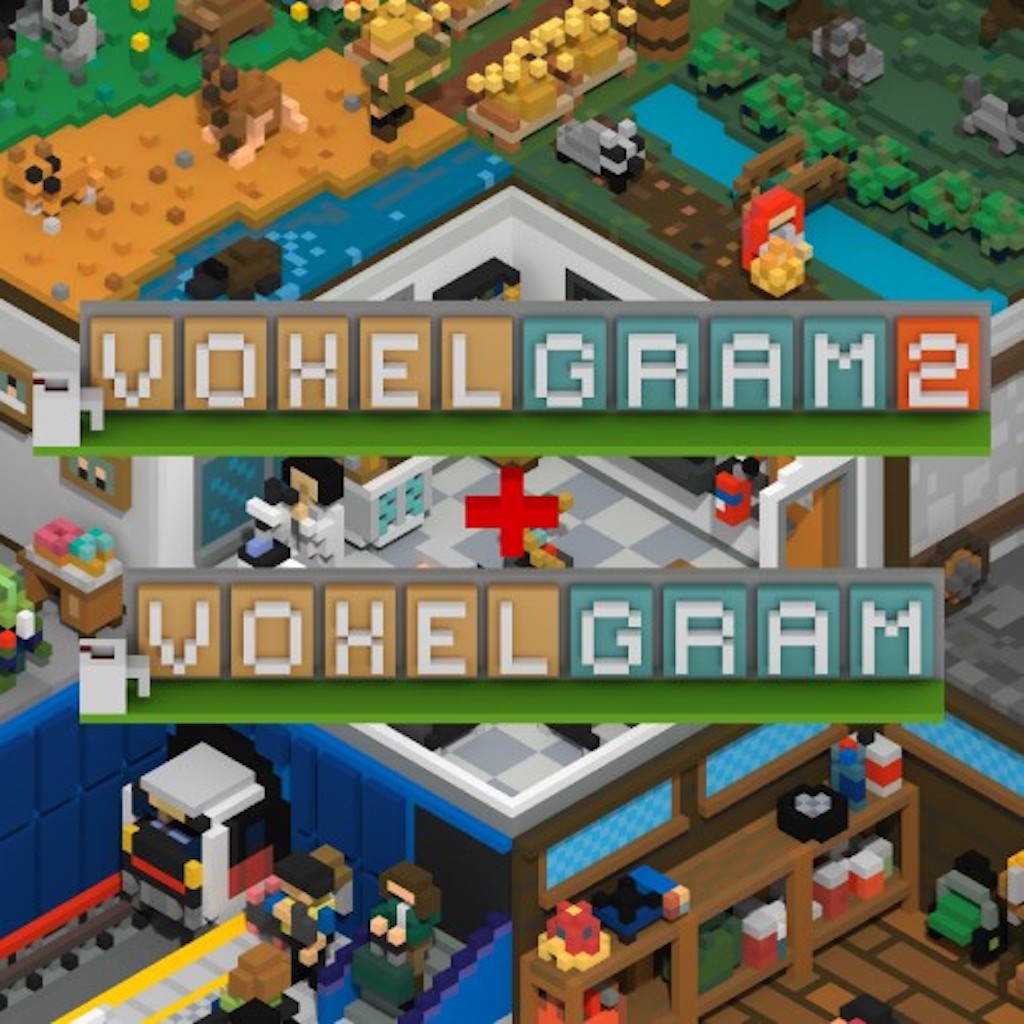
For years, fans of Nintendo’s long-dormant Picross 3D series have found themselves in an unusual position. Traditional nonogram games remain plentiful, appearing on virtually every platform imaginable, yet true three-dimensional logic puzzles have remained frustratingly rare. There is a good reason for that. Translating the elegant simplicity of nonograms into a fully three-dimensional space requires careful design, intuitive controls, and puzzles that challenge without overwhelming. Few developers have managed to strike that balance.
Procedural Level not only understood the challenge but embraced it wholeheartedly. The original Voxelgram arrived as a love letter to spatial reasoning, offering players the chance to carve hidden objects from massive blocks of voxels through careful deduction. Now, with Voxelgram 2 expanding on that foundation in meaningful ways, the series has evolved into something special. Together, these games represent one of the finest examples of modern puzzle design, delivering hundreds of hours of deeply satisfying brainwork while maintaining a consistently welcoming and relaxing atmosphere.
A Puzzle Box in Three Dimensions
At its core, Voxelgram rests on a deceptively simple premise. Players are presented with a solid cube composed of hundreds, sometimes thousands, of individual voxel blocks. Along each axis, numerical clues indicate how many blocks should remain in a particular row or column. By carefully interpreting these clues and eliminating unnecessary blocks, players gradually reveal hidden objects within the larger structure.
While the concept sounds straightforward on paper, the reality is far more engaging. Every puzzle becomes an exercise in observation and logic. Rotating the structure, examining internal layers, and identifying patterns create a steady rhythm of discovery. Each correct deduction feels rewarding because every step is earned through genuine reasoning rather than trial and error.
What makes the process particularly compelling is how the games encourage players to think spatially. Traditional two-dimensional nonograms ask you to interpret rows and columns from a single perspective. Voxelgram demands that you consider every angle. Solving one side of a puzzle often reveals critical information hidden deep within another layer, creating a wonderful sense of interconnected logic that keeps your brain constantly engaged.
The Evolution of Voxelgram 2
The original Voxelgram was already an excellent puzzle game, but Voxelgram 2 shows what thoughtful iteration can achieve. Rather than simply offering more levels, Procedural Level introduces a dual-colour system that fundamentally changes how puzzles are approached.
Instead of deciding only which blocks should remain, players must now also identify the correct colour for surviving pieces. Numerical clues are split across separate colour categories, forcing players to process additional layers of information simultaneously. It sounds like a small adjustment, but the impact is enormous.
The result is a more sophisticated and rewarding experience. Puzzles become richer and more nuanced without feeling unfair. The new system has an elegance that continually pushes players towards deeper logical thinking. Every completed puzzle feels less like a guessing exercise and more like solving an intricate mathematical sculpture.
Perhaps most importantly, the added complexity never sacrifices accessibility. Newcomers can still ease into the mechanics gradually, while experienced puzzle enthusiasts gain a fresh challenge that keeps the formula feeling vibrant.
Tiny Dioramas with Big Personality
One of the most charming aspects of both games is their sense of progression. Rather than presenting puzzles as isolated challenges, many are grouped into themed collections that gradually build up into larger scenes.
You may start by carving a simple chair, then uncover a table, a lamp, and eventually an entire room. Piece by piece, these creations populate detailed miniature dioramas that evolve over time. Watching a blank display transform into a bustling village, a cosy workshop, or a whimsical fantasy setting provides a surprisingly powerful sense of accomplishment.
This visual progression gives every completed puzzle additional meaning. You are not simply checking items off a list. You are contributing to something larger. The process feels creative despite being entirely driven by logic, and that combination proves remarkably satisfying.
The voxel models themselves are full of charm. Their blocky simplicity keeps them instantly recognisable while maintaining a delightful toy-like quality. There is a warmth to the presentation that prevents the games from ever feeling sterile or overly mathematical.
Endless Challenges for Puzzle Enthusiasts
One potential criticism of many puzzle games is that they eventually run out of content. Voxelgram 2 tackles this concern head-on through procedural puzzle generation and support for community-created content.
The procedural system generates an effectively endless supply of new puzzles across a range of difficulty levels. Whether you want a quick ten-minute challenge or an evening-consuming brain teaser, there is always something new to solve. While these generated puzzles occasionally lack the handcrafted cleverness found in the main campaigns, they remain excellent tools for sharpening your deductive skills.
Community support further extends the game’s lifespan. Creative players have produced a wealth of custom puzzles that continue to expand the library of available content. This creates a sense that Voxelgram 2 is not simply a sequel but a long-term platform for puzzle enthusiasts.
The sequel’s integration of content from the original game adds even more value. Returning players are rewarded with an enormous catalogue of legacy puzzles, updated to take advantage of the newer systems, creating a staggering amount of content across the combined package.
Relaxation Through Deduction
Puzzle games live or die by their presentation. If the interface is clumsy or the visuals become tiring to look at, even brilliant puzzle design can suffer. Fortunately, Voxelgram excels in this area.
The clean visual design keeps information easy to process without overwhelming the screen. Colours remain soft and inviting, while the voxel models themselves are attractive without becoming distracting. Long play sessions rarely cause visual fatigue, which is essential for a game built around concentration.
The soundtrack deserves equal praise. Gentle ambient melodies and relaxed electronic themes create an atmosphere that feels almost meditative. Even when tackling particularly difficult puzzles, the music encourages patience rather than frustration. The entire experience has a calming quality that makes it easy to lose track of time.
Control implementation is equally impressive. Navigating three-dimensional spaces can often feel cumbersome in puzzle games, yet both mouse and controller support are responsive and intuitive. Rotating models, adjusting layers, and marking blocks quickly become second nature.
A Few Minor Rough Edges
Despite its many strengths, Voxelgram is not without challenges. Players accustomed to traditional nonograms may initially struggle to make the transition to three-dimensional thinking. The ability to rotate structures and inspect internal layers adds complexity that can feel daunting in the first few hours.
Procedural puzzles, while valuable, occasionally lack the memorable moments found in handcrafted designs. The best manually created stages often feature clever reveals and satisfying logical breakthroughs that algorithms cannot always replicate. Generated content remains enjoyable, but it rarely captures the same sense of personality.
These criticisms are relatively minor in the grand scheme of things. They stem more from the inherent limitations of procedural design and the learning curve associated with three-dimensional logic than from any meaningful design flaws.
Final Verdict
Voxelgram and Voxelgram 2 represent puzzle design at its finest. They respect the player’s intelligence, trust deduction over guesswork, and transform abstract numerical clues into delightful works of digital craftsmanship.
The original game laid an excellent foundation, while the sequel expands on that formula with confidence and creativity. Together, they offer an astonishing amount of content, a beautifully relaxing atmosphere, and some of the most satisfying “aha” moments the genre has to offer.
For fans of nonograms, Picross veterans, and anyone who enjoys thoughtful puzzle-solving, this collection is easy to recommend. It challenges your mind without becoming exhausting, rewards patience without wasting your time, and consistently delivers that rare feeling of genuine intellectual accomplishment.
Sometimes the best puzzle games make you feel clever. Voxelgram and Voxelgram 2 make you feel like an artist, carefully carving masterpieces from blocks of pure logic.