Few games arrive with a mechanic so singular that you instantly know it’s going to leave you thinking — the kind that makes you tilt your head, re-orient everything you thought you knew about space, and wonder how level design can feel so alive. Viewfinder does exactly that. On Switch, this first-person puzzle adventure from Sad Owl Studios delivers a quietly dazzling — if somewhat flawed — journey that invites you to reshape reality one photograph at a time.
The Core Idea: Snap — Place — Remodel Reality
At its centre lies a deceptively simple but brilliant mechanic: you’re armed with a magical camera. Take a photograph (or find a painting, sketch or screenshot) of part of the environment — a bridge, a staircase, a doorway — and when you place that image in the world, it becomes physical reality. A fallen plank becomes a walkway; a distant roof becomes a ramp. It’s a playful rethinking of geometry, space and perspective that feels less like a puzzle gimmick and more like a new language of level-design.
What makes this work so beautifully is the freedom and generosity built around it. Mistakes don’t penalise you harshly — there’s a rewind mechanic that lets you return to the moment of placement or the point at which the photo was taken, giving you room to experiment, explore and iterate without fear. This encourages creativity and lateral thinking rather than brute-force, trial-and-error solutions. Every time you solve a puzzle, you’re not just clearing a block — you’re bending reality. And that’s special.
As you progress, new puzzle elements layer on: copiers that duplicate existing photos, moving parts that must be aligned precisely, spatial illusions requiring careful photographic framing. Each new mechanic feels like unlocking a new tool in a cosmic toolbox — once you understand it, the world opens up.
Art Direction, Atmosphere and the Surreal Beauty of Simulated Worlds
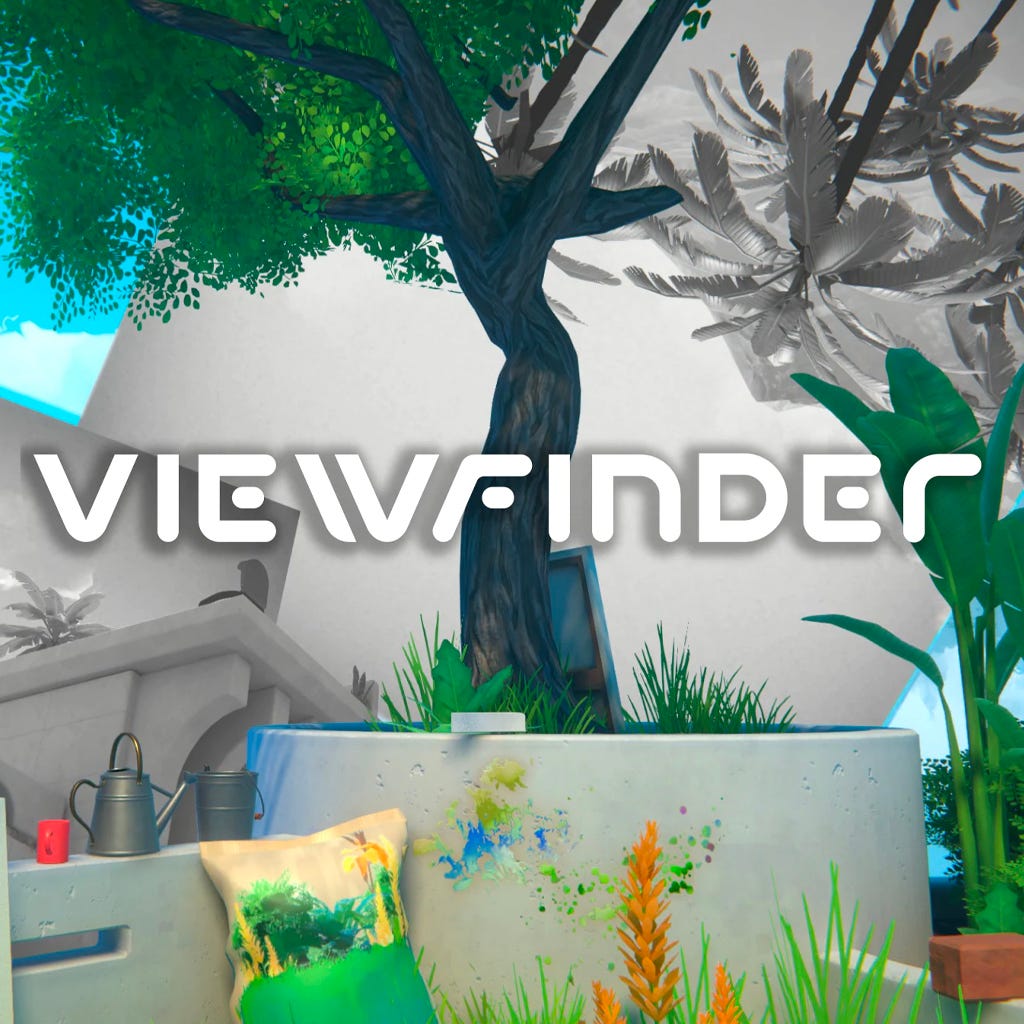
Part of what gives Viewfinder its identity is how it dresses this camera trick in a visual world that flips between dreamy, painterly, and occasionally unsettling. On Switch, even with the platform’s hardware limits, the game nails the aesthetic: bold primary colours, expressive environmental textures, soft lighting, and striking shifts in art style across levels — from crude sketches to water-colour washes to sterile corporate interiors.
This variety makes every level feel like a new painting you step inside of. Combined with ambient soundscapes and gentle music, the world becomes immersive even before you’ve snapped a single photo. It’s a game that invites slow exploration, quiet observation, and moments of “wait — what just happened?” when a flat image becomes three-dimensional under your feet.
Even on Switch — which isn’t as powerful as PC or consoles — the magic translates well. In handheld or docked mode, the sense of space remains intact, and the gradual reveal of environments keeps the atmosphere strong. A few visual downgrades are noticeable if you’re used to high-end hardware, but the core artistry still shines through.
Story & Structure: Light, But Serviceable
Unlike some puzzle games that lean purely on mechanics, Viewfinder wraps its mystery inside a narrative: you play as a scientist exploring a simulation left behind by a team of researchers. Audio logs, diaries and environmental clues hint at a deeper story about humanity, loss, change — heavy themes for a game so dreamlike.
That said, the narrative rarely reaches the heights of the mechanics. Characters are mostly off-screen voices; their stories feel distant, sometimes underwhelming. The writing is competent but seldom surprising, and the emotional stakes are rarely amplified by gameplay in a meaningful way. It never hurts to have a reason to rebuild bridges and reshape worlds, but the story often feels like window-dressing — a thin layer over the more compelling puzzle core.
For players who crave deep lore or emotional character arcs, Viewfinder may feel slight; for those more interested in mind-bending environment puzzles and spatial trickery, the story serves its purpose quietly in the background.
Switch Version: Strengths & Limitations
Bringing Viewfinder to Nintendo Switch is an admirable feat, and for the most part the port works. The puzzles remain intact, the environments look pleasing, and the core joy of photo-manipulated reality survives. The interface is intuitive, the game runs acceptably, and it feels natural to play whether docked or in handheld mode.
But it isn’t perfect. Because the Switch hardware is weaker than PC or next-gen consoles, you do notice lower fidelity textures, occasional frame-rate dips, and a general softness during transitions or extensive environmental transformations. Movement occasionally feels less fluid, and some of the visual sharpness that heightens the surreal effect is muted. In a game that hinges on spatial clarity and visual cues, these compromises sometimes undercut the illusion.
Additionally, Viewfinder is short. The main campaign wraps up in roughly four to six hours, depending on how much you explore. There are hub worlds with optional side-challenges and collectibles, but once you’ve experienced the core inventive puzzles, the desire to revisit them quickly fades. Replay value is limited unless you’re going for achievements or like exploring levels from new angles.
What Works
- Ingenious and mind-bending core puzzle mechanic that genuinely feels fresh
- Visually rich and stylistically bold environments, even on Switch hardware
- Generous rewind/experiment-friendly design fosters creativity over frustration
- Flexible gameplay: accessible to newcomers yet layered enough to satisfy puzzle veterans
What Falters
- Story is lightweight and never quite elevates the experience
- Visual compromises on Switch — lower fidelity, occasional frame drops
- Short runtime, with limited replay value once the main puzzles are done
Pros & Cons
Pros
- Brilliant, inventive photo-placement mechanic that feels genuinely unique
- Strong, varied art direction with striking shifts in style
- Rewind-friendly design encourages experimentation without punishment
- Well-paced puzzles that reward creativity and spatial thinking
- Switch port maintains core gameplay and atmosphere despite hardware limits
Cons
- Visual downgrades and occasional frame dips on Switch
- Story is serviceable but rarely compelling
- Short runtime with limited replay value once puzzles are solved
- Some puzzles lose impact due to reduced clarity in handheld mode
Verdict: A Unique Puzzle Title — Worth the Leap, Despite the Shortfalls
Viewfinder on Nintendo Switch isn’t perfect, but it doesn’t have to be. Its ambition lies not in length or blockbuster scope, but in a single, brilliant idea: that photographs can reshape the world. That idea echoes through every room, every corridor, every environmental twist — and it’s a powerful voice in a genre often cluttered with familiar tropes.
For puzzle fans looking for something inventive, meditative, and visually arresting — a game that gives you space to think in new dimensions — Viewfinder is one of the most rewarding experiences of recent years. It doesn’t overstay its welcome. It doesn’t pretend to be epic. Instead, it quietly asks you to look, to snap, to re-imagine — and in that space, there’s magic.