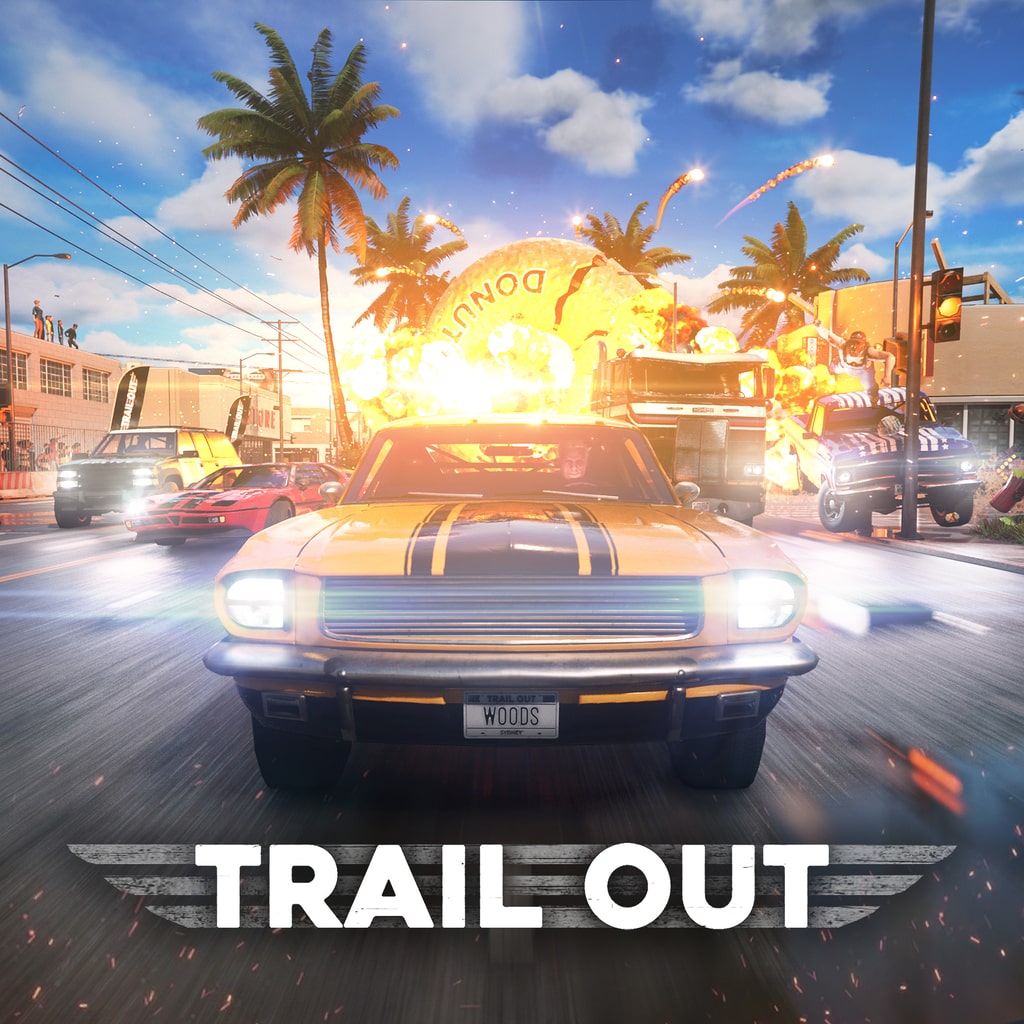
Arcade racing games focused on pure destruction have become increasingly rare in today’s gaming scene. While realistic racing simulators currently dominate the genre, there was a time when racing games embraced chaos, physics-based crashes, and over-the-top spectacles. Few series captured that spirit better than FlatOut, a cult favourite renowned for its high-speed carnage and ragdoll driver stunts.
TRAIL OUT, developed by GOOD BOYS and published by Crytivo, clearly positions itself as a spiritual successor to FlatOut. Originally released on PC in September 2022, it later arrived on Xbox Series X|S in April 2024 and PlayStation 5 on 5 March 2026. The game aims to revive the destructive racing formula with modern visuals and even more outrageous stunts.
Set during a fictional racing festival spanning multiple locations around the world, players assume the role of racer Mihalych, competing in a chaotic championship filled with explosive tracks, bizarre challenges, and eccentric rivals.
From exploding cars to ragdoll drivers flying through windscreens, TRAIL OUT makes one thing clear from the outset: finishing the race is only part of the goal. Causing as much destruction as possible is equally important.
High-Speed Carnage
At its core, TRAIL OUT is a destruction-focused arcade racer where collisions are not just expected—they are encouraged.
Tracks are filled with hazards designed to cause chaos. Explosive barrels, collapsing structures, and environmental traps ensure that every race quickly descends into a spectacular mess of wrecked vehicles and flying debris.
Unlike traditional racing games that penalise crashes, TRAIL OUT treats them as entertainment. Cars can flip, spin, and smash into one another with exaggerated physics that prioritise spectacle over realism.
One of the key mechanics borrowed from the FlatOut formula is the ragdoll driver system. During particularly violent crashes, your driver is launched through the windscreen in dramatic fashion, tumbling across the track in slow-motion chaos.
It is ridiculous, over-the-top, and exactly what fans of destruction racing expect.
The driving itself leans heavily into arcade handling. Vehicles slide easily around corners, encouraging aggressive manoeuvres and high-speed collisions rather than precise racing lines.
This approach makes TRAIL OUT immediately accessible, though it also means that driving purists may find the handling lacking in depth.
Game Modes and Variety
TRAIL OUT offers an unexpected amount of content for an indie racing game.
The game features around 50 vehicles across different classes and eras, each with varying levels of durability, speed, and handling. Some cars are clearly designed for pure racing, while others excel in demolition-focused modes.
Similarly, the game includes roughly 50 tracks, from urban environments filled with destructible objects to chaotic derby arenas built specifically for vehicular combat.
Beyond standard races, TRAIL OUT features several alternative modes that emphasise destruction over speed.
Derby modes focus entirely on eliminating opponents in enclosed arenas, rewarding players for aggressive driving and strategic collisions. Meanwhile, Hunter-style modes challenge players to survive waves of enemy vehicles attempting to destroy them.
One particularly memorable mode involves fleeing from an armed aircraft, forcing players to dodge incoming attacks while navigating dangerous tracks.
These diverse modes help prevent the game from feeling repetitive, ensuring that the focus constantly shifts between racing, survival, and destruction.
The Absurdity Factor
Perhaps the most distinctive feature of TRAIL OUT is its humour.
The game never takes itself too seriously. Its cast includes exaggerated characters and over-the-top rivals, such as a Vin Diesel-inspired racer called Los Torrent.
The story mode follows Mihalych’s quest to win the festival championship by defeating a series of bosses, each with their own themed challenges.
Narratively, the plot is simply an excuse to move from one chaotic race to another, but the presentation adds personality to the experience.
TRAIL OUT also features a variety of mini-games that celebrate the franchise’s absurd origins.
These challenges often involve launching the driver’s ragdoll body as a projectile in bizarre events like darts, bowling, or other physics-based stunts.
They are silly, sometimes frustrating, but undeniably entertaining.
Vehicles, Tracks, and Destruction
The game’s vehicle roster offers a diverse mix of styles, including classic muscle cars, modern racers, and heavily reinforced demolition machines.
The PS5 launch was a “surprise’ release after multiple delays due to certification issues. It was released as a complete package, including four previously available DLC packs: Legendary Cars, Luxury Life, Steel Wheels, and Hunt 007 Special.
Tracks are designed with destruction as a core element. Instead of pristine circuits, many environments are filled with obstacles, shortcuts, and explosive hazards.
Large crowds, collapsing scenery, and flying debris create a constant sense of chaos.
While the destruction physics can be impressive, they sometimes verge on the unpredictable. Cars may bounce or flip unexpectedly, which can be either hilarious or frustrating depending on the situation.
Presentation and Performance
Visually, TRAIL OUT emphasises spectacle over realism.
Cars deform convincingly during crashes, with body panels bending and parts flying off as collisions intensify. Explosions are exaggerated and vivid, reinforcing the game’s arcade style.
The environments are detailed enough to add variety, although they lack the visual polish seen in larger racing franchises.
Character models and story cutscenes sometimes feel rough around the edges, reflecting the game’s indie development roots.
On PlayStation 5, performance is generally stable, with the game maintaining smooth racing even during chaotic multi-car pile-ups.
Longevity and Replayability
TRAIL OUT offers a substantial amount of content through its campaign, vehicle unlocks, and various game modes.
The festival-style progression system motivates players to complete events across different racing disciplines, gradually unlocking new vehicles and tracks.
Local multiplayer and split-screen support provide extra replay value, making the game especially enjoyable with friends.
However, the chaotic nature of the gameplay means that some events can feel repetitive over time, particularly if players focus heavily on the standard racing modes.
Nonetheless, the variety of modes and mini-games helps keep the experience engaging across longer sessions.
Pros & Cons
Pros
- Chaotic destruction racing reminiscent of classic FlatOut games
- Large number of vehicles and tracks
- Entertaining ragdoll physics and stunt mini-games
- Variety of race types and combat-focused modes
- Strong local multiplayer options
Cons
- Driving mechanics lack depth
- Physics can feel unpredictable at times
- Story presentation is rough
- Visual polish is inconsistent
Final Verdict
TRAIL OUT is unapologetically chaotic.
Rather than trying to rival realistic racing simulators, it embraces the wild, destructive spirit of classic arcade racers. Exploding cars, ragdoll drivers, and absurd mini-games combine to create an experience that prioritises fun over precision.
For fans of the FlatOut series, TRAIL OUT feels like a long-overdue revival of a forgotten style of racing game. The chaotic physics, derby-style combat, and stunt challenges capture the same reckless energy that made those earlier titles so memorable.
However, the game’s rough edges are hard to overlook. Driving mechanics lack the depth of more polished racers, and the presentation occasionally reveals its indie roots.
Even so, TRAIL OUT succeeds where it matters most: delivering a high-energy festival of destruction that is consistently entertaining.
It may not be the most refined racing game available, but it stands out as one of the most chaotic and amusing.