There is something wonderfully refreshing about a game that does not seem particularly interested in rushing you anywhere. In a medium that often fills every spare second with objectives, enemies, collectibles and flashing notifications, TOEM 2 takes a very different approach. It hands you a camera, points you towards a world full of odd little characters and unexplained happenings, then essentially says: go and have a look around. It is gentle without being dull, charming without becoming saccharine, and perhaps most importantly, it understands that sometimes the best adventures are the ones where you stop worrying about the destination and simply enjoy the journey.
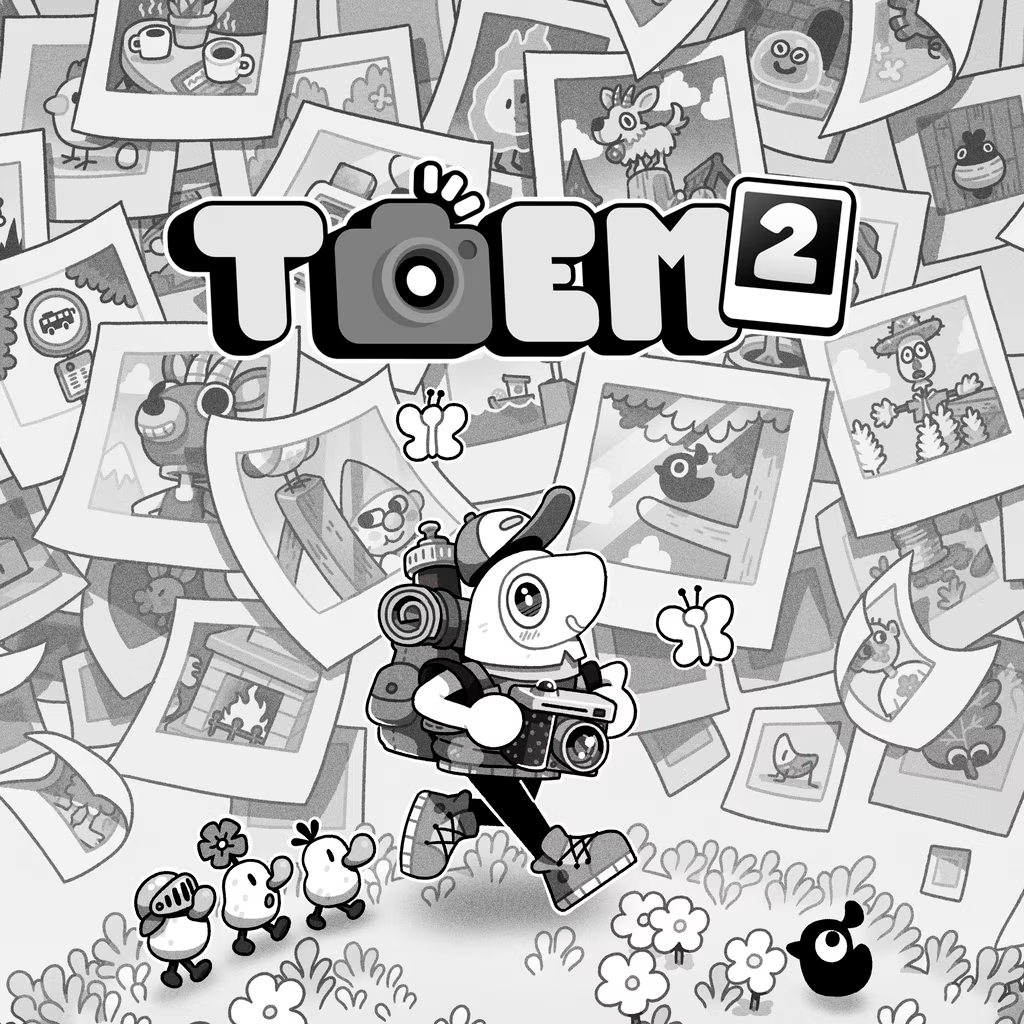
Developed and published by Something We Made alongside popagenda, TOEM 2 follows in the footsteps of the much-loved 2021 original while expanding its world and possibilities. The distinctive monochrome, hand-drawn visual style remains firmly intact, but this time the environments feel more open and tangible, giving you greater freedom to run, jump and climb your way around them. At the centre of everything is still that wonderfully simple idea of using photography to interact with the world. The result is an adventure that feels familiar to returning players while remaining welcoming enough for anyone who missed the first game.
A Camera and a Curious Mind
The heart of TOEM 2 is photography, but this is not a game about finding the perfect composition or fretting over exposure settings. Your camera is your most important tool, and the world is designed around the simple pleasure of looking through its lens. Strange events, unusual creatures, hidden details and seemingly insignificant moments can all become important once you start paying attention.
That sense of observation is central to the game’s personality. You might wander into an area and initially think there is very little going on, only to notice something moving in the distance or a character behaving slightly oddly. Pulling out the camera can reveal something you would otherwise have completely missed, and there is a lovely feeling of discovery when a seemingly ordinary part of the environment suddenly becomes relevant.
The sequel also gives the camera some clever new tricks. Different attachments let you interact with objects and overcome problems in ways that go beyond simply taking photographs, adding another layer to the puzzle design. These additions are particularly effective because they never feel like they are trying to turn TOEM 2 into a traditional puzzle game. Everything remains intuitive, playful and rooted in the idea that your camera is your passport into this strange little world.
A World Worth Wandering Through
Exploration has been expanded considerably, and it makes a noticeable difference. Rather than simply walking from one objective to the next, TOEM 2 encourages you to poke around, climb things, investigate suspicious corners, and take the scenic route whenever you feel like it. Hidden paths and viewpoints are tucked away for those willing to look, and the game rewards curiosity far more than speed.
The move towards fully three-dimensional environments works particularly well, giving the world a greater sense of physicality. Being able to jump and climb adds freedom without turning traversal into an obstacle course, and there is rarely any pressure to perform a complicated manoeuvre just for the sake of it. You are free to explore because exploring itself is the point.
This philosophy makes TOEM 2 such an easy game to settle into. You can spend time following the main objectives, or you can completely ignore them for a while and wander off in search of something interesting. There are no ticking clocks breathing down your neck, and completion does not require you to become some kind of photographic perfectionist. If you want to sit on a bench and listen to the music for a moment, you can. If you want to stop and admire a particularly nice view, nobody is going to complain.
The Little People Make the Journey
A major part of TOEM 2’s appeal lies in the characters scattered throughout its environments. They are an eclectic bunch, often wonderfully odd, and their problems provide the framework for many of your adventures. Rather than simply dispensing quests, they help give each location a sense of identity, with their personalities and little stories providing plenty of reasons to keep exploring.
The writing has a warmth that suits the overall experience perfectly. There is humour here, but it does not constantly demand that you laugh. Instead, the game seems content to let its characters be amusing, peculiar or simply sweet, allowing their personalities to emerge naturally through your interactions with them.
There is also something genuinely satisfying about helping these characters. Completing a small favour might not feel like saving the world, but that is precisely why it works. TOEM 2 finds value in the small things, whether that means helping someone solve an everyday problem, photographing a particularly elusive creature or discovering something that makes an NPC’s day a little better.
Filling the Journal
The stamp system provides a satisfying sense of progression without ever feeling oppressive. Completing quests, photographing discoveries, and adding creatures to your compendium all contribute to filling your journal, and those stamps then unlock access to new regions.
It cleverly encourages exploration because progression comes naturally from doing what the game already wants you to do. There is no sense that you have been sent out to grind for experience or collect meaningless resources. If you explore thoroughly and help people along the way, the game simply acknowledges your efforts and opens another part of the journey.
The critter compendium is particularly enjoyable because it gives you another reason to keep looking. Once you start noticing the strange little creatures inhabiting the world, it becomes surprisingly difficult to resist photographing them. It is the sort of optional activity that can easily turn into the thing you suddenly realise you have spent the last twenty minutes doing.
Beautifully Unhurried
The greatest compliment I can pay TOEM 2 is that it understands the importance of pace. There is no artificial urgency here, which lets the experience breathe. You can move through the game quickly if you want, but doing so almost feels like missing the point.
The soundtrack plays a key role in shaping that atmosphere. Its cosy chiptune character sits comfortably alongside the monochrome artwork, giving each area a distinct sense of place without overwhelming the quieter moments. There is a pleasant rhythm to simply walking around, listening to the music and waiting to see what catches your eye next.
That makes TOEM 2 particularly easy to recommend to players who enjoy games as a way of unwinding. It does not demand constant concentration, yet it still gives you enough to think about to keep the adventure engaging. There are puzzles to solve, characters to help and secrets to uncover, yet none of them feels as though it exists purely to keep you busy.
A Sequel That Knows What Made the Original Special
Perhaps the biggest challenge facing TOEM 2 is also one of its strengths. It is very much an evolution of the original rather than a radical reinvention. Returning players will immediately recognise the philosophy, visual identity and gentle rhythm, and anyone expecting the sequel to completely transform the formula may find it deliberately familiar.
Personally, I think that restraint works in its favour. Something We Made has expanded the world, improved traversal and given the camera additional functionality without losing sight of the simple pleasures that made the first game so appealing. It is a sequel that understands that bigger does not necessarily mean louder.
There is a particular confidence in making a game that knows exactly what it wants to be. TOEM 2 does not suddenly throw combat, complex progression systems or unnecessary difficulty into the mix simply because sequels are expected to escalate. Instead, it gives you more opportunities to explore, more characters to meet, more things to photograph and more reasons to slow down.
The Joy of Looking Around
There is a lovely irony at the heart of TOEM 2. You spend much of the game looking through a camera, yet the real reward is learning to look at the world itself. It encourages you to notice details that would otherwise pass you by, whether that is a creature hiding somewhere unexpected, a character who needs your help, or a tiny visual joke tucked into the scenery.
That is what gives the adventure its soul. Beneath all the stamps, photographs and gentle puzzles lies a simple message about paying attention. The world is full of little moments worth remembering, and TOEM 2 makes finding them feel like an adventure in its own right.
There are certainly players who will find the relaxed approach too lightweight, particularly if they prefer games built around challenge, combat or complex progression. The relatively gentle puzzle design also means that experienced adventure players may occasionally wish for something more demanding. Yet those limitations feel less like shortcomings and more like deliberate consequences of a game that knows exactly what experience it wants to provide.
Verdict
TOEM 2 is a lovely reminder that games do not always need to shout to make an impression. Its monochrome artwork, gentle soundtrack, amusing characters and inventive photography mechanics combine to create an adventure that feels wonderfully comfortable from beginning to end. The expanded traversal and new camera attachments give the sequel more mechanical variety, while the relaxed progression ensures that none of it gets in the way of simply enjoying the journey.
What makes it special is how it encourages curiosity without demanding it. You are free to chase every secret, photograph every creature and complete every favour, but you are equally free to sit down, listen to the music and watch the world go by. In an industry that often equates bigger with better, there is something rather wonderful about a sequel that chooses to be warmer, broader and more confident instead.
Whether you played the original or are discovering TOEM for the first time, there is plenty here to enjoy. It is cosy without being empty, relaxing without being completely passive, and playful without ever becoming exhausting. Most importantly, it leaves you with that rare feeling that you have genuinely spent time somewhere rather than simply playing through another collection of objectives.