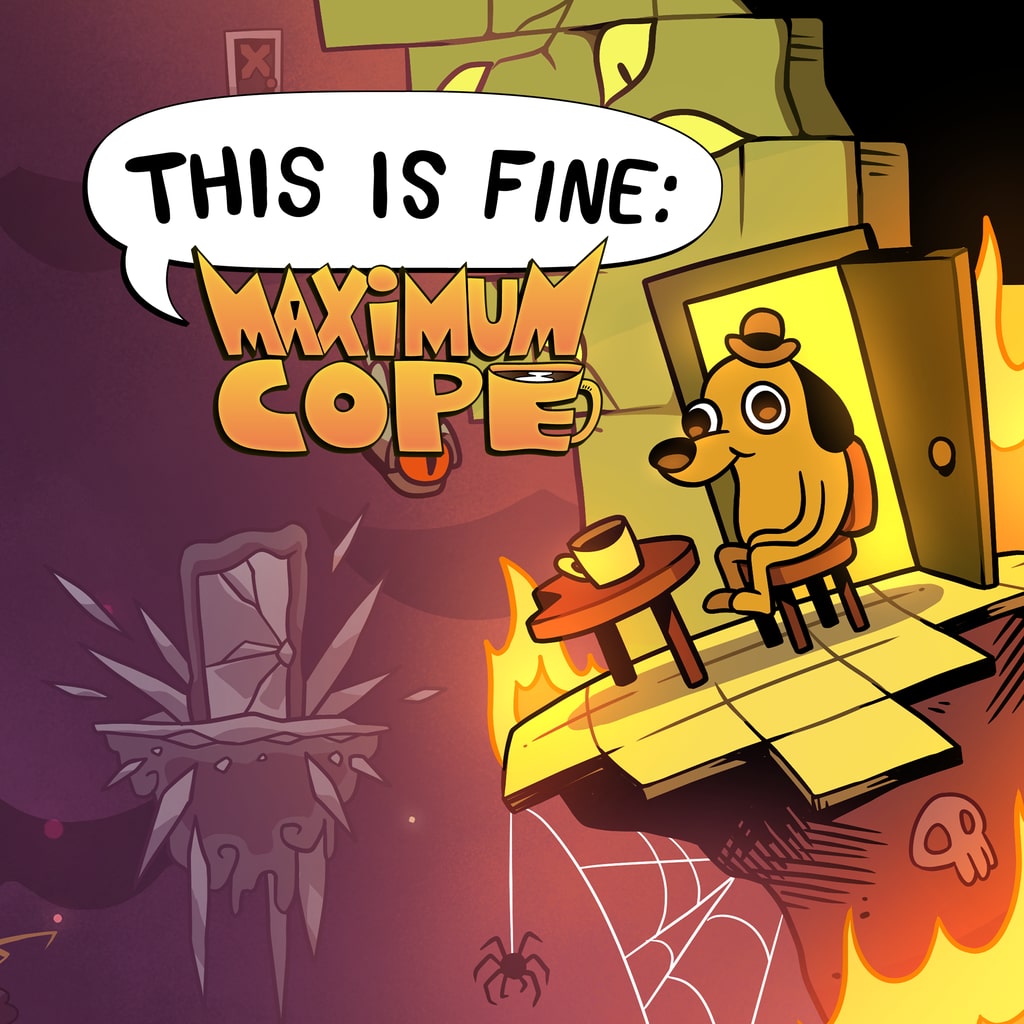
This Is Fine: Maximum Cope carries a strange burden from the outset. The “This is fine” meme is so widely recognised that it risks flattening anything built around it into a novelty. A quick laugh, a passing reference, then on to something else. Instead, this game lingers.
You play as Question Hound, the same polite, coffee-sipping dog, but here he is not merely sitting in a burning room. He is falling through it. The setting unfolds as a collapsing theme park built from his own anxieties, a place where humour and dread sit uncomfortably close. It is a clever reinterpretation. The meme becomes a starting point rather than the entire idea.
A Metroidvania Built on Emotional Geography
At a structural level, Maximum Cope follows familiar Metroidvania design. You explore interconnected areas, unlock abilities, revisit earlier zones, and gradually expand your reach. What sets it apart is how those areas are defined.
Instead of forests or caves, you move through concepts. Humiliation. Failure. Fear. Loss. Regret. Each is realised as a distinct environment with its own visual language and mechanical identity.
Humiliation might throw you into exaggerated social scenarios that turn hostile. Failure leans into collapsing platforms and missed timing. Regret circles back on itself, forcing repetition that feels deliberate.
This approach gives the game cohesion that goes beyond mechanics. You are not just unlocking new paths. You are navigating states of mind.
Movement That Feels Precise, Even When Everything Else Isn’t
For a game built on such abstract ideas, the moment-to-moment gameplay is surprisingly grounded. Movement is tight, responsive, and consistent. Jumps land where you expect them to. Dodges feel reliable. Attacks have a clear sense of timing.
That consistency is essential. The environments may be surreal, but the controls never are. It provides a stable foundation that lets the game explore more experimental ideas without becoming frustrating.
Combat sits comfortably alongside platforming. It is not overly complex, but it demands attention. Enemies often behave in ways that reflect the themes of their areas, adding a layer of personality without complicating the core mechanics.
Boss fights are where things come together. These encounters are larger, louder, and more chaotic, yet they still rely on the same fundamental skills. Learn the pattern, control your movement, manage your resources.
Coffee as Survival, Not Comfort
One of the game’s most distinctive systems is its use of coffee as both a healing and an energy resource. Coffee Beans are scattered throughout the world, and your cup acts as a limited resource that must be managed carefully.
It is a simple mechanic, but it fits neatly with the game’s themes. Coffee becomes a coping tool, something you rely on to push through difficult moments. Use it too freely, and you leave yourself vulnerable. Hold onto it for too long, and you risk unnecessary failure.
There is a quiet commentary here on how people manage stress. It is not heavy-handed, but it is present.
The system also adds a layer of decision-making to combat and exploration. Do you spend your coffee now to recover, or save it for what might be coming next?
A World That Feels Hand-Crafted and Unsettled
Visually, Maximum Cope stands out for its hand-animated style. Characters and environments have a fluidity that gives them personality, even when they are unsettling.
Enemies range from absurd to vaguely disturbing, including flying textbooks, warped household objects, and fragments of memory that refuse to stay still. Each design feels intentional, tied to the emotional theme of its area.
The theme park framing works particularly well. It allows the game to shift between bright, almost cheerful visuals and darker, more distorted imagery without feeling inconsistent. Everything exists under the same uneasy umbrella.
Sound design complements this tone. Music shifts between playful and tense, often within the same track. Sound effects are sharp and clear, reinforcing feedback during gameplay while also adding to the atmosphere.
Humour That Knows When to Step Back
Given its origins, it would have been easy for Maximum Cope to lean too heavily on humour. Instead, it uses it sparingly and effectively.
There are genuinely funny moments. Dialogue lands with dry wit, and visual gags play with expectation. But these moments rarely overstay their welcome.
More importantly, the game knows when not to joke. It allows quieter, more reflective moments to exist without undercutting them. That balance gives the experience emotional weight. The humour does not distract from the themes. It highlights them.
Where Familiarity Creeps In
For all its creativity, Maximum Cope does not entirely escape the limitations of its genre. Some aspects of its progression feel predictable, especially for players familiar with Metroidvanias.
Ability unlocks follow expected patterns. Backtracking, while purposeful, can occasionally feel like retracing steps rather than discovering something new. Certain enemy types recur in later sections.
None of these issues are severe, but they are noticeable. The game’s strongest moments stem from its thematic ideas, and when it leans too heavily on genre conventions, it loses some of that uniqueness.
An Experience That Stays With You
What lingers after finishing Maximum Cope is not a specific boss fight or platforming challenge. It is the feeling of having moved through something personal, even when it is presented through surreal imagery and absurd scenarios.
The game does not offer simple answers or clean resolutions. It does not tie everything together neatly. Instead, it leaves space for interpretation. That restraint is part of its strength.
Final Verdict
This Is Fine: Maximum Cope is a rare game that builds on a widely recognised idea and turns it into something meaningful. It combines tight, responsive gameplay with a surreal, emotionally driven world that feels distinct from most entries in the genre.
While it does not entirely avoid familiar Metroidvania structures, its thematic commitment and strong presentation elevate the experience to something memorable. It is funny, unsettling, and occasionally sincere in ways that feel earned rather than forced. This is fine. But also, it really isn’t.