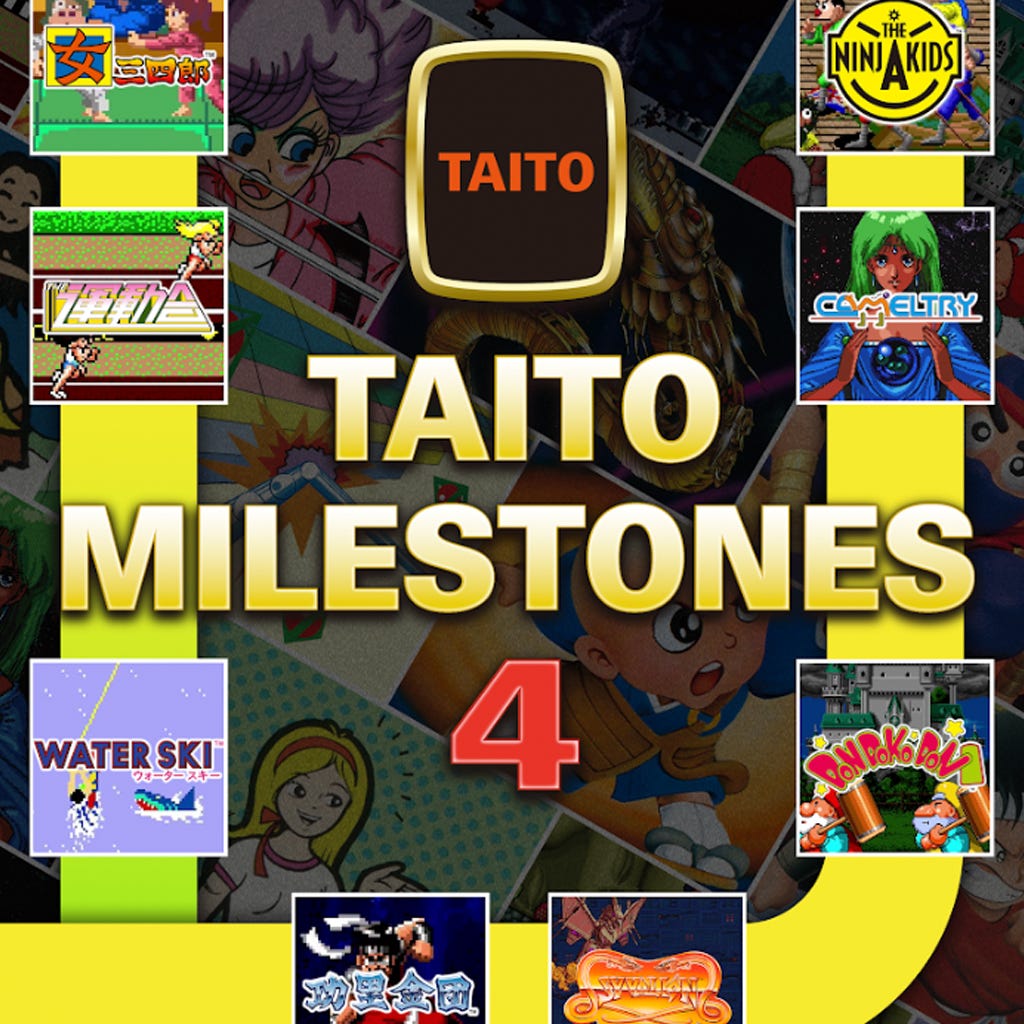
There’s something undeniably charming about stepping back into the neon-lit chaos of arcade history, and Taito Milestones 4 is perhaps one of the most eclectic entries in the series so far. Developed by Taito Corporation in collaboration with Hamster Corporation, this fourth volume doesn’t just revisit classics—it explores the more unusual, experimental corners of Taito’s catalogue.
Where previous collections relied heavily on familiar hits, Milestones 4 feels more like a curated museum exhibit. Yes, you see icons like Arkanoid, but you’re also introduced to curiosities like Cameltry and Syvalion—games that remain inventive today as they were decades ago.
The result is a collection that’s less about nostalgia alone and more about discovering new titles.
The Line-Up: A Mixed Bag in the Best Way
The ten titles included span a broad range of genres, from sports and fighting games to puzzles and shooters. It’s not the most immediately recognisable selection, but that adds to its appeal.
Let’s start with the headline act: Arkanoid. Even in 2026, it remains one of the most addictive games ever created. Its simple premise—bounce a ball, break blocks—belies a surprisingly deep skill ceiling. Precision, timing, and pattern recognition all come into play, and it’s easy to lose hours chasing high scores.
But Milestones 4 isn’t just relying on Arkanoid’s reputation. Cameltry, for example, stands out for entirely different reasons. Instead of moving a character, you rotate the entire maze to guide a ball to the exit. It’s a concept that feels almost ahead of its time in design, and it translates surprisingly well to the Switch’s controls.
Then there’s Syvalion, arguably the most ambitious title in the collection. You control a multi-segmented, dragon-like ship, navigating environments with a freedom rarely seen in arcade shooters of its period. Its branching storylines and multiple endings give it a sense of scale that still impresses.
Other highlights include the co-op chaos of The Ninja Kids, the whimsical platforming of Don Doko Don, and the yokai-infused action of Bonze Adventure.
Not every title is a hit, however. Early games like Water Ski and Field Day feel more like historical curiosities than genuinely engaging experiences. They’re interesting to sample, but unlikely to hold your attention for long.
Preservation Done Right (Mostly)
As with previous entries, Hamster’s involvement ensures that these games are preserved carefully. Emulation is reliable overall, with minimal input lag and authentic recreations of the original arcade experience.
Players can customise display settings, including screen filters and aspect ratios, enabling both sharp modern visuals and nostalgic CRT-style presentation. Save states are also included, a welcome feature for games that were originally designed to drain your coins.
However, the collection still lacks some of the extras that have become typical in other retro collections. There’s no detailed exploration of development history, no behind-the-scenes content, and only minimal background information about each game.
For a series that feels increasingly like a digital archive, this omission is evident.
Multiplayer Mayhem and Couch Co-Op
One of the biggest strengths of Taito Milestones 4 is its support for local multiplayer. Several titles—including The Ninja Kids and Field Day—allow multiple players to join in, recreating the social atmosphere of the arcade.
On the Nintendo Switch, this works particularly well. Passing a Joy-Con to a friend and jumping into hectic co-op sessions feels natural, giving some of the more average games a new lease of life.
However, the absence of online multiplayer is a missed opportunity. In an era where even retro collections embrace online play, its lack here feels outdated.
A Snapshot of Arcade Evolution
What makes Taito Milestones 4 particularly interesting is how clearly it demonstrates the evolution of arcade design.
Early titles like Water Ski are simple and straightforward, based around a single mechanic. By the late ’80s and early ’90s, games like Syvalion and Cameltry are exploring complex systems and unconventional controls.
It’s a reminder of how rapidly the medium developed during that period—and how willing developers were to take risks.
This sense of experimentation is perhaps the collection’s greatest strength. Even when a game doesn’t fully succeed, it’s almost always doing something intriguing.
Where It Falls Short
Despite its strengths, Taito Milestones 4 has its flaws.
The main issue is consistency. While the variety is impressive, the quality varies greatly between titles. For every Arkanoid or Cameltry, there’s a Field Day that feels more like a novelty.
Moreover, the absence of modern features—particularly online multiplayer and improved archival content—makes the package seem somewhat limited compared to rivals.
There’s also the matter of accessibility. Some of these games are unapologetically old-school, with steep difficulty curves and little guidance. Although this adds to their charm, it could put off newer players.
Performance on Switch
Technically, the collection performs well on Nintendo Switch. Load times are quick, controls are responsive, and there are no major performance issues to mention.
The games scale smoothly to modern displays, and the ability to switch between handheld and docked modes adds flexibility.
However, the absence of touch support—especially for games like Cameltry—feels like a missed opportunity given the platform.
Final Verdict
Taito Milestones 4 is a captivating, if inconsistent, collection that focuses more on preservation and discovery than pure nostalgia. It’s not the most polished retro compilation available, but it offers a distinctive insight into a creative and experimental phase of arcade history.
For dedicated fans of Taito Corporation, it’s an easy recommendation. For newcomers, it’s a mixed experience—requiring patience but offering rewards for curiosity.
While it may lack the blockbuster appeal of other retro collections, it possesses something arguably more precious: personality.