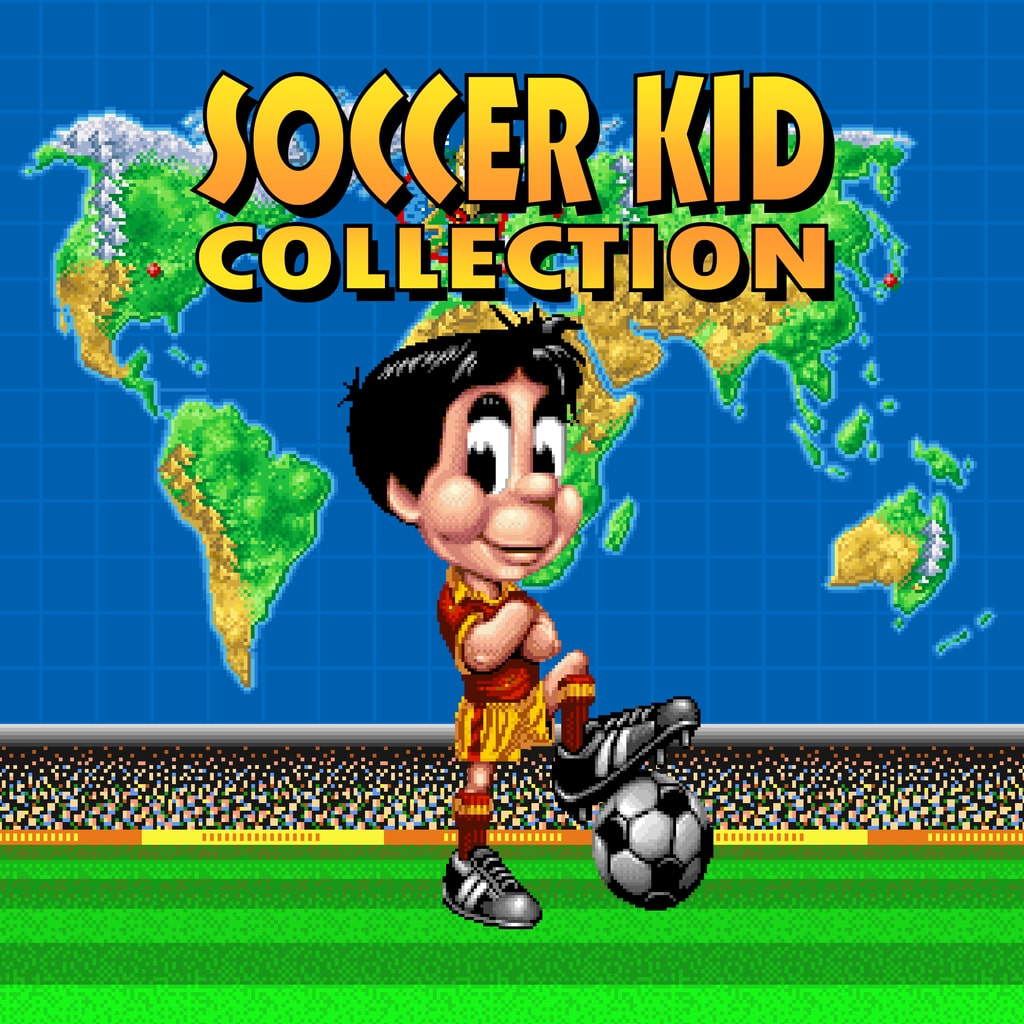
The 1990s saw a glut of mascot platformers. Every publisher seemed determined to create the next gaming icon, whether a hedgehog, a dragon, a gecko, or another cartoon creature destined for supermarket shelves and magazine covers. Soccer Kid took a different approach. Rather than relying on animal mascots or cartoon superheroes, it put an ordinary football-loving youngster centre stage and handed him a ball capable of saving the world.
Soccer Kid Collection brings this cult classic back to modern audiences through QUByte Interactive’s preservation-focused release. Rather than offering a massive anthology of every version ever created, the package focuses on two specific editions: the Super Nintendo release and the CD-based MS-DOS version. Some players may feel disappointed by the limited scope, particularly given the “Collection” title, but what remains is still a fascinating snapshot of a unique era in platforming history.
The premise is delightfully absurd. An alien collector has stolen and shattered the World Cup trophy, scattering its pieces across the globe. Naturally, the fate of international football rests on the shoulders of a young boy armed with little more than his ball skills. What follows is a globe-trotting adventure that feels equal parts platformer, puzzle game, and football exhibition.
Platforming Through the Beautiful Game
What immediately sets Soccer Kid apart from countless platformers of its generation is its core mechanic. Most games ask players to jump on enemies, swing weapons, or fire projectiles. Soccer Kid asks you to master a football.
Every action revolves around the ball. You dribble it across levels, kick it at enemies, bounce it off walls, juggle it into position, and use advanced tricks to navigate hazards. Even basic platforming becomes intertwined with ball control. Certain obstacles require precise headers, while others demand carefully timed volleys or bicycle kicks.
This creates a learning curve that remains surprisingly fresh even today. The ball behaves with a degree of independence, forcing players to think about positioning and momentum. It is not enough to simply move from left to right. You must constantly consider where the ball is, where it needs to go, and how to maintain control under pressure.
The result feels unlike almost anything else from the era. Even decades later, few platformers have attempted to merge sports mechanics with traditional level design in quite the same way.
Around the World in Search of Trophy Pieces
The adventure takes players across a variety of colourful international locations, each with its own distinct flavour. From bustling cityscapes to trains, deserts, forests, and industrial zones, the game consistently introduces new visual themes to maintain momentum.
One particularly interesting aspect of this collection is the differences between the included versions. The SNES release and the MS-DOS edition feature notable variations, including unique stages and environmental themes. This gives returning fans a reason to explore both versions rather than treating one as a simple alternative.
The MS-DOS edition also benefits from animated cutscenes and enhanced CD-quality audio. These additions lend extra personality and help sell the game’s quirky narrative. While neither version dramatically transforms the experience, the differences are meaningful enough to justify their inclusion.
Level design remains one of the game’s strongest qualities. Stages encourage exploration rather than simple completion. Hidden pathways, collectables, and secret areas reward curious players willing to venture off the beaten track.
The Collectathon Challenge
Beneath its platforming exterior, Soccer Kid is very much a collectathon. Each world contains hidden football cards essential for unlocking bonus stages and ultimately achieving the game’s true ending. Players who rush through levels, aiming only for the exit, may be disappointed when the story concludes prematurely.
This design philosophy feels distinctly old-school. Modern games often make progression straightforward and clearly signposted. Soccer Kid expects players to investigate every corner, revisit suspicious areas, and pay close attention to environmental details.
At times, this can be frustrating. Missing a single collectable may require replaying significant sections of a level. Yet there is also something undeniably satisfying about fully exploring each environment and uncovering secrets through observation rather than relying on map markers.
The collection preserves this design intact, for better and worse. Players seeking a pure nostalgia trip will appreciate the authenticity, while newcomers may occasionally find the requirements a little unforgiving.
Preservation Done Right
One area where Soccer Kid Collection genuinely shines is its presentation as a historical package. QUByte has gone beyond simply loading old ROM files into an emulator. The collection includes a virtual museum packed with supplementary material, including original manuals, box art, historical information, and additional development insights. These extras provide valuable context for players unfamiliar with the game’s origins.
The inclusion of CRT filters, aspect ratio adjustments, and save states further enhances accessibility. Being able to customise the visual presentation helps recreate the feel of playing on original hardware while still providing modern conveniences.
Save states are particularly welcome given the game’s occasionally punishing difficulty. Certain sections require precise platforming and exact ball control, which can prove challenging even for experienced players.
There is, however, one odd omission. The rewind feature is available only in the SNES version. Since both games benefit equally from quality-of-life improvements, the absence of rewind functionality in the MS-DOS release feels like a strange and unnecessary inconsistency.
When Age Starts to Show
For all its creativity, Soccer Kid undeniably shows its age. The controls, while innovative, can feel stiff by modern standards. Ball physics remain central to the experience, but they occasionally tip from challenging to awkward. Precise manoeuvres require careful directional inputs, and some actions never feel as responsive as players might hope.
This issue is particularly noticeable when using modern analogue sticks. The game was originally designed around digital directional inputs, and that heritage is sometimes impossible to ignore. Certain tricks that once felt natural can become frustratingly inconsistent.
Difficulty balancing also reflects a different era of game design. Some challenges demand repetition and memorisation rather than pure skill. While save states soften the blow considerably, there are moments when frustration threatens to outweigh enjoyment.
Thankfully, the game’s creativity and charm often compensate for these rough edges. The unusual mechanics remain engaging enough to carry players through occasional moments of irritation.
A Piece of Platforming History
What ultimately makes Soccer Kid Collection worthwhile is not perfection. It is preservation. This is a chance to revisit a genuinely distinctive platformer from an era overflowing with experimentation. The concept remains unusual, the presentation remains charming, and the football-based gameplay still stands out from almost everything else in the genre.
Not every aspect has aged gracefully. The controls can feel stubborn, the difficulty occasionally borders on aggravating, and the collection’s limited scope may disappoint those hoping for every historical version. Yet none of these issues diminish the importance of preserving a game that dared to try something different.
Soccer Kid may never have achieved the mainstream success of some of its contemporaries, but it remains an inventive, memorable piece of gaming history.
Final Verdict
Soccer Kid Collection is less a celebration of a forgotten masterpiece and more a loving preservation of a fascinating cult classic. Its football-focused mechanics remain inventive, its world-spanning adventure retains plenty of charm, and the museum features add genuine value for retro enthusiasts.
The package is not without shortcomings. The controls can feel dated, some quality-of-life features are unevenly implemented, and the limited selection of included versions prevents the collection from feeling truly comprehensive. Yet the game’s creativity continues to shine through decades later.
For retro platforming fans, gaming historians, and players curious about one of the strangest mascots of the 16-bit era, Soccer Kid Collection offers a rewarding journey back in time. It may not lift the trophy quite as confidently as it once hoped, but it still deserves a place on the squad sheet.