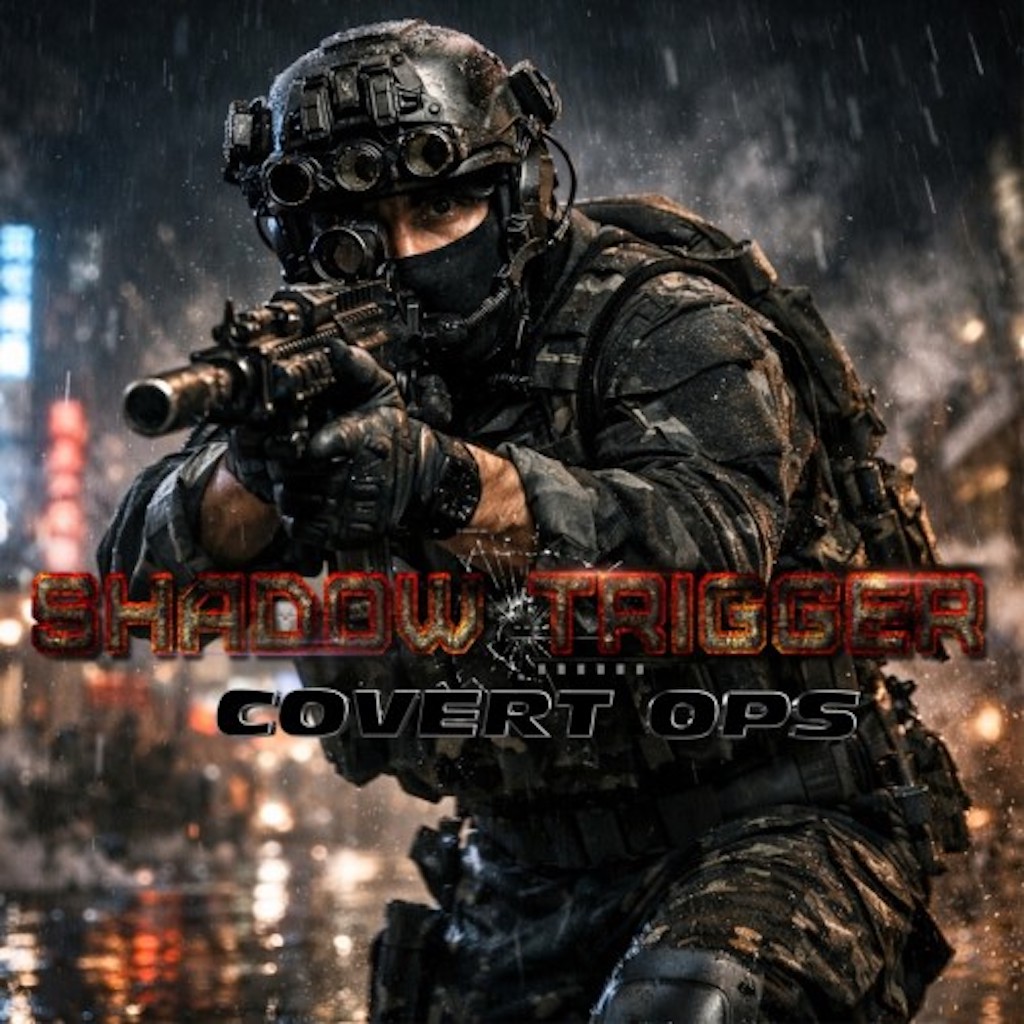
Military shooters have spent years chasing authenticity. Some lean into spectacle, others into simulation, but only a handful manage to balance chaos with human tension. Tales of Shadow Trigger: Covert Ops clearly wants to sit somewhere in the middle. It presents itself as a grounded tactical first-person shooter wrapped in modern visuals, political conspiracy, and covert warfare.
The setup certainly sounds promising. A failed operation in the fictional Middle Eastern nation of Al-Sarat leaves an elite unit stranded after a carefully orchestrated ambush destroys a Black Hawk formation. Official channels freeze, politics take priority, and one operator is sent into hostile territory to recover survivors and uncover the truth. It is a familiar blueprint, yet one delivered with enough sincerity to initially pull you in.
The opening hours carry genuine urgency. Sandstorms roll across shattered streets, tracer fire cuts through smoke-filled alleys, and abandoned buildings become improvised battlegrounds. The game immediately establishes its atmosphere well, even if it occasionally struggles to rise above genre conventions.
The Weight of the Battlefield
Visually, Shadow Trigger often impresses. Desert environments have a convincing sense of scale, particularly in open-canyon sections where dust storms reduce visibility and create moments of tension. Urban districts feel scarred by years of conflict, with collapsed buildings, improvised barricades, and burned vehicles reinforcing the sense of a city abandoned to war.
Lighting also deserves praise. Night missions lit only by flashlights, weapon optics, and distant fires create some of the strongest moments in the campaign. There are sections where you creep through silent compounds in moonlight, hearing distant gunfire echo through empty streets, and the game genuinely captures the loneliness of covert operations.
Explosions also carry satisfying impact. Shockwaves ripple through debris while smoke lingers across battlefields longer than expected. The presentation occasionally slips into animation stiffness and inconsistent facial work during narrative scenes, but moment-to-moment gameplay remains visually strong throughout.
Tactical Freedom with Familiar Edges
Gameplay centres on mission freedom. Players can approach objectives through stealth, long-range sniping, or direct assault, and to the game’s credit, it usually supports those choices reasonably well.
Silent infiltrations work best. Moving through enemy compounds in darkness, marking targets, and carefully planning engagements create the strongest tension. Sniper rifles feel weighty and rewarding, while suppressed weapons reinforce the fantasy of operating behind enemy lines.
The arsenal itself is respectable. Assault rifles, submachine guns, anti-tank launchers, and precision weapons all handle differently enough to encourage experimentation. Switching loadouts between missions adds welcome flexibility.
Combat remains responsive throughout. Shooting feels tight, movement is smooth, and encounters rarely descend into chaos despite larger enemy numbers.
Unfortunately, enemy intelligence does not always keep pace. Opponents can be surprisingly sharp one moment and utterly oblivious the next. Some firefights feel genuinely tactical, while others devolve into enemies funneling through doorways or exposing themselves unnecessarily. This inconsistency weakens the immersion the game works hard to establish.
A Story Lost Between Ambition and Familiarity
The narrative strives to build a layered geopolitical thriller. Proxy wars, intelligence failures, criminal networks, regional powers, and hidden betrayals swirl beneath the surface. The central mystery, involving the ambush and the hunt for the traitor, provides enough momentum to carry the campaign forward.
The issue is not ambition. It is execution. Characters rarely develop beyond military archetypes. Squad mates receive moments intended to humanise them, but most arrive too late or pass too quickly to leave a lasting impact. The protagonist remains particularly thin, functioning more as a player vessel than an actual character. This becomes frustrating because the setting occasionally hints at something deeper.
Al-Sarat itself feels like a place shaped by conflict rather than merely built as a battlefield. Environmental storytelling does heavy lifting through abandoned homes, propaganda broadcasts, and civilian spaces caught in the crossfire. Those details create emotional texture that the script sometimes struggles to match. There are flashes of stronger writing beneath the surface. The game simply never explores them enough.
Mission Variety Keeps Momentum Alive
Where Shadow Trigger succeeds most consistently is in mission pacing. Rather than repeating identical combat arenas, the campaign moves between infiltration assignments, rescue operations, defensive holds, urban escapes, and large-scale assaults. This variation prevents fatigue from setting in.
One standout mission sees players navigating a partially destroyed forward operating base under cover of darkness as communications collapse around them. Another places you in tight city streets during a desperate extraction attempt as hostile forces close in from every direction. These moments work because they understand rhythm. Quiet tension gives way to sudden violence before settling back into uneasy silence. The game is at its best when it slows down and lets the atmosphere breathe.
Not every mission reaches that level. Some mid-campaign objectives rely too heavily on wave-based encounters, and repetition occasionally creeps in during longer firefights. Still, the structure generally keeps things moving.
Competent, But Rarely Surprising
The biggest challenge facing Tales of Shadow Trigger: Covert Ops is not quality. It is identity. The game is competent across most categories. Gunplay works. Visuals impress. Mission design remains varied. Atmosphere frequently lands. Yet it rarely produces moments that feel uniquely its own.
Veterans of tactical shooters will recognise familiar DNA everywhere. Echoes of older military campaigns, modern stealth design, and blockbuster FPS pacing all sit within its structure. The game borrows effectively, but rarely evolves those ideas. That leaves it occupying an awkward middle ground. It is better than many lower-budget military shooters, yet never reaches the heights it clearly aims for.
Final Verdict
Tales of Shadow Trigger: Covert Ops delivers a solid tactical shooter experience, wrapped in impressive visuals and a respectable range of missions. Its strongest moments come during slower infiltration sequences, when atmosphere, tension, and environmental storytelling align.
The combat is satisfying, the setting feels convincing, and mission freedom gives players room to approach objectives creatively. However, inconsistent enemy behaviour and a narrative that never fully capitalises on its themes prevent the game from reaching greater heights. There is passion here. You can feel it in the environmental detail, in the mission structure, and in the effort to create meaningful battlefield tension. It simply needed sharper writing and a stronger identity to truly stand out. For fans of military shooters seeking a focused tactical campaign, there is enough here to enjoy. Just do not expect it to redefine the genre.