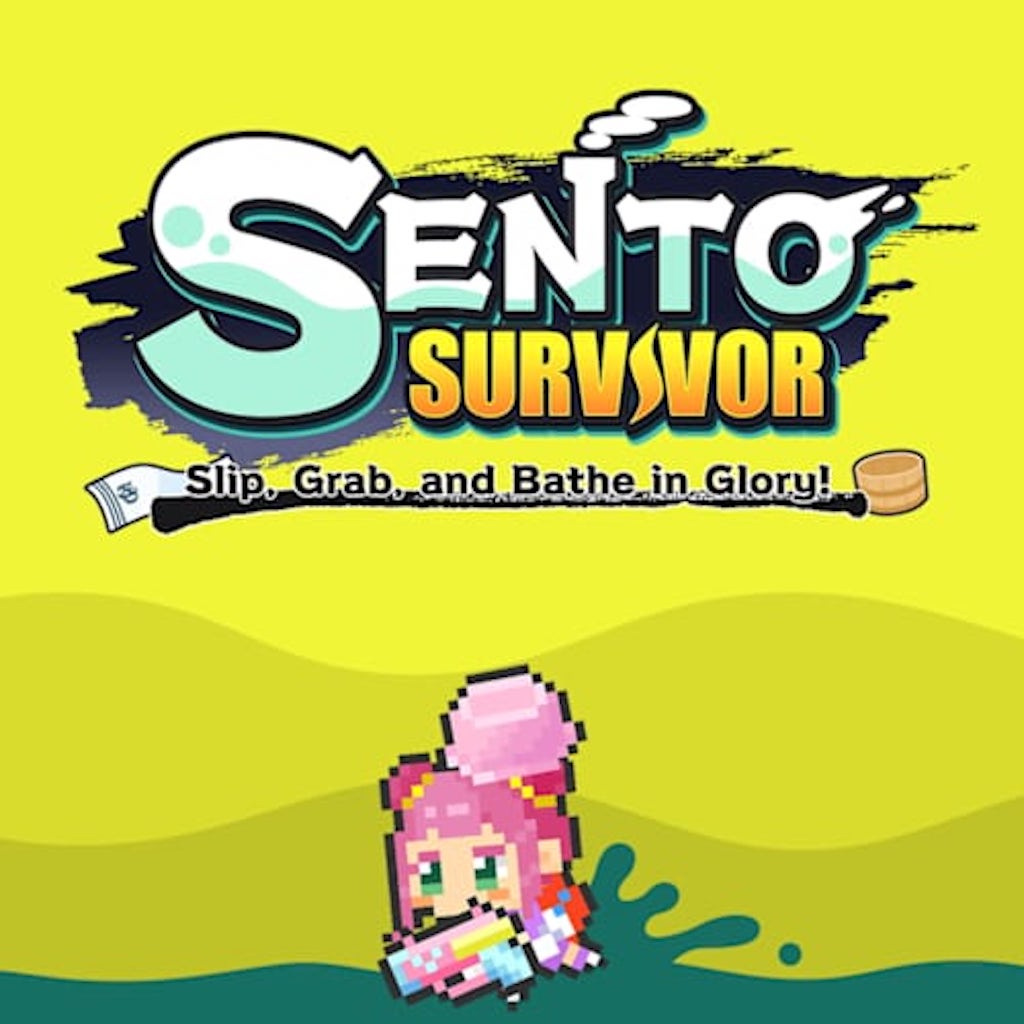
Forget everything you thought you knew about Japanese public bathhouses. Yes, there are showers, hot baths and an unmistakable sense of relaxation, but SENTO SURVIVOR: Slip, Grab, and Bathe in Glory! has decided that what the traditional sento really needs is a few water guns, slippery floors, giant rubber ducks and a group of people desperate to be the first into the bath. Naturally, things get far less peaceful from there.
The result is one of those wonderfully ridiculous arcade games that makes perfect sense within about thirty seconds of picking up the controller. You slide around the wet floor, fire water at your rivals, grab powerful weapons and try not to send yourself careering helplessly into a wall. It is silly, colourful and gloriously chaotic, but beneath the absurdity lies a surprisingly enjoyable combat system that rewards players who learn to control their momentum.
And despite the word “Survivor” in the title, this isn’t another auto-shooting roguelike in the mould of Vampire Survivors. Instead, this is much closer to a classic arcade arena brawler, with a substantial single-player campaign and local multiplayer designed to turn your living room into a battlefield. If you have a few friends or family members nearby, the potential for complete mayhem is enormous.
The Grand Sento First Bath Festival
The story doesn’t waste time explaining why everyone is shooting each other with water guns in a bathhouse. Once every four years, the Grand Sento First Bath Festival brings together Sento Masters from across Japan to compete for the sacred honour of Ichibanfuro, or First Bath.
There is apparently tremendous prestige in being the first to step into the bath, which means pride, tradition and several litres of ammunition are about to collide. It is wonderfully daft, and the game knows it. Rather than trying to make the premise sound more serious than it is, SENTO SURVIVOR embraces the ridiculousness and turns it into part of its charm.
There is something refreshingly self-aware about a game that knows it is being silly. The whole thing feels like somebody asked, “What if a Japanese bathhouse became an arena?” and everyone involved simply replied, “Absolutely.” That enthusiasm carries through the characters, stages, weapons and wonderfully bizarre situations you find yourself in.
Slippery When Wet
The first thing to understand is that movement is not normal. The floors are wet, extremely slippery, and seem determined to send you flying in directions you never intended to go.
At first, this can feel downright awkward. You push the stick in one direction, and your character keeps gliding as though the floor were covered in ice rather than a perfectly reasonable amount of bathwater. Your first few encounters can therefore involve an awful lot of accidental collisions, missed attacks, and moments when you find yourself sliding majestically past the opponent you were trying to shoot.
Then something clicks. Once you begin to understand the momentum, the slippery movement becomes the game’s greatest strength. Positioning becomes more important than simply pointing and shooting, and you start thinking about where you’ll be after the attack rather than where you are when you press the button. Suddenly, that ridiculous sliding isn’t fighting against you anymore. It becomes a weapon.
Water Guns At Dawn
Naturally, no sento battle would be complete without water guns, and SENTO SURVIVOR gives you four distinct types to experiment with. The Aqua Shot is the dependable all-rounder, offering balanced performance and a quick reload. It is the sort of weapon you can pick up immediately and feel comfortable using.
The Aqua Burst takes a completely different approach, firing a wide spread that is particularly useful when enemies are nearby. The Aqua Lancer is the precision option, offering impressive range and power, while the Aqua Storm lets you unleash a relentless stream of shots. Each weapon has a clear personality, and choosing the right one can make a surprising difference.
The important thing is that there isn’t necessarily one weapon that works everywhere. Different stages encourage different approaches, and experimenting with the weapons alongside the four playable characters gives the combat more depth than the deliberately silly premise might suggest.
Four Masters Enter The Bath
The character selection is equally straightforward and effective. Asahi is your balanced fighter, offering strong offensive and defensive abilities without leaning too heavily in either direction. Rei is built around acceleration, making her particularly useful if you want to chase down opponents and take advantage of slippery arenas.
Teppei is the heavyweight of the group, relying on toughness to absorb punishment and overpower his rivals. Yuzuki, meanwhile, focuses on speed and agility, allowing her to dart around the arena and keep enemies guessing.
The differences aren’t merely cosmetic, either. Changing character can genuinely alter how you approach a stage, particularly when combined with your chosen water gun. A level that feels awkward with one character can suddenly become considerably more manageable with another.
Thirty Six Ways To Get Wet
The single-player campaign is considerably more substantial than I initially expected. There are 36 stages across six areas inspired by different parts of Japan, each culminating in a boss.
That is a healthy amount of content for what could easily have been a game designed primarily around multiplayer. More importantly, the stages aren’t simply repeated variations of the same arena. Their layouts, sizes and gimmicks vary, forcing you to adjust your strategy rather than relying on one approach throughout the campaign.
That variety helps keep things interesting. You might enter one stage thinking you’ve finally mastered the movement, only for the game to introduce a new obstacle that completely changes how you need to navigate the arena. It is a clever way of keeping the slippery physics fresh.
The Bathhouse Is Trying To Kill You
The stage gimmicks are where SENTO SURVIVOR really starts showing its sense of humour. Jet showers can suddenly erupt from the floor, enormous rubber ducks can become part of the battlefield, and all manner of other strange hazards can turn an otherwise straightforward fight into complete chaos.
Some of these situations are genuinely funny because they can disrupt everyone at once. You can have a perfectly sensible plan in place, only for some ridiculous bathhouse contraption to send you or your opponent flying across the room. It creates the kind of unpredictable moments that are particularly entertaining when several people are playing together.
And no, I don’t have an answer for why a giant rubber duck belongs in the middle of a deadly water-gun competition. Frankly, I’m not sure we need one.
Grab The Good Stuff
Special Weapons provide another reason to keep moving around the arena. Powerful weapons can appear during battles, and naturally everyone wants to get their hands on them.
This creates wonderfully frantic moments because grabbing the weapon is only half the battle. If another player gets there first, you suddenly have a much bigger problem on your hands. Taking them down and stealing the weapon for yourself creates a satisfying little reversal that can completely change the flow of a match.
It also encourages aggression. Sitting in a corner and hoping everyone else eliminates each other isn’t necessarily the best approach when the most powerful equipment is sitting in the middle of the arena. Sometimes you simply have to take the plunge and hope your slippery feet don’t betray you.
Thirty Six Stages, Three Challenges Each
Simply completing a stage is only the beginning. Each stage includes three additional challenges, giving players who enjoy mastering arcade games a reason to return.
This is important because the basic campaign could otherwise become relatively straightforward once you’ve learned the movement and weapon systems. The challenges encourage you to approach familiar stages differently, experiment with characters and weapons, and improve your overall performance.
It also gives the game a clear distinction between completion and mastery. You can play through the campaign at your own pace, or you can start chasing every challenge and try to squeeze everything possible out of each stage. That additional layer gives the single-player experience considerably more longevity.
The Revenge Factor
There is also something particularly satisfying about getting revenge. When another player has just ruined your carefully planned attack or stolen the Special Weapon you were desperately trying to reach, you naturally want to return the favour.
The game’s scoring systems encourage that competitive mentality. Battles can quickly become personal, particularly when you’re playing with people sitting next to you. Someone who was comfortably winning five minutes ago can suddenly find themselves being hunted around the bathhouse by everyone else.
That is exactly the sort of thing local multiplayer arcade games are supposed to create. It isn’t necessarily about serious competition. It is about laughing when someone slips into a wall, shouting when someone steals the weapon you wanted, and immediately demanding a rematch when you lose.
Couch Multiplayer At Its Best
Up to four players can join the madness locally, and this is undoubtedly where SENTO SURVIVOR feels most comfortable. There is something wonderfully old-school about sitting in the same room with several controllers and watching a perfectly ordinary evening descend into water-gun warfare.
The local multiplayer works because the game’s unpredictability gives everyone a chance to cause trouble. Even if one player is technically better than the others, a well-timed attack, environmental hazard, or unfortunate slide can completely change the result.
The major limitation is equally obvious. There is no online matchmaking, so the game’s multiplayer appeal depends heavily on having other people physically available to play. That won’t bother players who enjoy traditional couch multiplayer, but it does mean the experience isn’t quite as convenient as modern online-focused games.
Learning To Love The Slide
The biggest hurdle is undoubtedly the movement. SENTO SURVIVOR asks you to abandon the expectation that your character will stop when you stop moving, and that takes time to learn.
Early matches can be messy. You will overshoot opponents, crash into obstacles, and occasionally send yourself flying in a direction that makes no tactical sense. The game can feel more frustrating than fun until you begin to understand how momentum works.
Once it clicks, however, there is real satisfaction in mastering it. You begin to use the slippery floors deliberately, building up momentum before an attack and anticipating where your character will end up afterwards. What initially feels like an awkward control system gradually becomes the defining mechanic.
The Joy Of Something Completely Bonkers
There is much to be said for games that simply embrace the ridiculous. SENTO SURVIVOR doesn’t need an enormous cinematic story or a complicated progression system to justify itself. Its appeal lies in the immediate fun of sliding around bathhouses, blasting friends with water guns and watching plans collapse spectacularly.
The presentation reinforces that personality without getting in the way of the action. Everything feels colourful and playful, and the Japanese bathhouse setting gives the game a distinctive identity that sets it apart from the sea of generic arena shooters.
It isn’t trying to be the next major competitive multiplayer phenomenon. It feels much more like the sort of game you pull out when friends come round and everyone wants something that can be understood within minutes. That is not a weakness. In this case, it is very much the point.
Final Verdict
SENTO SURVIVOR: Slip, Grab, and Bathe in Glory! is gloriously silly arcade fun, with a surprisingly clever movement system beneath all the water-gun chaos. The slippery floors initially feel like an obstacle, but once you learn to control your momentum, they become one of the game’s most enjoyable mechanics. Combined with four distinct characters, four water guns, Special Weapons, and a huge collection of stage gimmicks, there is considerably more here than the wonderfully ridiculous premise might suggest.
The 36-stage single-player campaign is a particular strength. It gives the game something substantial to sink your teeth into before you even consider multiplayer, while the three challenges attached to every stage provide a reason to return and improve. The six areas and their different layouts keep the campaign from becoming too repetitive, although some encounters can still descend into button-mashing when the screen gets crowded.
Where SENTO SURVIVOR truly comes alive, though, is with friends sitting beside you. Four-player local multiplayer turns the game into exactly the sort of chaotic party experience that can produce genuine laughter, arguments, and immediate demands for another round. The absence of online matchmaking limits its accessibility, but for traditional couch multiplayer, this is an absolute blast.
It may not be the deepest arcade game you’ll ever play, and the controls take a little patience before they begin to feel natural. But once you’ve learned to embrace the slide, grabbed a water gun, and sent your first rival skidding helplessly across the bathhouse, it’s hard not to grin.