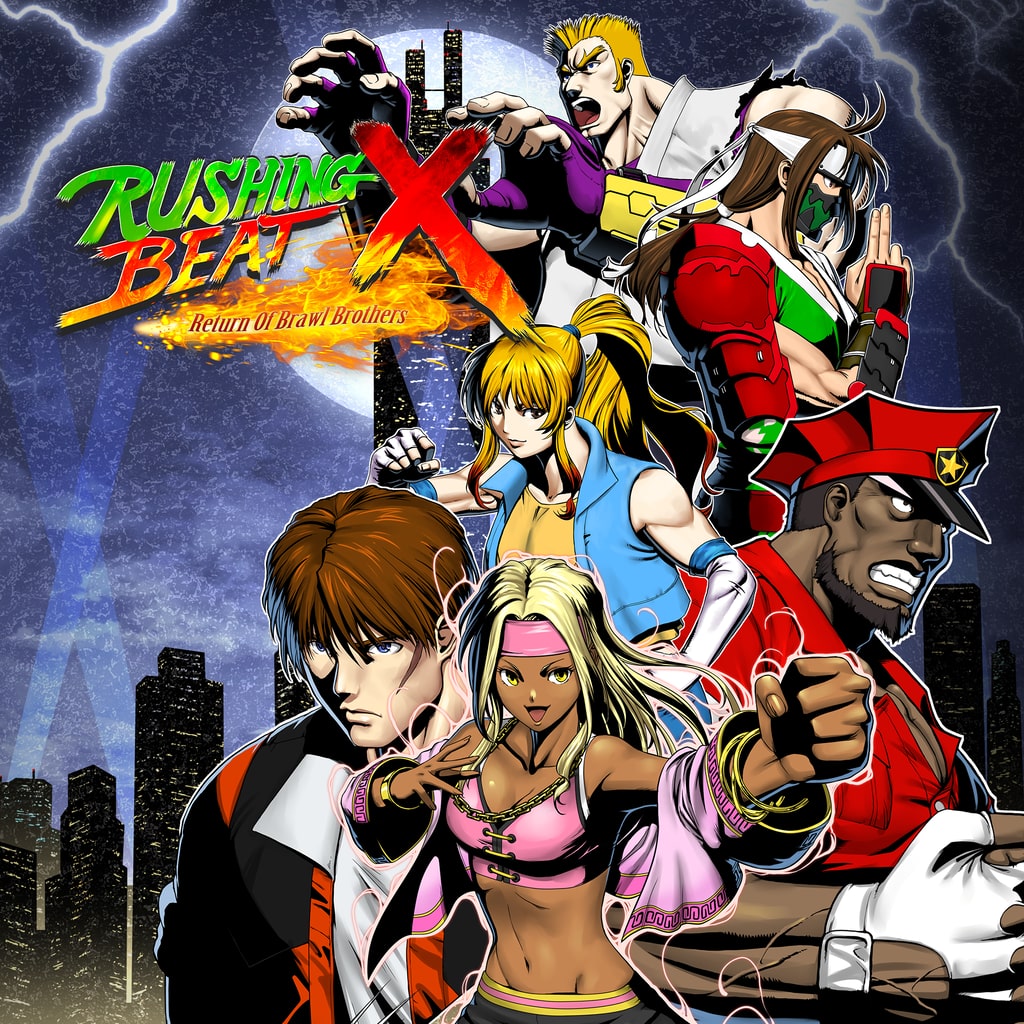
There’s a fine line between revival and resurrection, especially with classic beat ’em ups. Too much nostalgia, and you risk becoming irrelevant. Too much modernisation, and you lose the soul that made the originals memorable. RUSHING BEAT X: Return Of Brawl Brothers, developed by City Connection, walks that line with impressive confidence.
Positioned as the long-awaited sequel—and narrative link—between the games Western audiences knew as Rival Turf!, Brawl Brothers, and The Peace Keepers, this modern entry does more than just revisit the past. It aims to unify it, refine it, and carry it into a genre that has quietly evolved over the years.
The result is a game that feels both familiar and surprisingly nuanced.
A Return to the Streets of Chaos
Set within the gritty, neon-lit cityscape of Neo-Cisco, RUSHING BEAT X wastes little time getting straight to the point: something’s wrong, the Zeekus virus is spreading, and fists are the quickest way to uncover the truth.
The story isn’t particularly deep, but it’s more cohesive than its predecessors—especially thanks to the effort to unify the previously fragmented Western and Japanese narratives. Characters like Rick Norton and Douglas Bild return with a sense of continuity that long-time fans will appreciate, even if newcomers might find the lore a tad thin.
But narrative has never been the core of this genre. What matters is how it feels to fight your way through it.
And here, RUSHING BEAT X delivers.
Combat That Balances Old and New
At first glance, the combat system seems simple. Punches, kicks, grabs, throws—it’s all here, just as you’d expect. But beneath that simplicity lies a system that quietly encourages experimentation.
The addition of an auto-combo system makes the game immediately accessible. New players can jump in and create satisfying attack chains without needing to memorise complex inputs. It’s a clever feature that lowers the entry barrier without diminishing the experience.
For more experienced players, the cancel system is where things become intriguing. The ability to interrupt actions with dashes or jumps introduces a layer of depth that classic beat ’em ups rarely explored. Combos can be extended, attacks repositioned, and defensive options embedded into offensive sequences.
It’s not quite fighting game-level complexity, but it’s enough to reward skill and creativity.
The Rage Gauge adds another dimension. As you deal and take damage, the gauge fills, eventually triggering Rage Burst—a temporary state of heightened power. At its peak, you can unleash “Beat Rush”, a punishing finisher that feels suitably impactful.
It’s a familiar mechanic, but well-integrated. It promotes aggressive play without feeling overpowered, and it adds a sense of escalation to each encounter.
Environments That Encourage Interaction
The nine stages of RUSHING BEAT X cover the expected locations—shopping centres, subways, slums, laboratories—but they’re more interactive than you might expect.
Enemies can be thrown not just at each other but into the background, breaking objects and revealing items that would otherwise be out of reach. It’s a small detail, but it adds a layer of spatial awareness to combat.
Weapons are scattered throughout levels, providing temporary advantages and encouraging you to adapt your strategy. Paired with the cancel system, this creates a combat flow that feels more dynamic than the genre’s traditional “move forward and punch” approach.
Side missions also bring variety, breaking up the linear progression with optional challenges that reward exploration and replayability.
Co-op: Where It Truly Shines
Like any great beat ’em up, RUSHING BEAT X is best enjoyed with a second player.
The two-player co-op mode transforms the game. Coordinated attacks, shared resources, and the occasional accidental friendly throw create a rhythm that solo play simply cannot replicate.
There’s a satisfying sense of teamwork in handling crowds, juggling enemies, and timing Rage abilities together. It captures that classic arcade feeling—two players against the world, driven by momentum and mutual chaos.
Solo play remains enjoyable, but it lacks the same vibrancy. The game is clearly designed with co-op in mind, and it’s where its systems feel most complete.
Food, Strategy, and Small Innovations
One of the more unexpected additions is the food system. At checkpoints—presented as a “Tuff E Nuff” food truck—you can combine items into meals that offer enhanced healing and bonuses.
It’s a quirky mechanic, but a welcome one. It adds a small layer of strategy between stages, allowing you to prepare for upcoming challenges rather than relying solely on reflexes.
You can also carry food with you, introducing a light resource management element that complements the otherwise straightforward progression.
It’s not revolutionary, but it is characteristic of the game’s approach: small, thoughtful additions that expand the formula without overwhelming it.
Presentation: Retro Roots, Modern Touches
Visually, RUSHING BEAT X balances retro inspiration with modern clarity. Character designs keep that chunky, exaggerated style of 16-bit brawlers, while animations and effects bring them into the present.
Hits feel impactful, with satisfying feedback that reinforces every punch and throw. Environments are detailed enough to feel alive without distracting from the action.
The soundtrack features energetic, driving tracks that match the pacing, though it doesn’t quite reach the iconic status of genre classics.
Performance across platforms is smooth, and the game rarely encounters technical issues—a key aspect for a genre that relies on responsiveness.
Where It Stumbles
Although RUSHING BEAT X has its strengths, it also has flaws.
Enemy variety, while satisfactory, starts to feel repetitive over time. You encounter different versions of familiar archetypes more often than entirely new threats, which can make later levels seem less fresh.
The difficulty curve can also be inconsistent. Some sections suddenly become harder, especially when enemy numbers and aggression increase at the same time.
Although the combat system has depth, the game doesn’t always motivate you to explore it fully. It’s possible to rely on simpler strategies and still succeed, which might result in more advanced mechanics being underused.
A Revival Done Right
What RUSHING BEAT X: Return Of Brawl Brothers ultimately achieves is something deceptively challenging: it honours its origins while making just enough changes to feel current.
It doesn’t attempt to reinvent the genre. It refines it. It layers complexity without losing immediacy, depth without sacrificing accessibility.
And perhaps most importantly, it understands what makes beat ’em ups enjoyable — not just the combat, but the rhythm, the momentum, and the shared experience.
Final Verdict
RUSHING BEAT X: Return Of Brawl Brothers is a confident and well-executed revival that revives a classic series with style and substance. Its mix of accessible mechanics and deeper combat systems makes it appealing to both newcomers and veterans, while its co-op mode captures the spirit of the genre at its best.
It’s not without its flaws—repetition and uneven pacing prevent it from reaching true greatness—but it serves as a strong reminder of why beat ’em ups continue to endure.
For fans of classic brawlers, it’s an easy recommendation. For everyone else, it offers a welcoming entry point into a genre that still has plenty of fight left in it.