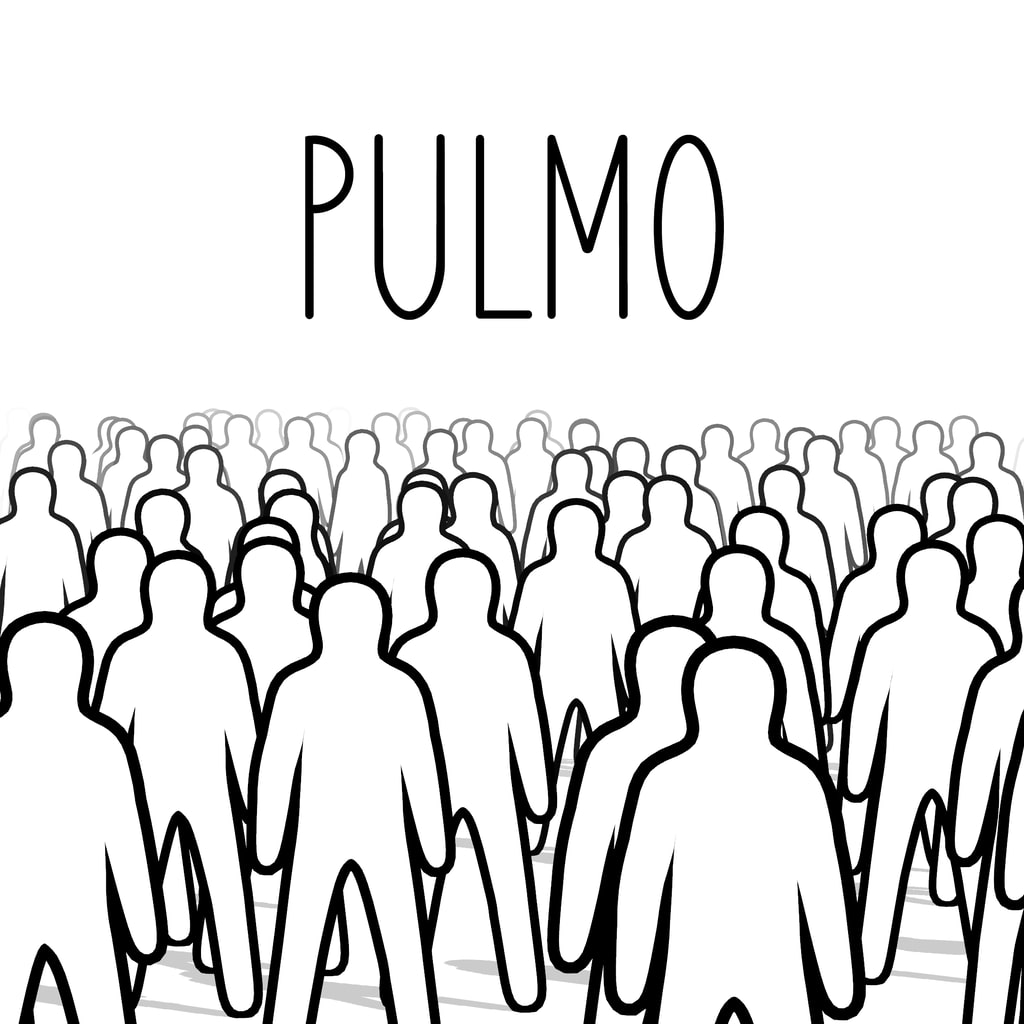
There are games that test your reflexes, games that challenge your strategy, and then there are games like PULMO—creative works that drift into something more contemplative, more abstract, and perhaps more divisive. Positioned as the ideological successor to ALVEOLE and the second part of a broader trilogy about the human journey, PULMO cares less about traditional gameplay satisfaction and more about mood, metaphor, and introspection.
This is not a game you “beat.” It’s one you experience.
A World That Watches You Back
At first glance, PULMO appears as a minimalist puzzle-adventure. You guide a lone wanderer through various environments filled with silent crowds, manipulating the world to influence their behaviour and advance. However, even in its opening moments, it’s clear this isn’t a typical puzzle game.
The crowds aren’t static obstacles or simple AI— they’re reactive, unpredictable, and can seem hauntingly autonomous. They act according to their own logic, responding to your actions in ways that might be helpful, obstructive, or completely indifferent. There’s no clear moral good or evil. They simply are.
This creates a compelling tension. You are both participant and observer, pushing the environment and witnessing how ripples of consequence spread through the crowd. Sometimes your actions bring harmony; other times, they cause confusion or chaos. The game rarely clarifies these outcomes, leaving you to interpret their significance.
It’s a subtle yet powerful design choice—one that highlights the game’s core themes of agency, solitude, and the boundaries of control.
Puzzles Without Pressure
Mechanically, PULMO focuses on spatial puzzles. You manipulate elements of the environment—platforms, pathways, barriers—to guide both yourself and the surrounding crowd towards specific outcomes. Each puzzle introduces a new idea or twist, ensuring that the experience remains diverse despite its limited scope.
What’s striking is the absence of traditional failure states. There are no timers, no score counters, no explicit penalties for mistakes. If a solution doesn’t work, you simply try something else. This lack of pressure fundamentally changes your approach to the game.
Instead of rushing to optimise, you’re encouraged to observe. To experiment. To consider the consequences of your actions. It’s a slower, more deliberate pace—one that won’t appeal to everyone, but feels entirely suited to the experience PULMO aims to create.
That said, the effectiveness of the puzzles varies. Some are genuinely thought-provoking, requiring careful consideration of how your actions will influence the crowd. Others feel more opaque, with solutions that can seem arbitrary or unclear. Without explicit feedback, it’s not always obvious whether you’re on the right track or simply missing a key insight.
Aesthetic Minimalism, Emotional Weight
Visually, PULMO is striking in its restraint. The combination of 3D environments and minimalistic, hand-drawn elements creates a world that feels both tangible and abstract—like a memory half-formed.
Characters are simplified, almost faceless, reinforcing the sense of anonymity within the crowd. You are not interacting with individuals so much as with a collective presence, a shifting mass that reflects and refracts your actions.
Lighting and colour play a crucial role in shaping the game’s atmosphere. Soft gradients, muted tones, and carefully composed scenes give each moment a painterly quality. It’s the kind of game where you might pause simply to take in the composition of a frame.
Complementing this is a hauntingly understated soundtrack. The audio design is subtle but effective, using ambient tones and sparse musical cues to underscore the emotional weight of each scene. Silence is just as important as sound, creating space for reflection.
Narrative Through Suggestion
If PULMO has a traditional narrative, it’s buried beneath layers of symbolism and suggestion. The game conveys its themes through imagery, brief cutscenes, and the interaction between player and environment.
The quote given in the game’s description—reflecting on loneliness, impermanence, and the bittersweet nature of existence—acts as a kind of thesis statement. Everything in PULMO revolves around these ideas, though never in a straightforward or didactic manner.
This method will resonate deeply with some players. There’s a quiet strength in piecing together meaning from fragments and interpreting the game’s imagery through your own viewpoint. However, it also risks alienating those who prefer clearer storytelling.
At times, PULMO can feel almost too abstract, holding back just enough context to make its themes seem elusive rather than profound. It walks a delicate line between evocative and अस्पष्ट—and doesn’t always land on the right side.
A Short but Lingering Journey
One of the most notable features of PULMO is its brevity. This is not a lengthy experience; most players will reach its conclusion in a single sitting. However, that brevity seems deliberate.
Similar to a short film or experimental theatre, PULMO is designed to leave an impression rather than offer extended engagement. Its power lies in the moments it creates—the quiet interactions, the ambiguous outcomes, the lingering questions.
Whether those moments resonate will largely depend on what you bring to the experience. This is a game that requires patience, openness, and a willingness to accept uncertainty.
Final Verdict
PULMO is a daring, introspective work that emphasises atmosphere and meaning over traditional gameplay satisfaction. Its distinctive approach to puzzles, along with its evocative presentation and thematic ambition, makes it a memorable—if sometimes uneven—experience.
It won’t be for everyone. Players looking for clear objectives, structured progression, or mechanical complexity may find it confusing. But for those willing to engage with its quiet, contemplative nature, PULMO offers something rare: a space to reflect.
It doesn’t shout. It doesn’t demand. It simply exists—and invites you to do the same.