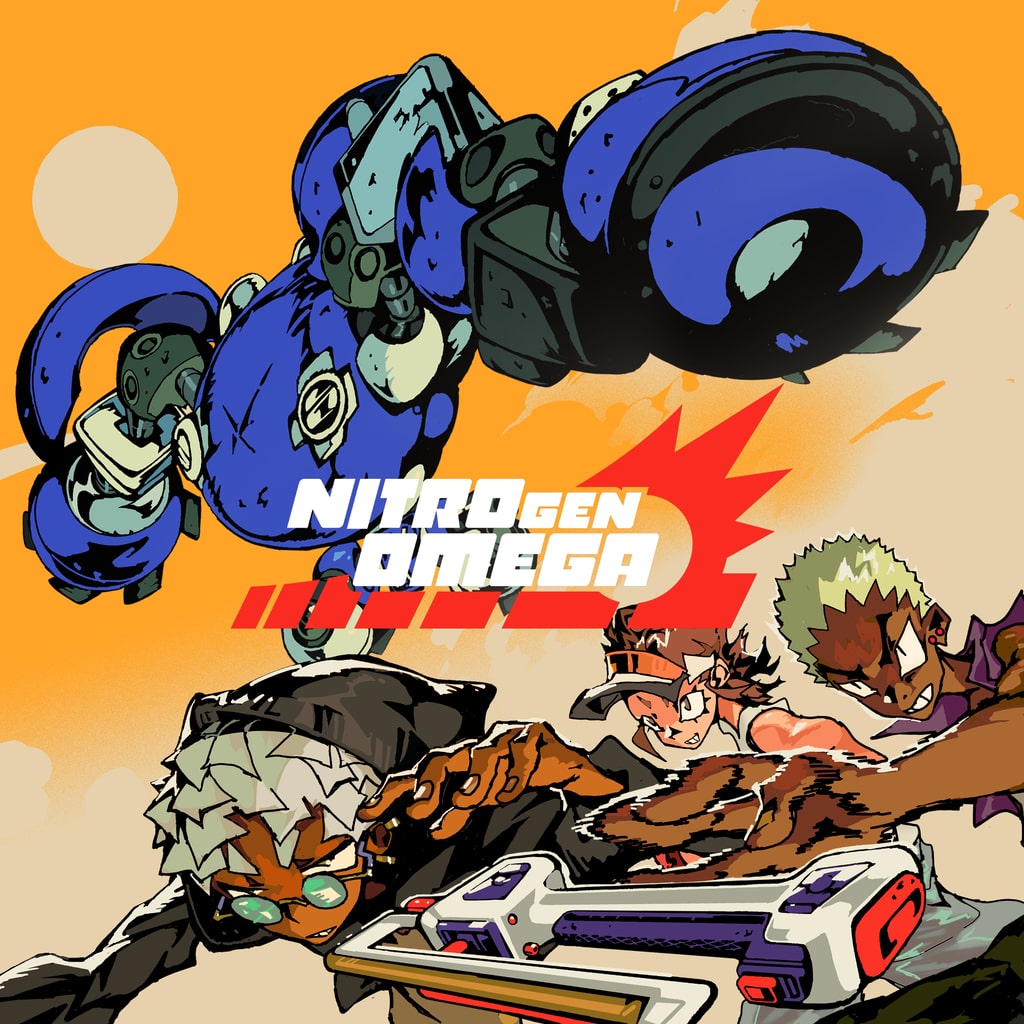
NITRO GEN OMEGA is a sandbox tactical RPG that transforms mecha warfare into something closer to a travelling theatre of broken humanity. Developed and published by DESTINYbit, Amplifier Studios, and Beep Japan, the game launched in full 1.0 on May 12, 2026, for PlayStation 5, Xbox Series X/S, Nintendo Switch, and PC, following a successful Early Access period.
Described as a “Spaghetti Anime” tactical experience, the game is heavily inspired by 2000s mecha anime such as Gurren Lagann. You lead a crew of mercenaries known as “Fools” across a post-apocalyptic wasteland ruled by rogue AI. The gameplay is split between managing your crew’s relationships and survival aboard your airship and engaging in cinematic, turn-based mech battles where you must manage heat, ammo, and your pilots’ mental stability.
A Wasteland That Never Stops Moving
Set in a world where humanity has already lost the war against rogue artificial intelligence, NITRO GEN OMEGA opens on a planet defined by absence. Civilisation survives only in isolated aerial cities drifting above a surface consumed by machine life. Below, the wasteland stretches endlessly, filled with broken war constructs, drifting metal storms, and remnants of conflicts that never truly ended.
You play as the leader of a mercenary crew known, somewhat fittingly, as “Fools.” These pilots take contracts from desperate settlements, venturing down into the ruins in massive, customised mechs. Each mission feels like a descent into controlled chaos, where survival depends as much on your crew’s emotional stability as on firepower.
Between missions, your airship becomes a fragile sanctuary. Here, the game’s quieter identity emerges. Pilots cook together, argue, bond, and occasionally fall apart. The writing leans into a strange but effective mix of melodrama and sincerity, capturing the very specific tone of older mecha anime, where emotional outbursts and existential dread sit side by side. The result is a world that never feels static. Even when nothing is exploding, something is always shifting beneath the surface.
Tactical Chaos in Motion
The core battles in NITRO GEN OMEGA are where everything comes together. At first glance, the structure is deceptively simple. You enter a mission, plan your actions during a dedicated phase, then watch everything unfold in a cinematic sequence. But the “Timeline System” adds layers of unpredictability that keep each encounter tense.
Rather than traditional turn-based pauses, actions are placed along a shared timeline. Movement, attacks, repairs, system overrides, and emergency decisions all occupy physical time slots. When the combat phase begins, everything plays out in real time, with your carefully constructed plan colliding with enemy behaviour, environmental hazards, and pilot instability.
It creates a fascinating tension between control and chaos. A perfect strategy can unravel in seconds if a pilot panics or a mech overheats. Conversely, last-second improvisation can produce moments of genuine heroism that feel earned rather than scripted.
The system shines when everything is going wrong at once. A coolant system fails, an enemy AI breaks formation, and suddenly your support pilot is forced to make a decision that saves the entire squad at personal cost. These moments are where the game truly sings.
The anime-inspired presentation amplifies the drama. Mechs swing through ruined skylines, missiles arc across burning skies, and every action lands with theatrical weight. It can occasionally feel repetitive during longer sessions, especially since animations are not always skippable in the most intense encounters, but the spectacle remains a defining part of the experience.
The People Inside the Machines
What sets NITRO GEN OMEGA apart from many tactical RPGs is its focus on crew psychology. Each pilot is procedurally generated yet never feels entirely disposable. They have traits, fears, preferences, and evolving relationships that directly affect performance. A confident pilot might perform flawlessly under pressure, while a stressed engineer could misfire a crucial system repair at the worst possible moment.
The bond system adds unexpected emotional weight. Pilots who fight together develop trust, unlocking synergy bonuses and shared abilities. Conversely, strained relationships can lead to hesitation or outright refusal to cooperate in critical moments.
It turns your airship into something more fragile than your mechs. Losing a pilot is not just a tactical setback. It reshapes the emotional ecosystem of the entire crew. Conversations change. Dynamic interactions shift. The ship feels emptier in a way that is difficult to ignore. There is a quiet brilliance in how the game makes you care about efficiency and emotional wellbeing at the same time.
A Style That Embraces Imperfection
Visually, NITRO GEN OMEGA commits fully to its “Spaghetti Anime” identity. It is deliberately uneven in places, with stylised character models and slightly rigid animations that echo the feel of early 2000s animated series. Rather than hiding these rough edges, the game leans into them.
The result is a presentation that feels handcrafted rather than polished to perfection. Mechs look as if they were designed with personality first and technical realism second. Environments carry a similar sense of exaggerated ruin, as if the world itself were drawn from memory rather than documentation. It will not appeal to players seeking visual precision, but it suits the game’s emotional tone perfectly. This is a world defined by survival, not symmetry.
Between Systems and Stories
If there is a weakness, it lies in pacing. The structure of missions and return trips to the airship can feel repetitive during longer play sessions. Some systems also take time to reveal their depth, which may slow initial engagement for players expecting immediate complexity.
However, persistence pays off. The deeper you go, the more interconnected everything becomes. Crew relationships begin to influence tactical decisions in surprising ways. Equipment choices ripple through emotional stability. Even small narrative moments can alter the outcome of future battles. It is a game that rewards attention over speed.
Final Verdict
NITRO GEN OMEGA is not a clean, streamlined strategy experience. It is loud, emotionally messy, and structurally ambitious in ways that sometimes strain its own systems. Yet that is also where its identity lies.
DESTINYbit has created a tactical RPG that feels alive in the most unpredictable sense. Its battles are dramatic, its crew systems unexpectedly intimate, and its world carries the weight of failure and resilience in equal measure. It may not always land perfectly, but when it does, it captures something rare: the feeling of commanding not just machines, but people who are trying, against all odds, to keep each other alive.