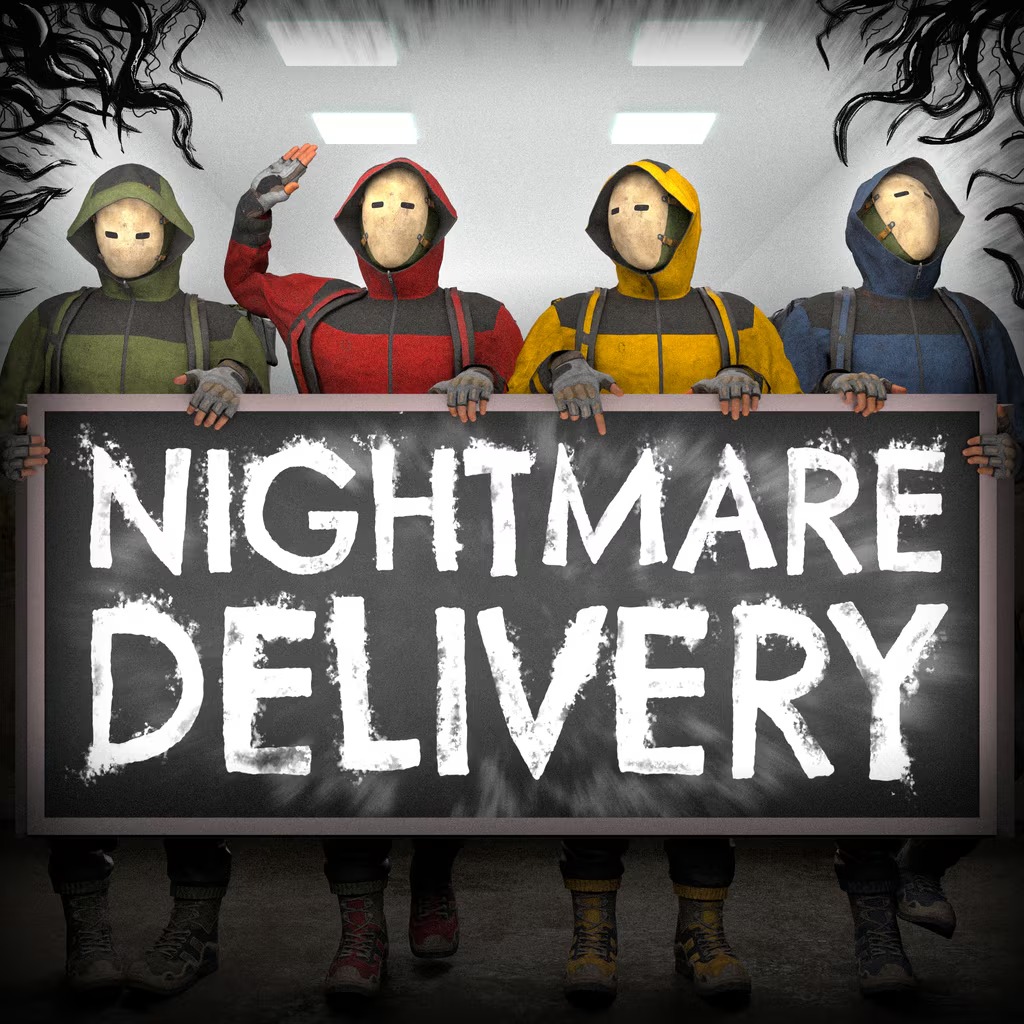
There is something wonderfully unsettling about the idea of being a delivery driver whose final destination is somebody else’s nightmare. We are so used to games turning ordinary jobs into relaxing simulations that Nightmare Delivery takes that familiar premise and throws it through a cracked mirror. You are not dropping parcels at suburban front doors or navigating a sleepy town after dark. You are entering distorted minds, carrying packages into places shaped by fear, guilt, obsession and trauma, with no guarantee that the way back will still exist when the job is finished.
That premise gives Nightmare Delivery an identity almost immediately. Developed as a cooperative psychological horror experience, it can be played alone or with up to four players online, turning its strange environments into spaces where communication can be as important as courage. What makes it particularly interesting is that the horror is not simply about running away from something with too many teeth. Each nightmare has its own rules, puzzles and threats, so survival often depends on understanding what the nightmare wants from you.
Welcome to the Wrong Address
The first thing Nightmare Delivery gets right is its wonderfully twisted take on the word delivery. Your destinations are not real houses, streets or familiar locations. Instead, you enter the consciousness of different people, with each mission presenting a strange mental landscape that initially seems almost recognisable before its logic begins to unravel.
This is where the game finds its strongest horror concept. A corridor can lead somewhere it absolutely should not, a room can repeat itself without explanation, and an ordinary household object can suddenly become an important part of a puzzle. The familiarity of these spaces makes their eventual distortion much more unsettling because the game is constantly taking things you understand and quietly moving the goalposts.
There is a real sense of curiosity in exploring these environments. You are not simply wandering around waiting for a monster to appear around the next corner. You are trying to work out what kind of place you have entered, what its rules might be, and what exactly you are supposed to deliver. That uncertainty creates a delicious tension because even when nothing is attacking you, the environment itself feels wrong.
The Delivery Comes First
At its core, Nightmare Delivery revolves around exploration, environmental puzzles and survival. The objective sounds simple enough: find the final delivery point, hand over the mysterious package and get out alive. The problem is that the world between your starting point and that destination has no interest in making your journey straightforward.
Every level is built around its own atmosphere, rules, puzzles and threats, giving the game a welcome sense of variety. Some creatures can be avoided entirely, while others apparently need to be understood before you can survive an encounter. That distinction is important because it prevents the game from becoming another horror title where the answer to every problem is simply to sprint in the opposite direction.
The best horror games teach you something about their monsters. You begin frightened because you do not understand what is happening, then gradually learn how the threat behaves. Eventually, you start making decisions based on that knowledge rather than pure panic. Nightmare Delivery taps into that satisfying process of learning, making the player feel as though they are gradually becoming more capable without ever making the nightmare itself feel completely safe.
Alone in the Darkness
Playing alone changes the character of the experience considerably. Without another player beside you, there is nobody to laugh nervously with when something bizarre happens, and nobody to blame when you take a wrong turn. Every strange noise becomes your problem, every puzzle is yours to solve, and every encounter with an entity carries considerably more weight.
There is something particularly effective about that isolation. Psychological horror works best when the player feels uncertain, and being alone amplifies that uncertainty. You have nobody to confirm that what you just saw was actually there, which makes the strange spaces feel even more unstable.
The solitary experience also gives the environmental design more room to breathe. You can stop and investigate an unusual room or examine an object without worrying about holding up a group. That slower pace suits the game’s emphasis on atmosphere and discovery, particularly when a seemingly ordinary environment gradually reveals its darker side.
Four Minds Are Better Than One
Cooperative play brings a different flavour. With support for up to four players online, Nightmare Delivery has the potential to become a horror experience where fear and comedy coexist. One player might encounter a disturbing creature while another is desperately trying to solve a puzzle, and suddenly the terrifying atmosphere is punctured by frantic communication and confused shouting.
That is not necessarily a bad thing. Some of the best cooperative horror games understand that laughter and fear can coexist, and Nightmare Delivery seems particularly well suited to that balance. Having several people explore an impossible environment together creates its own stories, especially when the group becomes separated or someone discovers something the others have not seen.
The danger is that cooperative horror can lose its edge when there are too many people involved. Four players naturally make an environment feel less lonely, and a group that communicates effectively can take some of the uncertainty out of the experience. Thankfully, the game’s emphasis on learning enemy behaviour and solving environmental puzzles means that cooperation does not simply turn the experience into a sightseeing trip.
A Nightmare With Rules
The idea that each level has its own rules is one of the most promising aspects of Nightmare Delivery. Horror becomes far more interesting when the player must understand the environment rather than simply memorise a route. The notion that one creature can be avoided while another must be understood gives each encounter the potential to become its own little psychological puzzle.
That also gives the game a satisfying sense of progression without necessarily relying on traditional upgrades. You become better because you have learned. You remember what happened the last time you entered a particular space, recognise the warning signs, and approach the situation differently. It is the sort of progression that makes horror games especially satisfying, because knowledge itself becomes your greatest weapon.
There is a lovely irony in that. You are technically a courier, someone whose job should be straightforward and routine, yet the only way to become competent is to learn the behaviour of nightmares. Forget driving directions or delivery schedules. Here, your professional development involves discovering how monsters think.
Atmosphere Over Gore
Nightmare Delivery also deserves credit for recognising that psychological horror need not constantly throw blood and gore at the player. The premise allows the environments themselves to become the source of discomfort. Familiar places becoming subtly impossible is often more disturbing than simply presenting a grotesque monster in a dark room.
The concept of fear, memory, guilt, obsession and trauma shaping each mental space gives the game a much stronger thematic foundation than a simple monster chase. These are inherently uncomfortable ideas, and placing them at the heart of the level design creates opportunities for horror that can linger beyond the immediate jump scare.
The title also benefits from its sense of mystery. The package itself becomes an intriguing object because you understand that it has a purpose, yet the game does not simply hand you every answer immediately. There is something compelling about carrying an object through increasingly bizarre surroundings while wondering exactly what is waiting at the other end of the delivery.
Room for Improvement
Not everything about Nightmare Delivery reaches the same heights as its premise. Psychological horror is an exceptionally difficult genre to balance, because once players understand the tricks being used, the fear can begin to fade. The game’s long-term success will therefore depend heavily on how varied its individual nightmares are and on whether the different rules and entities genuinely change the way players approach each mission.
There is also an inherent challenge in making cooperative horror genuinely frightening. Four experienced players communicating constantly can turn even a disturbing environment into a tactical exercise. The game needs to maintain enough uncertainty and unpredictability to ensure that teamwork feels useful without completely removing the sense of vulnerability that makes horror work.
Even so, the foundation is strong. The core idea is unusual enough to stand apart from the growing crowd of psychological horror games, and the emphasis on learning rather than simply running gives the experience a more thoughtful edge. If the individual scenarios can maintain that variety throughout the full experience, there is plenty here to keep horror fans engaged.
Verdict
Nightmare Delivery is built around a wonderfully simple question: what if delivering a parcel meant entering someone’s darkest thoughts? From there, it unfolds into an intriguing cooperative horror experience in which distorted environments, environmental puzzles and unpredictable entities turn every delivery into a journey into the unknown. The ability to play alone or with up to four players gives it flexibility, while the emphasis on understanding each nightmare’s rules adds welcome depth to the survival formula.
It is the concept that ultimately stays with you. There is something strangely compelling about being given a mundane responsibility and watching it become increasingly horrifying with every step. You are still a courier, but your route has become a maze built from somebody else’s suffering, and your only real goal is to understand the darkness well enough to make it home.
Nightmare Delivery may not completely reinvent psychological horror, but it has found an imaginative way to package its ideas. With its unusual premise, cooperative possibilities and focus on environmental discovery, it feels like a horror experience with a personality of its own. Sometimes the scariest delivery is the one where you already know what is waiting behind the door.