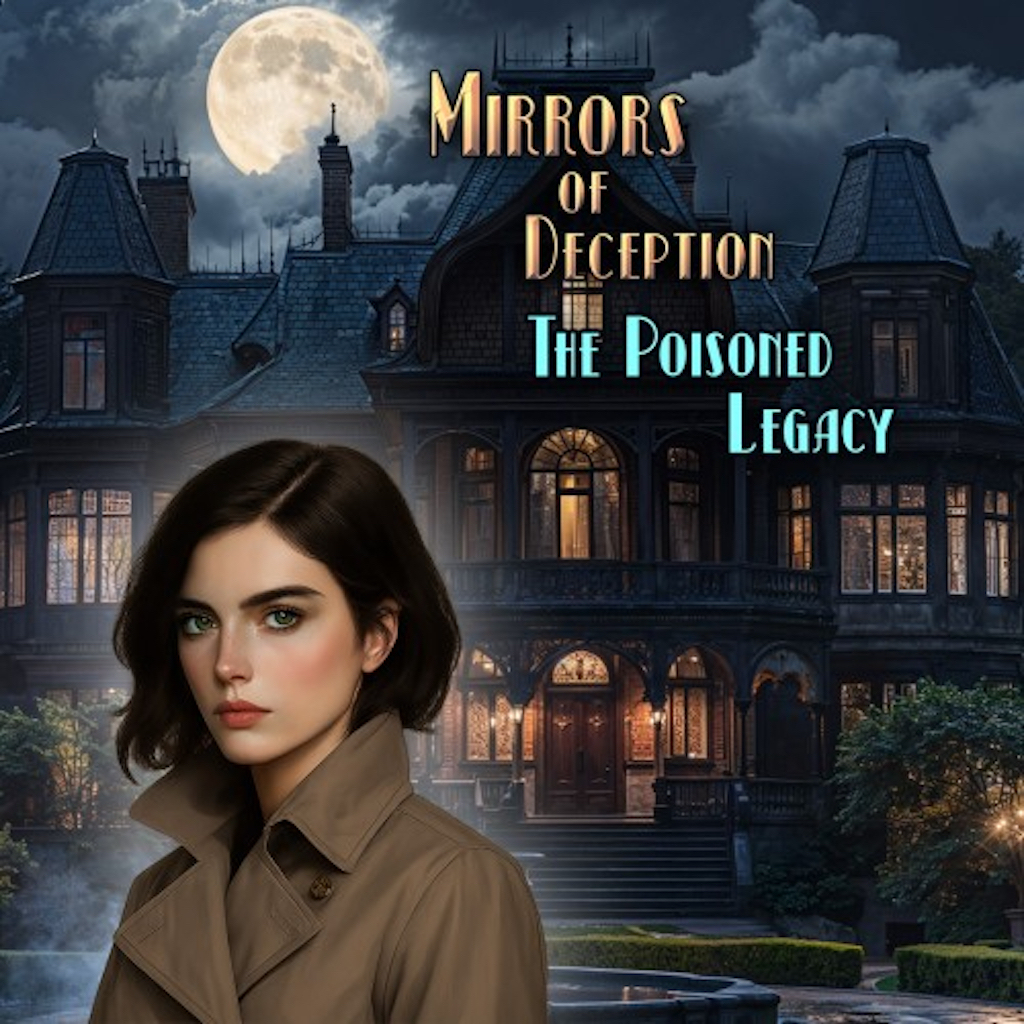
Psychological horror thrives on atmosphere and ambiguity, drawing fear from what might be lurking in the shadows rather than what’s overtly presented. Mirrors of Deception: The Poisoned Legacy embraces that philosophy with relish. It’s a game that unfolds like a dark fairy tale — beautiful and eerie by turns, suffused with hidden histories, twisted mirrors, and a legacy that poisons everything it touches.
From its opening sequence, the game focuses on mood before action. You play as Lucien Graves, a troubled investigator summoned to Morningfall Manor — an ancestral estate shrouded in rumours of madness, spectral sightings, and a family legacy marred by tragedy. Lucien’s task is ostensibly to determine the cause of a disturbing family “incident,” but what begins as a professional assignment quickly morphs into a personal descent as the manor’s secrets begin to entwine with his own fractured past.
Narrative & World
Few contemporary horror games commit so fully to their narrative voice. Mirrors of Deception crafts a story that rewards patience, curiosity, and attention to detail. Morningfall Manor isn’t just a backdrop — it is a character, living and breathing through layered lore, whispered rumours, and environmental storytelling that unfurls with satisfying precision.
The Poisoned Legacy refers not just to a cursed bloodline, but to the toxic patterns that repeat across generations. As Lucien, you uncover journals, letters, fragmented testimonies, and the remnants of family confessions that echo trauma and betrayal. Individual rooms, long corridors, and abandoned studies are visual texts themselves, filled with clues that tie personal histories to the supernatural events unfolding within the manor walls.
Rather than relying on cutscenes or direct exposition, the game leans on subtlety. Much of the storytelling happens in whispers — through half-remembered memories, fragmented voiceovers, and objects that evoke emotions rather than explanations. This design choice will frustrate players seeking clear answers, but for those who enjoy piecing together narrative threads, it’s deeply rewarding.
The story’s emotional gravity is heightened by Lucien’s own internal struggles. Nightmare sequences and hallucinations blur the line between reality and delusion, and the gradual erosion of certainty becomes a compelling mirror to the game’s title. You’re never just solving a mystery — you’re confronting decay, doubt, and the poison that festers when truth goes unspoken.
Gameplay & Mechanics
Mirrors of Deception marries narrative exploration with investigation, puzzle solving, and occasional stealth sequences. Combat is almost nonexistent; instead, the game prioritises tension, atmospheric danger, and cerebral challenges over traditional action.
Exploration & Puzzle Integration
Morningfall Manor is expansive, but not overwhelming. Rooms loop into one another in unexpected ways, corridors fold back on themselves, and the estate’s architecture feels almost alive in its subtle maze-like layout. This isn’t a dungeon crawler, but the sense of spatial disorientation reinforces the psychological horror at play.
Puzzles are thoughtfully embedded in the environment. You won’t find arbitrary lock combinations or trial-and-error mini-games; instead, challenges grow organically from the story. Deciphering a dilapidated diary may unlock a hidden passage. Matching family crests to forgotten shelves might tempt a secret drawer to open. These integrations make every discovery feel meaningful and intrinsically tied to the unfolding narrative.
While most puzzles are clever and cohesive, a few err toward obtuse, demanding leaps in logic that aren’t always telegraphed clearly. These can stall progression and break immersion, but they are infrequent and — in most cases — solvable with careful observation and note-taking.
Stealth & Tension
Rather than confronting dangers head-on, players often rely on stealth and avoidance. Unsettling entities roam certain wings of the manor, and being detected doesn’t always result in instant failure, but it does escalate tension and may trigger haunting sequences that displace Lucien into surreal visions. These encounters are less about combat and more about managing fear, awareness, and positioning — quiet, creeping dread rather than adrenaline spikes.
Inventory & Clues
Lucien’s inventory holds documents, relics, keys, and fragments of memory. There’s no HUD clutter; instead, items feel like artefacts to be examined and revisited. Clues collected in one room may only reveal their significance once you’ve discovered corroborating evidence elsewhere, which encourages thorough exploration and pattern recognition.
Visuals & Audio
Visually, Mirrors of Deception thrives on contrast — light and shadow, ornamental beauty and decay, innocence and corruption. Morningfall Manor is rendered with exquisite attention to lighting and detail. Dimly lit hallways, stained wallpapers, creaking floorboards, and peeling paint create a world that feels lived in and haunted by its own history.
Cinematic framing is employed dynamically, especially during key narrative moments. Camera angles shift to induce unease, and reflections — particularly in mirrors — play a recurring role in both gameplay and storytelling, often revealing subtle differences between reality and perception.
The audio design is similarly sophisticated. A brooding, ambient score underpins exploration, swelling at moments of revelation and fading into near silence when isolation is most potent. Environmental sounds — the scrape of a chair shifting, a hollow tap of distant footsteps, whispers barely caught at the edge of hearing — are woven into the experience, enhancing immersion without ever feeling forced.
Voice acting is strong and measured, giving life to journal narrations, flashback dialogues, and environmental voiceovers. Lucien’s internal monologue, in particular, adds emotional depth without overwhelming the sparse dialogue elsewhere.
Strengths
Narrative Depth: The story is rich, layered, and thoughtfully delivered, rewarding attentive players.
Atmospheric World: Morningfall Manor is one of the most compelling horror settings of recent years — beautifully realised and profoundly unsettling.
Integrated Puzzles: Environmental puzzles tie directly into story and character, enhancing immersion.
Sound & Visual Cohesion: Audio and visual design work in harmony to sustain tension and mood.
Weaknesses
Pacing Fluctuations: The slow, reflective rhythm won’t appeal to players who favour constant tension or fast action.
Occasional Obscure Clues: A few puzzles rely on subtle logic leaps that may frustrate without external hints.
Stealth Mechanics: While atmospheric, the avoidance sequences sometimes lack clarity in enemy behaviour or consequences.
Overall Experience
Mirrors of Deception: The Poisoned Legacy is a meditation on memory, legacy, and the intangible scars left by family secrets. It rarely resorts to cheap scares, instead opting for a measured, atmospheric dread that creeps into the corners of your awareness. This makes it less a rollercoaster of fear and more a winding descent into uncanny truths — and for many players, that’s precisely its power.
The experience isn’t perfect. Pacing can lag, and a few puzzles frustrate more than they enlighten. But these flaws are minor beside a tapestry of storytelling, world design, and thematic ambition that few games attempt with such confidence.
For fans of psychological horror who relish narrative complexity and immersive environments, The Poisoned Legacy is a haunting journey worth taking. It’s a game that values subtlety over spectacle, atmosphere over aggression, and introspection over action — and in doing so, it creates an experience that lingers.
Final Verdict
Mirrors of Deception: The Poisoned Legacy is a richly atmospheric psychological horror adventure that balances narrative depth with haunting exploration and integrated puzzle design. While its pacing may not suit everyone, the strength of its story, world, and thematic resonance make it one of the more compelling horror experiences of the year. A standout for players seeking thoughtful, immersive storytelling wrapped in a chilling, beautifully realised setting.