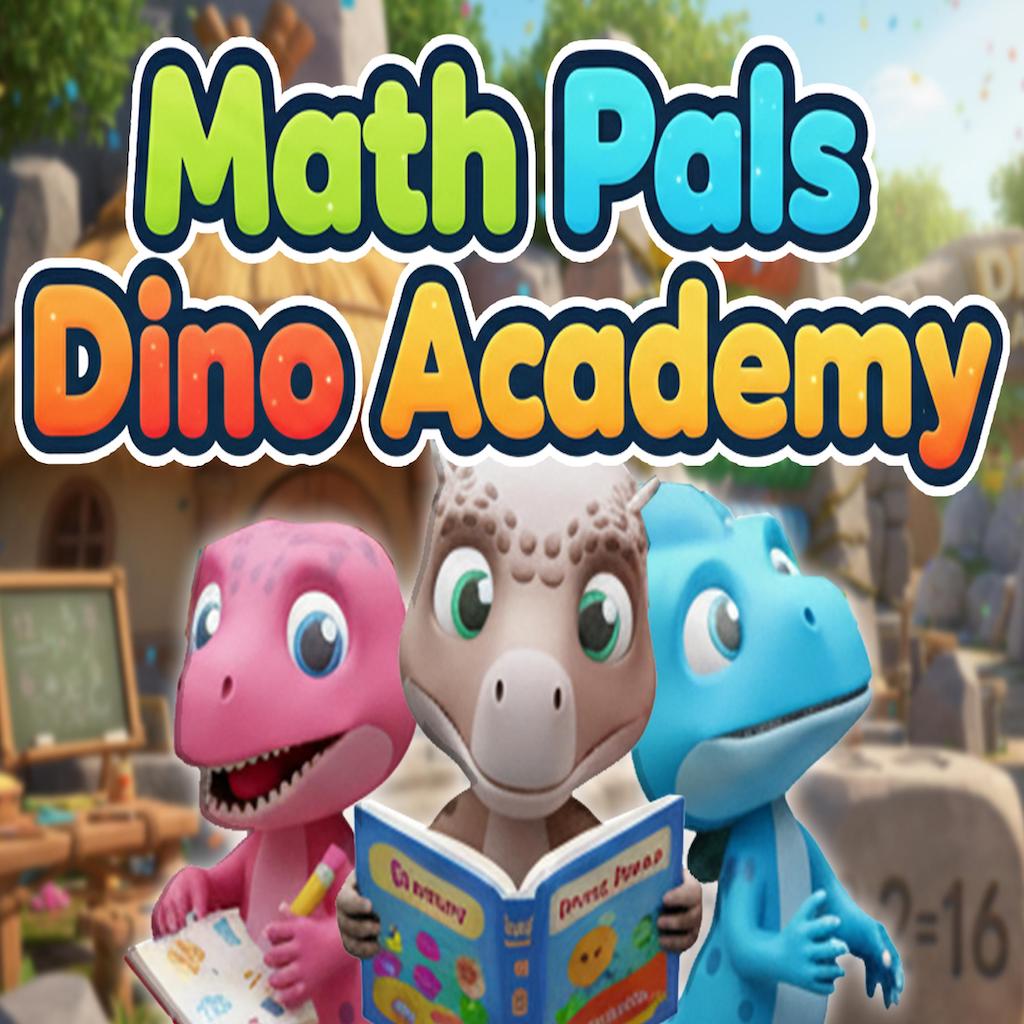
Math Pals – Dino Academy is built around a clear idea: learning works best when it feels safe, repeatable, and rewarding. The experience is organised into themed areas, each with around 20 levels that gradually increase in difficulty. It starts with the basics, such as counting small groups of objects, and gradually introduces more abstract ideas like addition, subtraction, and eventually multiplication and division. What stands out most is how deliberately paced everything feels. There is no rush to push children into complexity before they are ready, and that patience defines the entire structure of the game.
Each level follows a familiar multiple-choice format, but the variety within that structure helps prevent it from feeling overly repetitive. One moment a child might be counting animals on screen, and the next they are identifying numbers using dice, fingers, or simple visual groupings. This constant rotation of context helps reinforce the same mathematical ideas from different angles, which is especially important for early learning. The inclusion of spaced repetition is a quiet but meaningful strength, ensuring that concepts are not just introduced once but revisited in ways that support long-term retention.
Presentation and Tone
Where Math Pals – Dino Academy really distinguishes itself is in its tone. The entire experience is wrapped in a friendly, non-threatening presentation, led by cheerful dinosaur characters who guide players through each step. There is a consistent sense that mistakes are not failures but part of the process, a crucial mindset for early education. Positive feedback is constant, whether through encouraging audio cues, visual celebrations, or simple progression markers that make each correct answer feel meaningful.
This tone carries through even the UI and pacing. Everything is designed to feel approachable, with clear instructions and minimal friction between questions. The dinosaurs themselves are not just decorative mascots but gentle guides that give the experience personality without overwhelming it. For children who may be anxious about numbers or schoolwork, this kind of presentation can make a significant difference. It transforms what could be a stressful subject into something that feels more like guided play than formal education.
Gameplay Loop and Engagement
The gameplay loop in Math Pals – Dino Academy is intentionally simple, emphasising repetition with subtle variation rather than mechanical complexity. Each level presents a set of questions, usually in multiple-choice format, and rewards correct answers with stars and high scores. This structure creates a clear sense of progression, allowing both children and parents to track improvement over time. The three-star system in particular adds an extra layer of motivation, encouraging replay without feeling punitive.
While the loop is straightforward, it is carefully tuned to avoid overwhelming young players. Difficulty increases gradually, ensuring that early success builds confidence before more challenging problems are introduced. The transition from visual counting to abstract arithmetic is handled with care, and the game never feels like it abruptly shifts expectations. Instead, it feels like a steady climb, with each step small enough to be manageable yet meaningful enough to register as progress.
That said, the loop’s simplicity is both its greatest strength and its main limitation. For its intended audience, repetition is a tool for learning, but in longer sessions it can begin to feel predictable. There is very little mechanical variation beyond question types, so engagement relies heavily on the child’s interest in the subject matter rather than gameplay diversity. For short educational bursts, this works well, but extended play sessions may require breaks to maintain focus.
Educational Value and Effectiveness
As an educational tool, Math Pals – Dino Academy is clearly designed with purpose rather than gimmickry. It recognises that early maths education is not about speed or complexity, but about familiarity and confidence. The use of visual aids in the early levels is particularly effective, grounding abstract ideas in tangible examples such as animals, objects, or familiar gestures. This makes the transition to more traditional arithmetic feel less intimidating.
The game also benefits from its structured progression system. Each topic is neatly contained, allowing children to focus on one concept at a time before moving on. This prevents cognitive overload and supports gradual skill development. Parents seeking a structured learning aid will likely appreciate the transparency of the progression, especially as the star ratings and level completion markers provide immediate feedback on performance.
However, because the experience is so focused on structured learning, it offers little in the way of exploratory play or creative interaction. There are no narrative layers or gameplay systems beyond answering questions and progressing through levels. For some children, especially those who learn better through more dynamic or imaginative systems, this may feel a little rigid over time.
Performance and Accessibility
In practical terms, Math Pals – Dino Academy performs exactly as expected for a lightweight educational title. It is stable, responsive, and easy to navigate, which is essential for its target audience. Menus are clear, inputs are simple, and there is very little chance of confusion during gameplay. This accessibility is one of its strongest design choices, ensuring that even very young players can engage with it independently or with minimal guidance.
The lack of technical complexity also helps it run smoothly across platforms without distraction. There are no performance issues or unnecessary systems competing for attention. Everything is focused on delivering questions, feedback, and progression in the most direct way possible. It is a game that understands its role and avoids overcomplication.
Critiques and Limitations
Despite its strengths, Math Pals – Dino Academy has limitations. Its biggest drawback is the lack of variety in its gameplay structure. While the different question types provide some variation, the overall format remains consistent throughout. Over time, this can lead to a sense of repetition, particularly for older children or those who progress quickly through the material.
Another limitation is the absence of more interactive or imaginative gameplay elements. Many modern educational games incorporate light platforming, exploration, or creative systems to maintain engagement, but Math Pals – Dino Academy remains firmly rooted in quiz-based learning. This makes it highly focused, but also somewhat narrow in appeal. It excels at teaching, but it does not always entertain beyond that core function.
Final Verdict
Math Pals – Dino Academy is a thoughtful, carefully designed educational game that makes early mathematics approachable, structured, and reassuring for young learners. Its gentle pacing, visual learning aids, and positive reinforcement create an environment where children can build confidence without pressure. While it lacks mechanical variety and long-term gameplay depth, it compensates with clarity of purpose and consistent execution.
It is not a game designed to entertain in the traditional sense, but rather to support learning in a calm, encouraging way. For parents seeking a reliable educational tool that respects the learning process and keeps frustration to a minimum, Math Pals – Dino Academy delivers exactly what it promises.