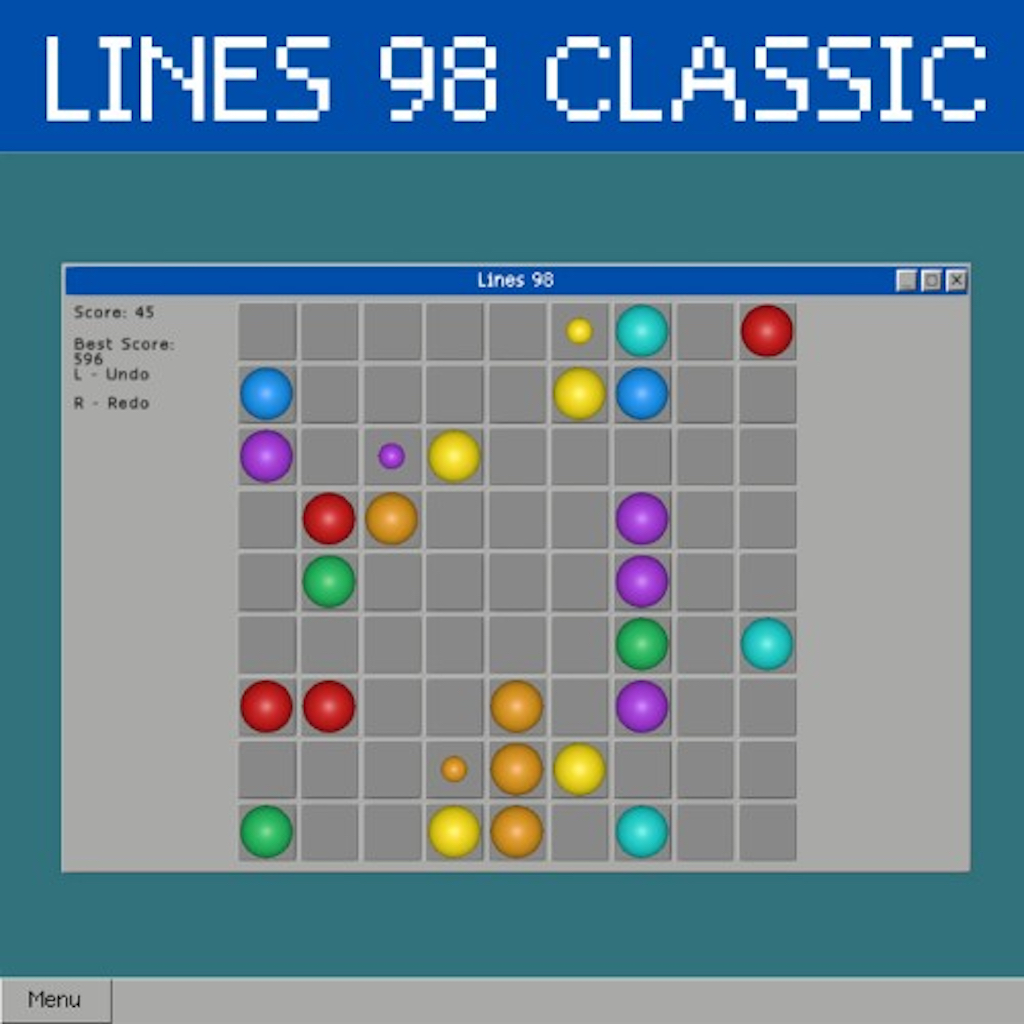
Some games don’t need reinvention — they simply need preservation. In an era dominated by live services, sprawling open worlds, and endlessly layered progression systems, there’s something quietly refreshing about a game built around pure logic. Lines 98 Classic, published by Soroka Games and released on February 7, 2026, for Nintendo Switch, is exactly that: a faithful revival of one of the most enduring puzzle concepts of the late PC era.
For many players, Color Lines was a staple of 1990s desktop gaming — a deceptively simple time-sink played between homework sessions, office breaks, or long evenings chasing a slightly higher score. Lines 98 Classic brings that experience almost unchanged to modern hardware, and while that fidelity is both its greatest strength and its greatest limitation, it results in a puzzle experience that remains surprisingly compelling decades later.
The Return of a Puzzle Classic
The premise of Lines 98 Classic is elegantly simple. You’re presented with a 9×9 grid, initially sparsely populated with colored balls. Your objective is to move these balls around the board, aligning five or more of the same color horizontally, vertically, or diagonally.
Create a line, and the balls disappear.
Fail to do so, and three new balls spawn randomly on the board.
That’s the entire game — and yet it creates a constant tension between planning and inevitability that remains deeply engaging even today.
Every move feels consequential. You aren’t racing a timer or reacting to sudden threats. Instead, pressure builds slowly, almost politely, until the board fills and options vanish. The danger creeps in gradually, making failure feel less like punishment and more like the natural end of a strategic battle you inevitably lose.
It’s puzzle design at its purest: easy to understand, endlessly difficult to master.
Strategy Hidden Beneath Simplicity
What separates Lines 98 Classic from many modern casual puzzle games is its emphasis on foresight. Success rarely comes from reacting to the current board alone — it comes from predicting future chaos.
Each turn introduces a crucial mechanic: the Next indicator, which reveals the colors of the upcoming balls. This single addition transforms gameplay from randomness into strategy.
You begin thinking several moves ahead:
- Should you finish a short line now or prepare space for a longer chain?
- Is it worth moving a ball across the board if it risks blocking future paths?
- Do you sacrifice space to chase higher-scoring combinations?
Movement itself requires a clear path across empty squares, turning the board into a constantly shifting maze. One careless placement can isolate entire sections, trapping valuable colors behind walls of randomness.
The result is a fascinating mental rhythm — part chess, part spatial puzzle, part risk management exercise.
The Score-Chasing Addiction
Unlike many modern puzzle titles that rely on levels or unlockable content, Lines 98 Classic is entirely score-driven. The only real goal is survival — lasting as long as possible while maximizing points.
This minimalist approach works because of subtle scoring depth. Clearing exactly five balls earns respectable points, but longer lines dramatically increase score multipliers. Skilled players learn to delay gratification, carefully stacking opportunities to clear six or seven balls at once.
It’s a dangerous strategy, of course. Waiting too long risks overcrowding the board.
That tension between greed and safety becomes the heart of the experience. Every decision feels like gambling against probability.
And when a perfectly planned chain clears half the board? Few puzzle games deliver a more satisfying moment.
Modern Touches Without Losing Identity
Soroka Games wisely avoids over-modernizing the formula. Instead, Lines 98 Classic focuses on polish rather than reinvention.
Enhancements include:
- Clean high-definition visuals.
- Smooth animations when balls move or vanish.
- Subtle particle effects during clears.
- A modernized interface readable on handheld screens.
The presentation respects the original aesthetic while ensuring it feels comfortable on a contemporary console.
Controls are equally flexible. Players can use traditional buttons or touchscreen input in handheld mode. The latter feels particularly natural — dragging balls across the grid closely mirrors the tactile feel of classic mouse-based gameplay.
Importantly, responsiveness is flawless. In a logic game where precision matters, even slight input delay would be disastrous, but performance remains consistently smooth.
A Perfect “Podcast Game”
Lines 98 Classic excels as what many players call a “second-screen game.” There’s no story demanding attention, no audio cues requiring focus, and no time pressure forcing urgency.
You can play while:
- Listening to podcasts.
- Watching television.
- Relaxing before bed.
- Taking short breaks during the day.
The calm pacing creates a meditative quality rarely found in modern releases. The board becomes a quiet mental space where decisions unfold at your own speed.
Ironically, this relaxed atmosphere often leads to long play sessions. The “one more run” effect remains as powerful now as it was on Windows PCs nearly three decades ago.
The Limits of Faithfulness
While nostalgia carries much of the appeal, Lines 98 Classic’s strict adherence to the original formula also reveals its weaknesses.
There are few modern additions beyond presentation polish:
- No online leaderboards.
- No daily challenges.
- No alternate modes or rule variations.
- Limited audiovisual customization.
For players accustomed to evolving puzzle systems or progression mechanics, the experience may feel barebones.
This isn’t necessarily a flaw — the game deliberately prioritizes authenticity — but it does narrow its audience. Those seeking innovation may find the experience repetitive after extended play.
Difficulty and Longevity
Lines 98 Classic doesn’t rely on artificial difficulty scaling. Instead, challenge emerges organically from probability and space management.
Early turns feel forgiving, but by mid-game, the grid becomes a battlefield of constrained movement and desperate planning. Late-game survival demands near-perfect efficiency.
Longevity depends almost entirely on player mentality. Competitive thinkers chasing high scores will return repeatedly. Others may enjoy shorter, occasional sessions rather than sustained play.
Given the extremely low price point (currently around £1.07), expectations align well with what’s offered.
A Puzzle From Another Era — In the Best Way
What makes Lines 98 Classic remarkable is how little it needs to succeed. The design predates modern retention psychology, monetization loops, and engagement metrics — yet it remains captivating.
There are no flashing rewards or progression bars pushing you forward. The motivation comes entirely from internal satisfaction: improving strategy, beating personal records, and understanding the board more deeply each time.
In 2026, that simplicity feels almost radical.
Final Verdict
Lines 98 Classic is less a remake and more a preservation project — a respectful recreation of a puzzle legend that proves great design doesn’t age.
It won’t surprise you. It won’t evolve dramatically over time. But it will quietly absorb hours of your attention with its thoughtful pacing and endlessly replayable logic.
For veterans, it’s a comforting return to a formative gaming experience. For newcomers, it’s a masterclass in minimalist puzzle design.
Sometimes, five matching colors are all you need.