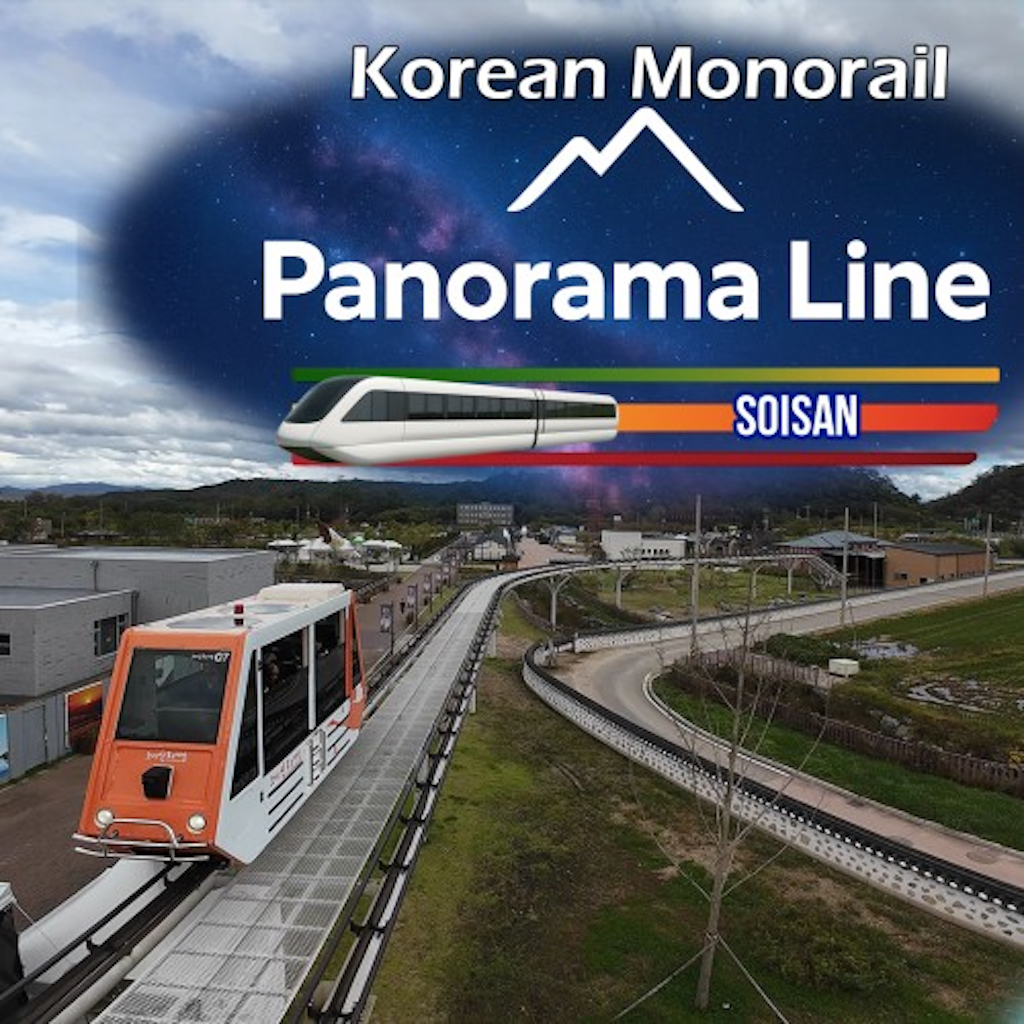
There’s a very particular kind of game that resists traditional criticism. No enemies to defeat. No branching skill trees. No competitive hooks. Korean Monorail Panorama Line Soisan, developed and published by 14Dimension Enterprise, is one such experience.
Released February 12, 2026, for Nintendo Switch, this title marks the second entry in 14Dimension’s panoramic monorail series, following last year’s Korean Monorail Panorama Line Hwagaesan. Like its predecessor, Soisan leans heavily on authenticity—using real filmed footage of South Korea’s Mt. Soi (Soisan) region in Cheorwon.
It’s not so much a “game” in the conventional sense.
It’s a digital journey.
A Monorail Through Living History
Mt. Soi, located in Cheorwon County, carries historical and geographical weight. The region offers views of the Korean Demilitarized Zone (DMZ) and overlooks Baekma-goji (White Horse Hill), a key battlefield from the Korean War.
Korean Monorail Panorama Line Soisan doesn’t dramatize that history. Instead, it invites players to experience the landscape quietly—through actual filmed monorail sections captured in high definition.
As you guide the monorail along the track, real footage unfolds before you. Rolling hills, dense forests, distant ridgelines. It feels less like navigating a digital world and more like watching a documentary you can subtly influence.
The authenticity is the selling point.
Two Modes, One Philosophy
The game offers two primary modes:
Section-by-Section Driving Mode
Here, players control acceleration, deceleration, and stopping points—much like operating a real monorail. Uphill and downhill segments require careful throttle management. Stopping precisely at designated checkpoints becomes the main challenge.
View Mode
For those uninterested in operational precision, View Mode allows players to simply ride and rotate the camera freely, soaking in the 360-degree panorama.
Neither mode introduces urgency. There are no penalties for missed schedules beyond gentle feedback. The experience is deliberately calm.
The Driving Experience
Driving the monorail isn’t mechanically complex, but it isn’t mindless either.
Because the Soisan line features varied terrain—gradual inclines, steeper slopes, and occasional jostling impacts—managing speed feels purposeful. Too much acceleration downhill can overshoot stopping zones. Too little power uphill slows progress significantly.
The game supports Mascon controllers from Zuiki for added realism, though standard Joy-Con inputs work comfortably.
Precision stopping provides mild tension. It’s not punishing, but it demands attention.
Still, compared to hardcore train simulators, this remains a relaxed driving experience.
The Power of Real Footage
What truly distinguishes Soisan is its use of authentic filmed video rather than fully rendered 3D environments.
The footage is crisp and detailed. Lighting shifts naturally as the monorail moves. Leaves sway in actual wind. Terrain textures aren’t approximated—they’re real.
This realism creates immersion that traditional simulations sometimes struggle to achieve.
However, the approach comes with trade-offs.
Because the footage is pre-recorded, interactivity is limited. You cannot deviate from the track. Weather conditions don’t dynamically change. The world doesn’t react to your presence.
You are, in essence, guiding playback with controlled pacing.
For some players, this will feel tranquil.
For others, it may feel constrained.
Storage and Technical Considerations
The price of authenticity is file size.
At approximately 22.6GB, Soisan occupies a significant portion of Switch storage space. For a single-route experience, that footprint may surprise players.
Performance remains stable, with smooth playback and responsive controls. Load times between sections are brief.
On Switch hardware, the high-definition video maintains clarity without noticeable compression artifacts, which is impressive given the scale.
Cultural Framing
Throughout the ride, in-game guides provide contextual information about the Soisan region—its natural landmarks, historical relevance, and cultural significance.
This educational layer enriches the journey. You’re not merely observing scenery; you’re gaining insight into why it matters.
The tone remains informative rather than heavy-handed.
It’s subtle, but meaningful.
Who Is This For?
Korean Monorail Panorama Line Soisan is unapologetically niche.
It’s not for adrenaline seekers. It’s not for players chasing progression systems or narrative arcs.
It’s for:
- Monorail enthusiasts
- Fans of Korean geography and history
- Players seeking a meditative, low-stress simulation
- Those curious about real-world locations rendered faithfully
If you enjoy ambient driving simulators or virtual tourism experiences, this will resonate.
If you crave dynamic gameplay systems, it may not.
Strengths and Limitations
Strengths:
- Stunning real-world footage
- Calm, immersive atmosphere
- Educational cultural context
- Accessible, low-pressure controls
Limitations:
- Limited interactivity
- Large storage requirement
- Minimal replay value beyond appreciation
The lack of dynamic systems means that once you’ve experienced the ride a few times, the novelty diminishes.
Yet there’s something oddly comforting about that.
A Digital Postcard
In many ways, Soisan feels like a digital postcard—a preserved slice of Korean landscape packaged for quiet appreciation.
There’s no urgency. No artificial gamification layered over natural beauty.
It’s slow travel, translated into interactive form.
And in an industry saturated with escalation and spectacle, that restraint is refreshing.
Final Verdict
Korean Monorail Panorama Line Soisan is less a traditional game and more an immersive scenic simulation built on authentic filmed footage. Its strength lies in its realism and tranquility. Driving the monorail through Mt. Soi’s landscapes offers a peaceful, educational escape—particularly for players drawn to Korean geography and history.
However, limited interactivity and substantial storage demands narrow its appeal. As a meditative travel simulator, it succeeds beautifully. As a game seeking broad engagement, it remains specialized. But sometimes, a quiet ride through the mountains is enough.