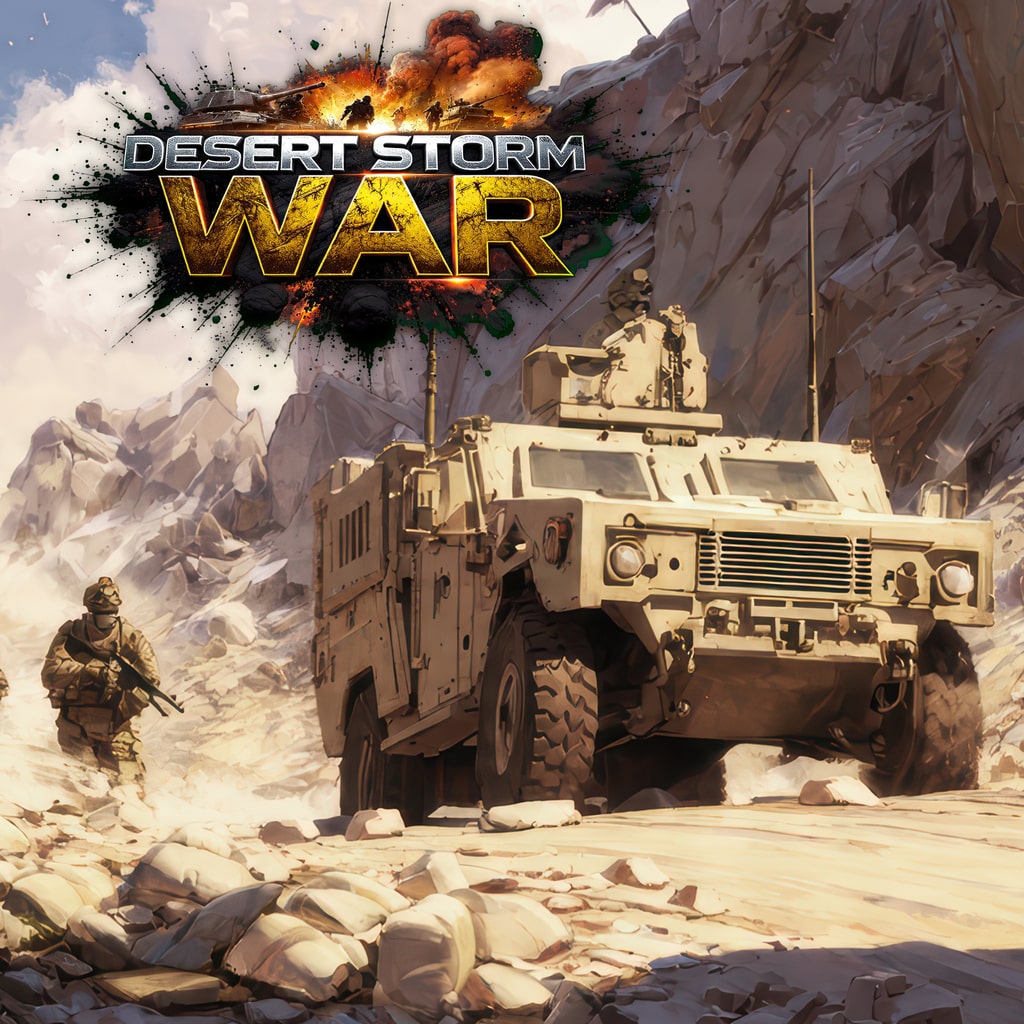
Desert Storm War FPS arrives with a clear mission: to deliver a grounded, squad-based shooter set during the Gulf War, emphasising realism through animation and AI behaviour. It’s an ambitious proposal, especially for a budget title, and one that immediately sparks curiosity. Can a smaller project genuinely capture the tension and coordination of modern warfare? Or does it fall short under the weight of its own ambitions?
The answer, as it turns out, lies somewhere in between.
Squad-Based Combat: The Core That Almost Works
At the core of Desert Storm War is its squad system. You’re never fighting alone—instead, you’re supported by AI-controlled teammates who are designed to act as a cohesive unit. They identify enemies, provide suppressive fire, and occasionally attempt flanking manoeuvres.
When it functions well, it genuinely enhances the experience. There are firefights where your squad pins down enemies while you reposition, creating a sense of tactical flow that feels intentional and satisfying. These moments reflect the kind of game Desert Storm War aspires to be.
However, consistency remains the main issue. Teammates can easily become passive spectators, failing to engage or reacting too slowly to threats. Sometimes, they bunch together awkwardly or get caught on environmental geometry, breaking immersion. The illusion of teamwork is fragile—and when it shatters, it’s hard to ignore.
Enemy AI exhibits a similar pattern. Occasionally clever, often adequate, but rarely dependable. Some encounters feel tense and reactive; others turn into predictable shooting galleries. It’s a system that shows potential but lacks the refinement to sustain it.
Gunplay and Moment-to-Moment Action
The shooting mechanics are straightforward, though not particularly noteworthy. Weapons feel reasonably weighty, and there’s sufficient feedback to make each shot impactful. Cover-based gameplay is encouraged, and coordinating positioning with your squad can lead to satisfying moments of tactical decision-making.
However, beyond that, there is little depth. The game lacks meaningful weapon customisation, evolving combat systems, and has limited enemy variety. After a few missions, most of what the game offers mechanically has been seen.
This results in repetition setting in much earlier than it should. The core loop—advance, shoot, clear, repeat—remains mostly unchanged throughout the campaign. Without new mechanics or increasing complexity, the experience struggles to keep up momentum.
Mission Design: Functional but Forgettable
Desert Storm War’s missions are based on real-world-inspired scenarios: desert ambushes, urban clearing operations, bunker assaults. On paper, this variety should help keep things engaging.
However, in practice, the missions feel overly simplistic. Objectives rarely go beyond basic directives like “eliminate enemies” or “reach the next checkpoint.” There’s little in the way of branching paths, dynamic events, or emergent objectives.
As a result, levels tend to blend together. While the settings change, the structure stays the same. There’s a missed opportunity here to explore more tactical gameplay—something that could have added much-needed depth to the overall experience.
Inverse Kinematics: A Technical Highlight
If there’s one aspect where Desert Storm War truly stands out, it’s in its animation system. The use of inverse kinematics (IK) imparts character movement with a grounded, believable quality that’s rare at this price point.
Soldiers plant their feet naturally on uneven terrain. Weapons adjust dynamically as characters lean into cover. Head tracking and subtle body shifts add a layer of realism that makes encounters feel more physical and immediate.
It’s not just a gimmick—it’s a genuinely impressive feature. The problem is that it exists in isolation. While the animation system enhances immersion, the rest of the game doesn’t quite rise to meet it.
Visuals and Performance
Visually, Desert Storm War remains within budget constraints. Environments lack detail, textures are basic, and lighting is functional rather than atmospheric. While the game depicts the broad aspects of its setting—sand-swept deserts, ruined buildings—it seldom extends beyond that.
On PlayStation 5, the experience is stable but visually unimpressive compared to modern standards. On Nintendo Switch, compromises are more apparent. Reduced draw distances and simplified environments make the world feel even more sparse.
Performance remains steady across platforms, which is commendable, but this comes at the expense of visual quality. It’s a trade-off that keeps the game playable, but not particularly immersive.
Sound Design and Atmosphere
Audio plays a key role here. Gunfire delivers a satisfying punch, and environmental sounds—wind, distant explosions, echoing shots—help create a sense of place.
However, voice lines are limited and often repetitive, and there’s little in the way of a memorable soundtrack. The game rarely builds tension beyond the immediate, moment-to-moment action, leaving the overall atmosphere feeling somewhat flat.
Accessibility and Player Consideration
One welcome feature is the game’s accessibility options. The ability to lessen dependence on rapid inputs or complex controls makes it more accessible to a broader audience. It’s a considerate addition, especially in a genre that often neglects these features.
Although it doesn’t fundamentally alter the experience, it’s a positive step that merits recognition.
Final Verdict
Desert Storm War FPS is a game marked by contrast. It boasts a genuinely interesting technical foundation, especially in its animation system, and shows moments of engaging squad-based combat that suggest something greater.
However, these moments are too sporadic to sustain the full experience. Repetitive mission design, inconsistent AI behaviour, and a lack of mechanical depth hinder it from fulfilling its potential.
There’s a solid concept here—a tactical, squad-focused shooter with a grounded feel—but it never quite comes together. What remains is a competent but ultimately forgettable experience that struggles to stand out in a crowded genre.