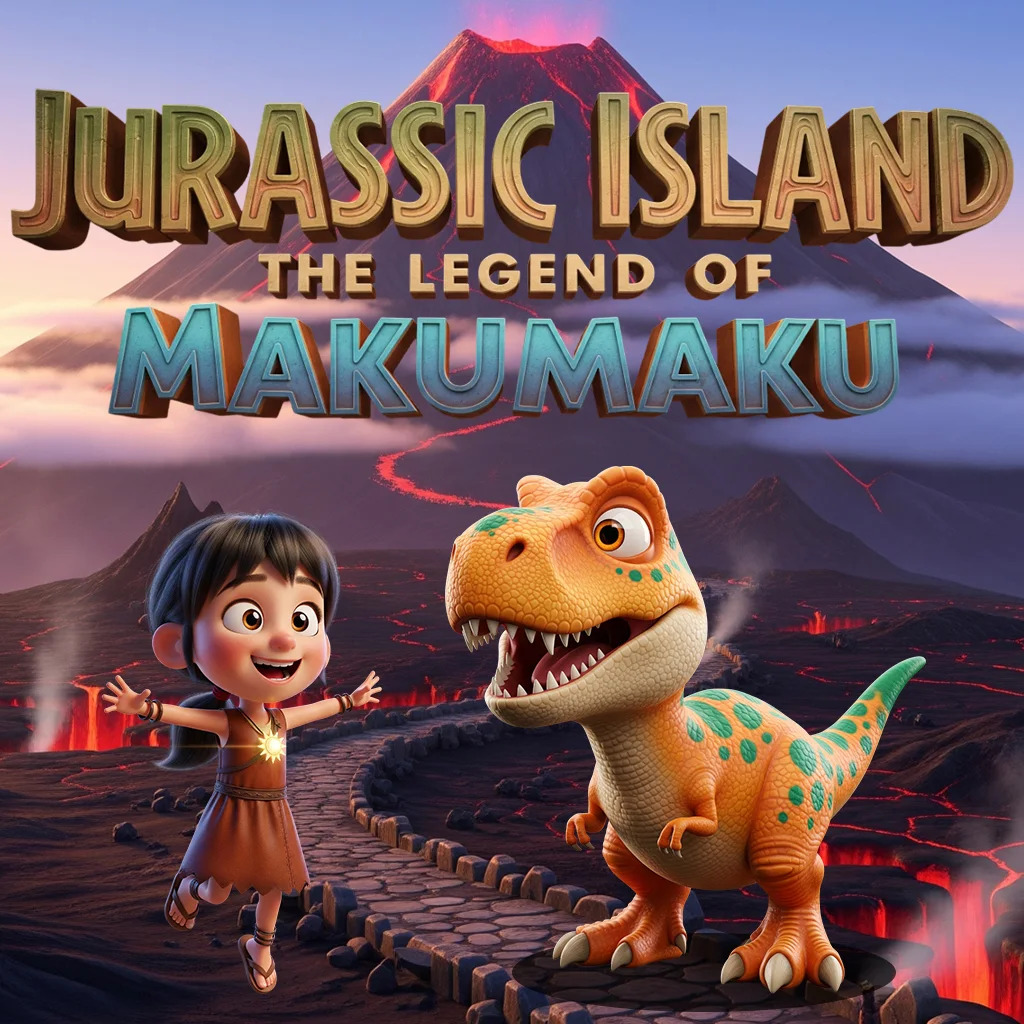
Jurassic Island: The Legend of Makumaku sets out to evoke the spirit of classic island adventures, blending light survival mechanics, exploration, and puzzle-solving within a dinosaur-infested setting. On paper, the premise is immediately appealing: a mysterious island, ancient legends, and the ever-present danger of prehistoric creatures lurking just beyond the treeline. Unfortunately, while the game shows flashes of charm and ambition, it struggles to fully realise its ideas, resulting in an experience that feels more functional than memorable.
This is not a disastrous title, nor is it entirely without merit. Instead, Jurassic Island occupies an uncomfortable middle ground — competent in structure but limited in depth, offering moments of curiosity and discovery that are too often undercut by repetition and technical restraint.
An Island Steeped in Myth
The game’s narrative revolves around the legend of Makumaku, an ancient presence tied to the island’s origins and its lingering dangers. Rather than delivering a cinematic or heavily scripted story, Jurassic Island opts for environmental storytelling and scattered lore. Fragments of text, ruins, and landmarks hint at a lost civilisation and its relationship with the dinosaurs that still roam the land.
This minimalist approach suits the game’s tone, encouraging players to piece together the story at their own pace. However, the execution lacks consistency. Key narrative beats are often vague, and the lack of strong characterisation makes it difficult to feel emotionally invested in the island’s history. The legend itself remains more conceptual than compelling, serving as a thematic backdrop rather than a driving force.
Still, the sense of isolation and mystery works in the game’s favour. There is a genuine atmosphere to wandering through overgrown paths and abandoned structures, even if the narrative never fully capitalises on that potential.
Exploration as the Core Experience
Exploration is the backbone of Jurassic Island. The island is divided into distinct regions — beaches, jungles, ruins, and interior zones — each offering its own hazards and points of interest. Progression is largely tied to discovering new areas, solving environmental puzzles, and acquiring tools that allow deeper access to the island.
Movement is serviceable but unremarkable. Traversal feels slightly stiff, with limited fluidity when navigating uneven terrain or tight spaces. While this doesn’t completely hinder exploration, it does dampen the sense of freedom that an open island environment should provide.
Environmental puzzles range from simple switch activations to light item-based challenges. They are rarely difficult, but they provide enough engagement to break up the pacing. Unfortunately, puzzle variety is limited, and later sections often reuse familiar mechanics rather than introducing meaningful twists.
Dinosaurs: More Presence Than Threat
Given the title, dinosaurs play a surprisingly restrained role in moment-to-moment gameplay. Encounters are infrequent, and when they do occur, they often feel more like obstacles than genuine threats. Most dinosaurs follow predictable behaviour patterns, making them easy to avoid or manage once their routines are understood.
Combat, when present, is simplistic. Tools and weapons lack impact, and encounters rarely demand strategy beyond basic positioning. As a result, tension dissipates quickly, and the sense of danger implied by the setting is never fully realised.
This design choice may have been intentional, focusing on exploration over action, but it leaves the island feeling less alive than it should. Dinosaurs are visually impressive at first glance, yet their limited interaction with the player diminishes their long-term impact.
Survival Mechanics Without Urgency
Jurassic Island flirts with survival mechanics but never fully commits to them. Players manage light resource systems — gathering items, crafting basic tools, and occasionally maintaining health — but these elements are forgiving to the point of irrelevance.
Food and resources are plentiful, and failure states are rare. While this makes the game accessible, it also removes much of the tension associated with survival gameplay. There is little sense of risk in venturing into unknown areas, as the penalties for mistakes are minimal.
The crafting system, though functional, is shallow. Recipes are straightforward, and progression follows a linear path. Once essential tools are unlocked, there is little incentive to experiment further, limiting the sense of player agency.
Visuals: Atmospheric but Uneven
Visually, Jurassic Island delivers a mixed experience. Environmental design is its strongest asset, with dense foliage, ancient ruins, and wide-open vistas contributing to a convincing island atmosphere. Lighting effects, particularly during sunrise and sunset, add warmth and depth to the world.
Character models and animations, however, lag behind the environments. Player movement and dinosaur animations feel stiff, occasionally breaking immersion. Texture quality is inconsistent, with some areas showing care and detail while others appear flat or underdeveloped.
Despite these shortcomings, the overall aesthetic remains cohesive. The island feels like a single, unified space rather than a collection of disconnected levels, which helps maintain immersion even when technical limitations become apparent.
Sound Design and Music
Audio design in Jurassic Island is understated but effective. Ambient sounds — rustling leaves, distant animal calls, and environmental echoes — enhance the sense of place. These elements do much of the heavy lifting in establishing atmosphere, especially during quieter exploration segments.
Music is sparse, often fading into the background or appearing only during key moments. While the compositions are serviceable, they rarely stand out. The restrained use of music suits the game’s tone, but it also means there are few memorable auditory moments to anchor the experience.
Pacing and Longevity
The game’s pacing is steady but occasionally sluggish. Early exploration feels rewarding, as new areas and mechanics are introduced at a reasonable pace. As the game progresses, however, the lack of mechanical evolution becomes apparent. Tasks begin to blur together, and the sense of discovery diminishes.
Completion time is modest, and replayability is limited. There are few alternate paths or optional challenges to encourage multiple playthroughs. Once the legend of Makumaku has been uncovered, there is little left to revisit beyond environmental appreciation.
Final Thoughts
Jurassic Island: The Legend of Makumaku is an earnest but restrained adventure that delivers atmosphere without fully embracing the potential of its premise. Its focus on exploration and environmental storytelling creates moments of quiet intrigue, but shallow mechanics and limited variety prevent it from leaving a lasting impression.
For players seeking a relaxed, low-pressure island adventure with light survival elements, there is enjoyment to be found here. Those hoping for deep systems, dynamic dinosaur encounters, or a richly developed narrative may come away underwhelmed.
Ultimately, Jurassic Island feels like a foundation for something greater — a concept that hints at depth but never quite digs far enough to uncover it.