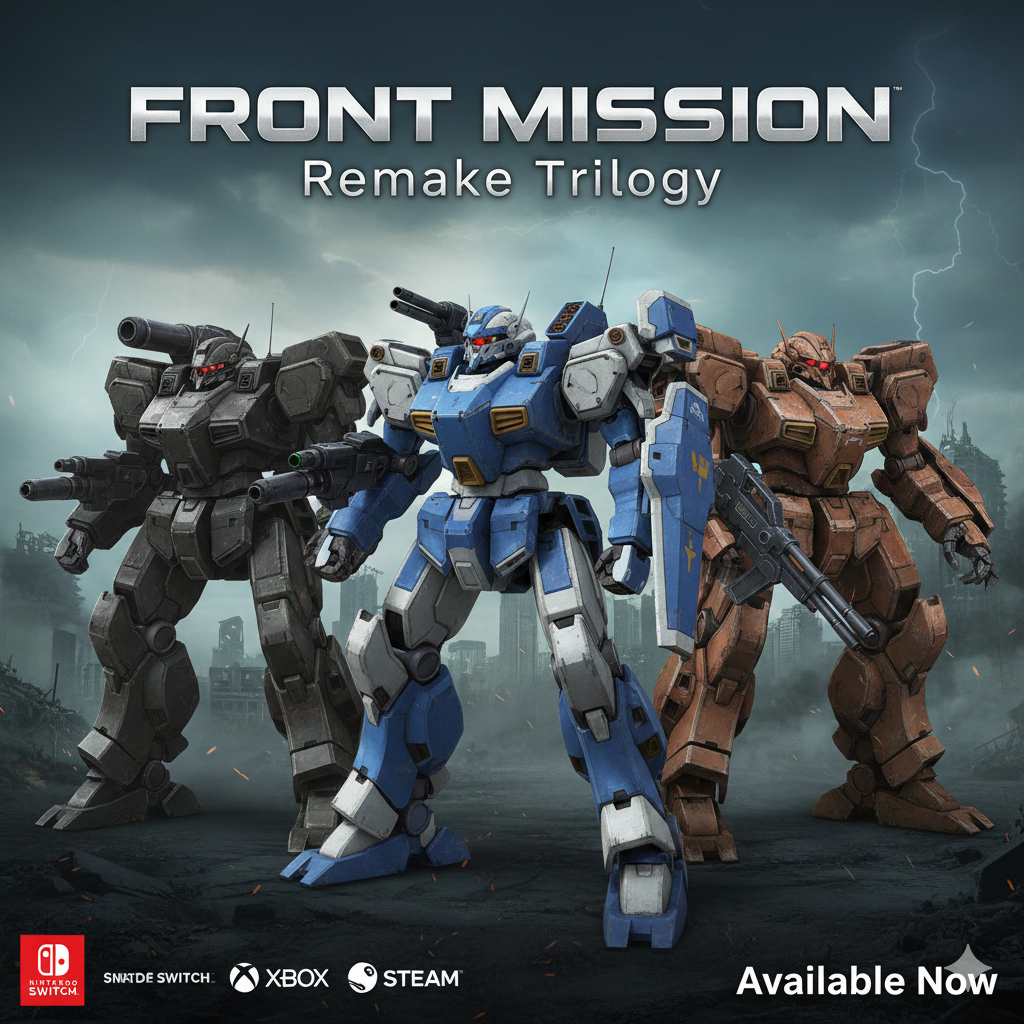
Few tactical RPG series carry the weight and legacy of Front Mission. Born in the mid-1990s under Square’s golden era, the franchise blended hard science-fiction politics with methodical mech warfare, earning a cult following that never quite faded. The FRONT MISSION Remake Trilogy gathers modernized versions of the first three entries, rebuilt by MegaPixel Studio and published by Forever Entertainment, and presents them as a single gateway into one of the genre’s most distinctive worlds. The result is not merely nostalgia repackaged, but a thoughtful revival that reminds us why Wanzers once ruled strategy fans’ imaginations.
A War Told in Three Acts
The trilogy spans decades of conflict centered on Huffman Island and the geopolitical powder keg surrounding it. FRONT MISSION 1st: Remake introduces the universe in 2090, where the Oceania Cooperative Union and the Unified Continental States wage proxy wars using towering mechanized weapons. What begins as a routine mission spirals into conspiracy, personal betrayal, and a grim exploration of how easily soldiers become pawns.
FRONT MISSION 2: Remake jumps twelve years forward to the impoverished People’s Republic of Alordesh. Here the series leans harder into political drama, portraying a nation collapsing under economic pressure and internal strife. The tone is bleaker, more grounded, and often uncomfortable in its depiction of post-war desperation.
Finally, FRONT MISSION 3: Remake shifts perspective to a more character-driven narrative with dual story routes. Protagonist Kazuki Takemura can align either with his sister Alisa or investigator Emma Klamsky, sending the plot down dramatically different paths involving secret weapons and corporate manipulation.
Taken together, the trilogy forms an unusually cohesive saga. Themes of nationalism, technological ethics, and the human cost of mechanized warfare echo across all three games. Playing them back-to-back highlights how ambitious the original writers were; these are not simple “good versus evil” tales but messy geopolitical thrillers where every faction believes it is justified.
Tactical Warfare Reforged
At the mechanical level, the remakes stay remarkably faithful. Battles remain turn-based affairs fought on grid-based maps where positioning, weapon ranges, and Wanzer loadouts determine victory. Veterans will recognize the deliberate pace: edging units forward, targeting specific body parts, and praying a lucky missile doesn’t turn your carefully built mech into scrap.
Customization is still the star attraction. Each Wanzer can be assembled from legs, arms, body, and weapons sourced from competing manufacturers, allowing for countless builds. Want a nimble scout with shoulder rockets? A walking fortress bristling with machine guns? The games happily oblige. This tinkering loop—fight, earn money, rebuild stronger—remains as addictive as ever.
MegaPixel Studio’s major contribution lies in accessibility. Interfaces have been cleaned up, tutorials expanded, and quality-of-life features added without diluting complexity. New players can finally approach systems that once required manuals and forum guides, while purists can disable assists to preserve the old-school challenge.
Visual Resurrection
The most obvious changes are visual. The original sprites and early 3D models have been replaced with detailed modern assets. Wanzers now look appropriately heavy and industrial, environments are more atmospheric, and battle animations carry satisfying impact. These are not flashy AAA makeovers, but respectful restorations that keep the gritty aesthetic intact.
Performance across the trilogy is generally solid, and the user interface benefits greatly from modern screens. Menus that once felt cramped are now readable, and camera controls during combat provide clearer tactical awareness. The reorchestrated music, particularly in the third game, adds emotional weight without betraying the classic melodies fans remember.
Where the Rust Shows
Despite the polish, the remakes cannot completely hide their age. Mission design in the first two titles can be brutally unforgiving, sometimes relying on trial and error rather than strategy. Enemy reinforcements appear without warning, and certain objectives feel designed to punish rather than challenge.
Pacing also reflects older sensibilities. Long stretches of dialogue and limited mid-mission saves may test modern attention spans. FRONT MISSION 2 in particular retains its reputation as the most punishing entry, and while patches have smoothed some frustrations, it remains a stern teacher.
Narratively, the localization occasionally sounds stiff, and character portraits lack the expressive range contemporary RPGs offer. These are historical artifacts more than flaws, yet newcomers should be prepared for storytelling rhythms from another era.
The Power of Choice
What elevates the trilogy above mere museum pieces is how relevant its ideas feel today. The depiction of corporations manipulating wars, nations collapsing under debt, and technology outpacing ethics resonates strongly. FRONT MISSION 3’s branching routes remain a masterstroke, encouraging replays that reveal entirely new perspectives on the same crisis.
Combat too retains a unique identity. Unlike flashier strategy games that favor spectacle, Front Mission emphasizes logistics and consequence. Losing an arm mid-battle can permanently change a unit’s role; resources are scarce; victory often tastes bittersweet. Few modern titles capture that grounded, military authenticity.
A Monument Worth Rebuilding
The FRONT MISSION Remake Trilogy ultimately succeeds because it respects both past and present. MegaPixel Studio resisted the urge to transform these classics into something they were not. Instead, they sanded the rough edges, clarified the systems, and let the core design speak for itself.
For longtime fans, this collection is a long-awaited homecoming—three essential chapters finally playable without digging out aging hardware. For newcomers, it offers a dense, rewarding alternative to more streamlined tactical RPGs. You must meet the games on their terms, but the effort is repaid with some of the genre’s richest mech warfare.
Not every bolt is shiny, and some missions still creak like an old Wanzer joint, yet the trilogy stands as proof that thoughtful remakes can preserve history while inviting new recruits onto the battlefield.