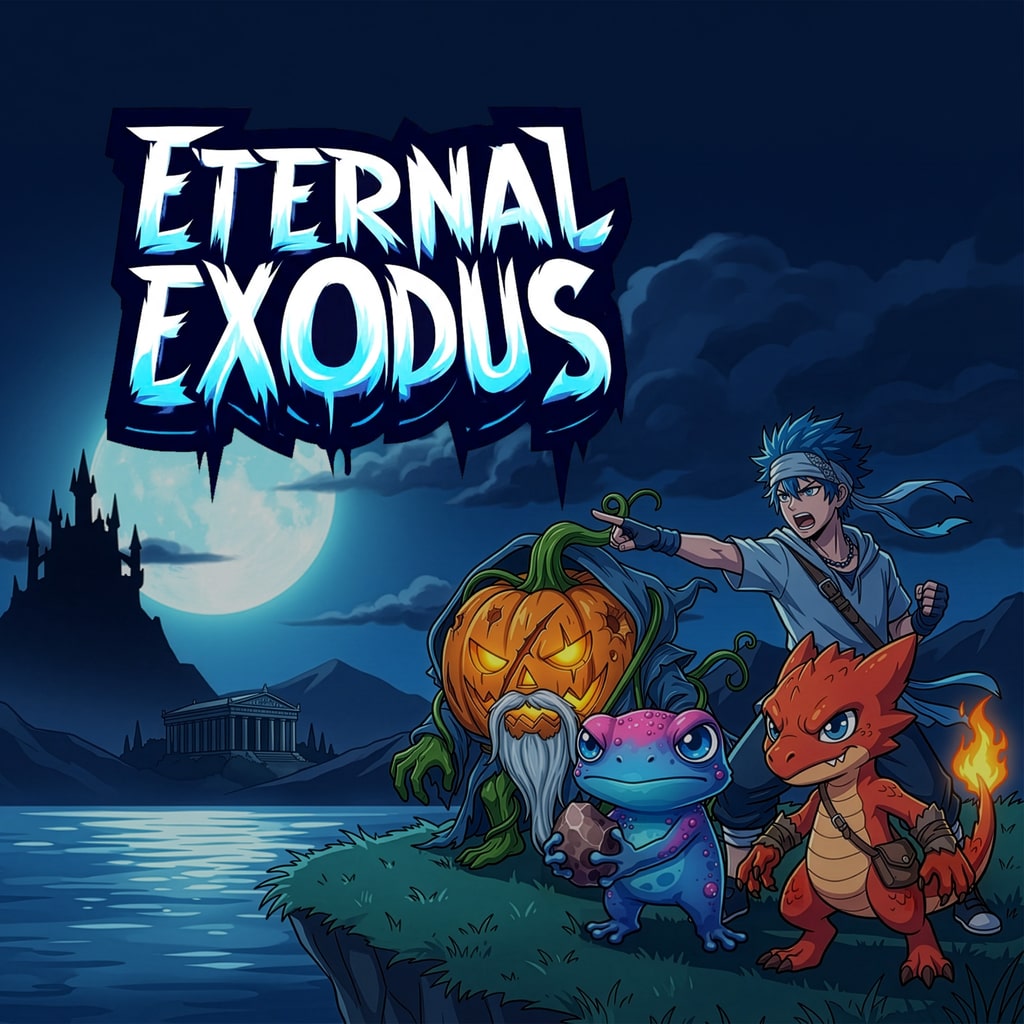
Released on April 10, 2026, for PlayStation 5 and PlayStation 4, and on May 4th for Nintendo Switch and Nintendo Switch 2. Eternal Exodus arrives with an ambitious premise: a 2D monster-catching RPG set not in a whimsical fantasy world but in the afterlife itself. Developed and published by Fordesoft, LLC, it wears its inspirations proudly—particularly the darker, more philosophical edges of classic JRPGs and demon-collecting series—while attempting to carve out its own identity through systems-driven gameplay and a weighty narrative.
What emerges is a game that is often compelling, occasionally uneven, yet consistently interesting—particularly for players willing to engage with its deeper mechanics and thematic ambitions.
A Journey Beyond Death
Eternal Exodus wastes little time establishing its tone. The “Dead Plains” are no comforting vision of the afterlife. Instead, they are rigid, hierarchical, and quietly oppressive—governed by a force known as “The Crown.” Immortality, it turns out, comes with conditions, and stepping out of line quickly reveals how fragile that eternity truly is.
You play as a character who gains access to a forbidden device known as a Subjugator, which allows you to summon and command demons. From there, what begins as a personal act of rebellion gradually expands into something far more existential. The narrative leans heavily into philosophical territory, touching on themes of control, identity, free will, and the nature of existence itself.
This is not a story that rushes to explain itself. Like many of its inspirations, Eternal Exodus prefers ambiguity, leaving players to piece together meaning through dialogue, environmental storytelling, and the gradual uncovering of lore. For some, this will feel engrossing and thought-provoking; for others, it may come across as overly opaque.
Combat: Strategy Through Exploitation
At its core, Eternal Exodus uses a turn-based combat system that will feel familiar to genre veterans, yet offers enough nuance to keep encounters engaging. The central mechanic revolves around exploiting enemy weaknesses to earn extra turns—a system that rewards careful planning and knowledge of enemy types.
Battles are rarely about brute force. Instead, success comes from understanding elemental affinities, sequencing actions correctly, and managing your party’s composition. A well-executed turn can snowball into a devastating chain of attacks, while a poorly planned one can leave you exposed.
The system is satisfying when it clicks, but it does come with a learning curve. Early encounters can feel punishing, particularly as the game expects players to engage with its deeper systems sooner rather than later. This is not a casual, auto-battle-friendly experience—it demands attention and rewards mastery.
Demon Collection, Fusion, and Customisation
Where Eternal Exodus truly distinguishes itself is in its layered approach to demon management. With over 150 demons to collect, the game offers a robust fusion system that lets players combine creatures into more powerful forms. This is complemented by the “Soul Socketing” mechanic, which adds another layer of customisation by letting you modify abilities and stats.
The result is a system that feels both deep and flexible. You are not simply collecting demons—you are shaping them, experimenting with combinations, and building a team that reflects your preferred playstyle.
Crafting also plays a significant role. Weapons and armour are not just stat upgrades; they can teach new abilities to your demons, creating a feedback loop between equipment and character development. This interconnected design encourages experimentation and makes progression feel more dynamic.
However, this depth can occasionally be overwhelming. Menus are dense, and the game does not always explain its more intricate systems clearly. Players willing to invest the time will find a rewarding level of control, but those looking for a more streamlined experience may struggle.
World Design and Exploration
The Dead Plains are presented in a 2D perspective that blends classic JRPG sensibilities with modern design touches. Environments are varied, ranging from desolate wastelands to surreal, almost abstract spaces that reflect the game’s metaphysical themes.
Exploration is structured yet rewarding. Side quests, hidden paths, and environmental puzzles encourage straying from the main path. These optional elements often add context to the world, deepening the player’s understanding of the afterlife’s structure and its inhabitants.
That said, navigation can occasionally feel repetitive. Some areas rely heavily on similar visual motifs, which can make backtracking less engaging. While the thematic consistency is strong, a bit more visual diversity would have helped maintain a stronger sense of discovery throughout the journey.
Visuals and Audio
Visually, Eternal Exodus embraces a retro-inspired aesthetic, with detailed pixel art and fluid animations that bring its world and characters to life. Demon designs are particularly strong, striking a balance between grotesque and fascinating.
The UI, while functional, can feel cluttered—especially when managing the fusion and crafting systems. It gets the job done, but it lacks the elegance of some of the genre’s more polished contemporaries.
The soundtrack leans towards atmospheric compositions, often favouring mood over melody. It complements the game’s tone effectively, though it rarely stands out as memorable on its own. Sound effects, particularly in combat, provide satisfying feedback and reinforce the impact of actions.
Narrative Ambition vs Accessibility
One of Eternal Exodus’s greatest strengths is also one of its biggest risks: its narrative ambition. The game is unapologetically philosophical, often prioritising thematic exploration over straightforward storytelling.
For players who enjoy dissecting meaning and engaging with abstract ideas, this approach can be deeply rewarding. The game invites interpretation, encouraging players to question not only the world but also the systems that govern it.
However, this same approach can create distance. Characters, while conceptually interesting, sometimes lack the emotional grounding needed to connect fully with the player. The story is compelling on an intellectual level, but it does not always resonate emotionally.
Performance and Console Experience
On the PlayStation 5, Eternal Exodus runs smoothly, with fast load times and stable performance. The transition between exploration and combat is seamless, and the game maintains a consistent frame rate throughout.
Although it does not make extensive use of advanced DualSense features, the core experience is solid and reliable. The PS4 version also performs competently, making the game accessible across both platforms without significant compromises.
Final Verdict
Eternal Exodus knows exactly what it wants to be: a dense, systems-driven RPG with philosophical ambitions and a clear reverence for classic design. It does not chase accessibility or broad appeal, instead focusing on delivering a deep, sometimes challenging experience for players willing to meet it on its own terms.
Its combat and customisation systems are its greatest strengths, offering a level of depth that rewards experimentation and mastery. Its narrative, while intellectually engaging, may not resonate with everyone, and its complexity can occasionally be a barrier.
But for those who appreciate thoughtful design and aren’t afraid to dig beneath the surface, Eternal Exodus offers a journey that is as intriguing as it is demanding.