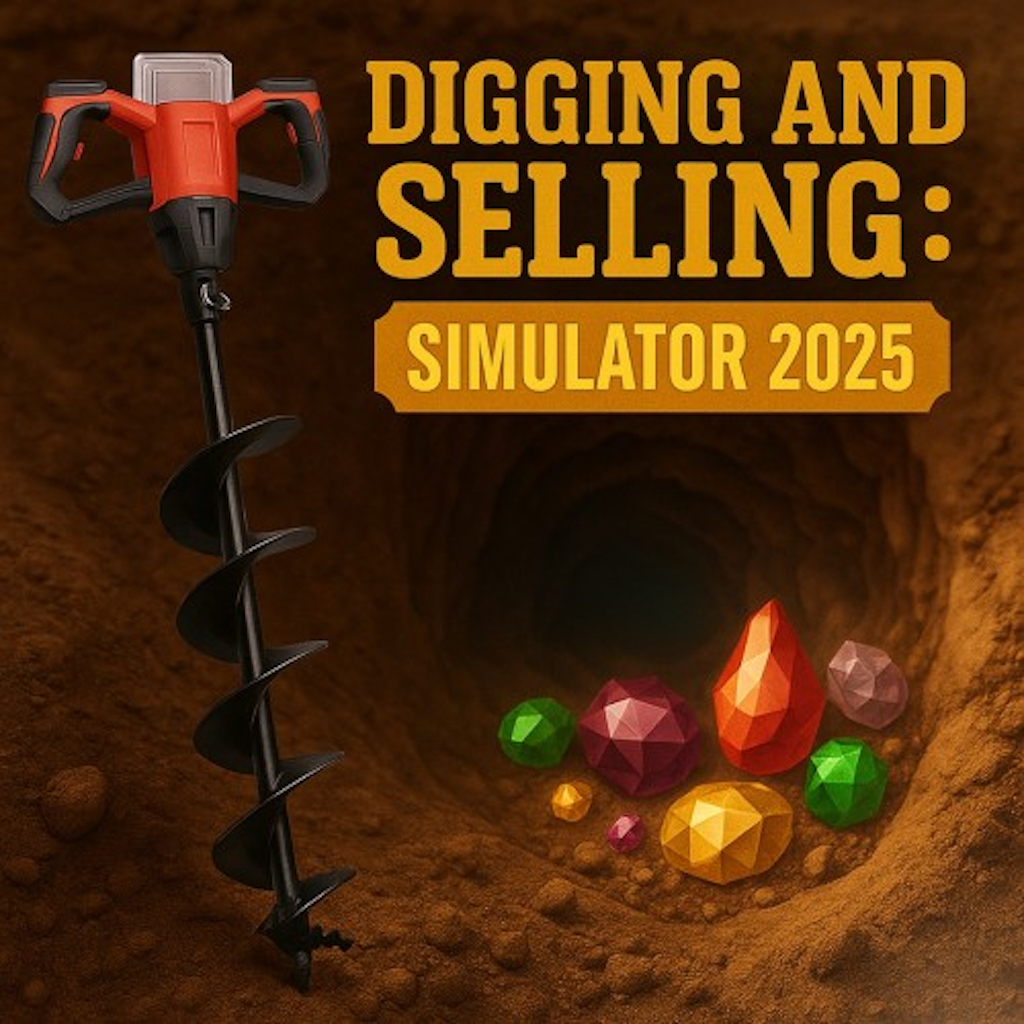
Digging And Selling: Simulator 2025 is the kind of game that turns a deceptively humble premise into surprisingly absorbing play. At a glance, its concept is simple: dig for resources, sell what you find, and use the proceeds to improve your tools, expand your digs, and uncover ever richer layers of the earth beneath you. Yet beneath this apparent simplicity lies a compelling loop of risk, reward, progression, and personal optimisation—a loop that can grow genuinely engaging if you enjoy incremental growth, resource management, and the satisfaction of slow but steady mastery.
In a genre saturated with survival, mining, and economy simulators, Digging And Selling stakes its claim on rhythm and pacing rather than spectacle. There are no sprawling narratives, no cataclysmic stakes, and no sprawling sandbox brimming with emergent drama. What carries this game is the feel of progress, the pull of incremental optimisation, and the tangible sense that each new purchase, upgrade, or strategic decision visibly shapes your operation.
The Core Loop — Simplicity That Sings
At the heart of Digging And Selling is a deceptively straightforward loop: extract resources, sell them, reinvest your profits, dig deeper or wider, and repeat. Like any effective simulation, this loop hinges on feedback that feels meaningful. When you first start, your toolset is underpowered, profits are modest, and you’re constantly making tough decisions about where best to invest your limited earnings. Do you buy a more durable pickaxe or spend on fuel to reach deeper resources? Should you expand your dig site horizontally or focus on penetrating vertically to richer veins?
This loop is where the game earns its keep. Early decisions matter, trade-offs matter, and the rate at which your capabilities expand depends on how well you balance risk and investment. The satisfaction derived from a large haul after days of grinding smaller digs is genuine. There’s a tangible sense of forward momentum when a new tool, drill bit, or support upgrade finally unlocks resources that were previously out of reach.
However, the loop’s strength is also its limitation: it is inherently repetitive. The experience hinges on pacing and feedback, and while the game excels when that pacing feels tuned, it can feel grindy if momentum stalls or if progress becomes too predictable. That said, the core design rarely feels unfair—the challenge is knowing when to invest, not overcoming arbitrary difficulty spikes.
Digging Mechanics — Physics, Strategy, and Spatial Logic
The digging mechanics in Digging And Selling strike a balance between strategy and simplicity. Every dig action has cost implications—time, tool wear, fuel, and sometimes structural concerns like stability or debris management. This means you’re not just randomly swinging at walls and hoping for treasure; you are plotting routes, reading resource indicators, and working with limited visibility to anticipate what lies ahead.
The dual tension of risk and reward is a core strength here. A well-planned vertical shaft might yield heavy ore deposits, but if done carelessly you risk collapse or higher fuel costs to reach depth. Similarly, sprawling horizontal digs can reveal rich seams, but at the cost of increased tool wear and transport logistics. The simulation doesn’t resort to arbitrary hazards; every challenge traces back to a system you can understand and, with experience, predict.
Resource discovery isn’t entirely uniform—certain materials are more common at specific depths or biomes, and tracking patterns becomes part of the long-term strategy. There is an “aha” moment that arrives once you internalise these patterns, and it’s one of the genuine pleasures of the game.
Economy and Selling — Dynamics That Reward Timing
Selling what you dig isn’t a trivial afterthought—it’s a key pillar of the game’s strategic framework. Market prices fluctuate based on simulated supply and demand, periodic contracts, and sometimes random events that temporarily boost or suppress values. This system forces players to think beyond mere extraction: when you sell matters.
Do you hold onto a precious resource in anticipation of a price surge, risking storage cost and tool deterioration? Or do you liquidate early and secure steady income at the risk of missing out on a bigger windfall? These decisions add meaningful texture to what could otherwise be a mechanical loop.
One limitation is that price fluctuations, while impactful, rarely create dramatic market shifts. Peaks and valleys are modest, and extreme swings are infrequent. This keeps the experience accessible, but it also blunts some economic tension for players who enjoy high-risk speculation as a core mechanic. Still, the system as implemented serves the game’s overall pacing well, rewarding thoughtful play without punishing missteps too severely.
Progression, Upgrades, and Customisation
Progression in Digging And Selling happens through tangible upgrades: better digs, stronger tools, more storage capacity, and expanded infrastructure. These upgrades are satisfying because they open new possibilities rather than simply inflate numbers.
Tool upgrades improve durability or digging speed. Transport upgrades reduce fuel costs or increase haul capacity. Support upgrades—lighting, stability beams, debris clearance systems—unlock deeper and more complex digs. The result is a sense of meaningful expansion rather than linear stat inflation.
However, the upgrade system remains practical rather than flashy. There are no dramatic abilities or emergent mechanics tucked away; each upgrade is a logical extension of existing systems. Players seeking wild variety or radically different playstyles may find the progression predictable, but for those who enjoy incremental optimisation and careful planning, it’s well-calibrated.
Presentation — Functional and Focused
Visually, Digging And Selling is functional. The art style leans toward clarity and readability rather than visual flair. Resource nodes are visibly distinct, tool and equipment stats are easy to interpret, and the interface prioritises information over panache.
For a simulation rooted in measurement and optimisation, this is appropriate. There are no distracting flourishes, and the visual language reinforces utility. That said, some players may find the presentation austere. While the simplicity aids gameplay clarity, it rarely surprises or delights on an aesthetic level. Environments have variety across biomes, but they lack dramatic stylistic identity.
Audio design mirrors this philosophy. Tool impacts, engine hums, and sell interactions are serviceable and unobtrusive. Background ambience supports focus without drawing undue attention. It’s effective, if unremarkable.
Accessibility and Learning Curve
The game’s onboarding is gentle and effective. Early objectives introduce mechanics one at a time, and the UI offers tooltips that explain systems clearly. Players unfamiliar with resource sims will find the entry point welcoming, while seasoned players will appreciate the opportunity to explore deeper strategies without mandatory tutorials slowing progress.
The learning curve remains moderate throughout. As new mechanics layer in—market fluctuations, resource patterns, structural challenges—the game nudges players toward understanding without ever feeling opaque or punitive.
Optional assist features—such as projected resource indicators and budget forecasting—are appreciable inclusions that help players focus on strategy rather than micromanagement.
Pacing and Replay Value
Here is where Digging And Selling occasionally reveals its limitations. The core loop is satisfying, but it is fundamentally iterative. Over long sessions, the familiar rhythms of digging, selling, upgrading, repeat can start to feel predictable. For players who derive satisfaction from incremental progress and optimisation, this will feel like a feature, not a flaw. For others, the absence of radically different challenges or emergent events may make extended play feel familiar rather than continually engaging.
There are no branching narrative arcs or dramatic sandbox events; progression is measured by expansion and efficiency. Replay value lies in personal performance goals—perfecting routes, maximising profits, or achieving faster extraction cycles—not in divergent game states.
Verdict
Digging And Selling: Simulator 2025 is a solid, methodical simulation that excels where focus, clarity, and meaningful progression are most important. Its core loop is satisfying, its mechanics are intuitive yet strategic, and its systems interact in ways that reward thoughtful play. While its aesthetic polish and long-term variety may not elevate it to “must-own” status for every player, it succeeds admirably at what it sets out to do.
For fans of resource management and incremental optimisation, this is a rewarding experience—one that turns humble digging into a game of careful decisions, market timing, and incremental mastery.