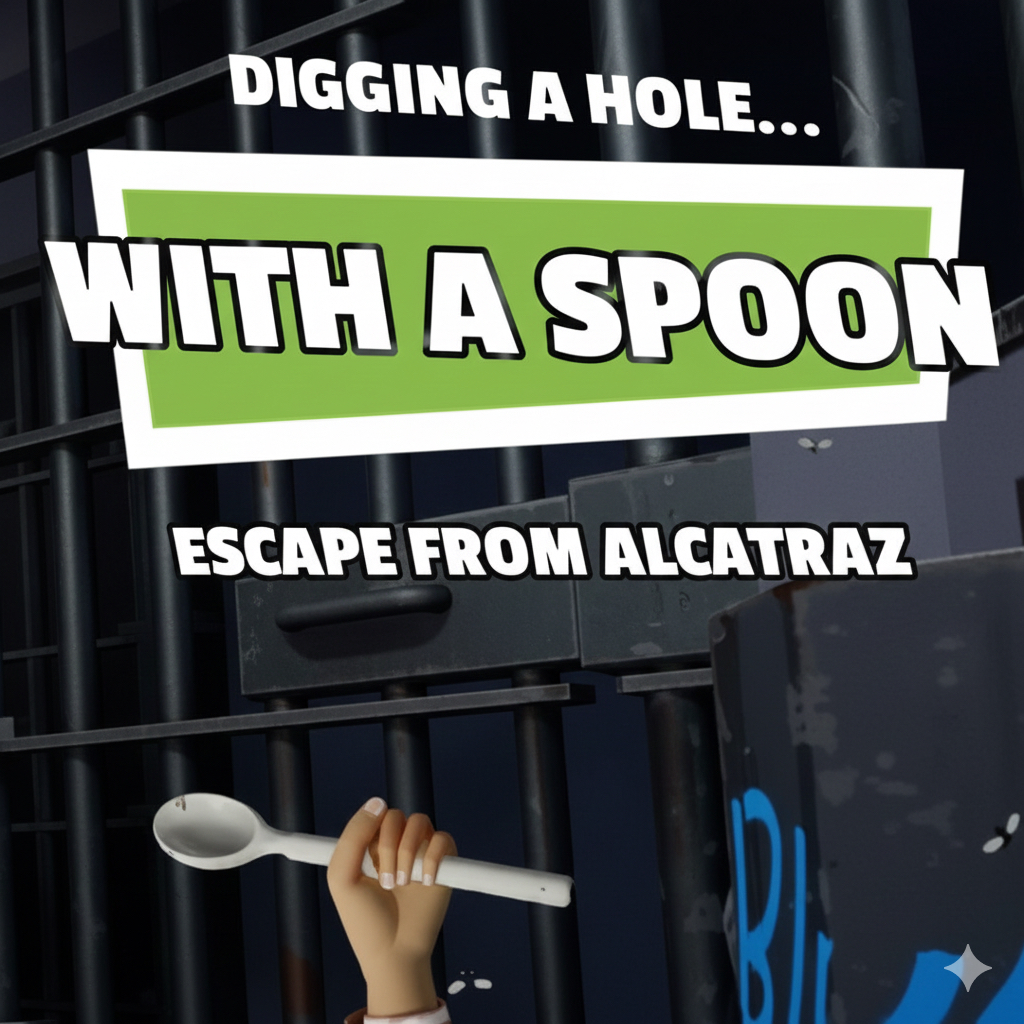
Digging a Hole… with a Spoon… Escape from Alcatraz is a game that wears its joke directly in the title and then commits to it with surprising sincerity. What initially reads like a novelty gag—a deliberately absurd prison-escape premise built around one of the least effective tools imaginable—slowly reveals itself as a focused, system-driven experience about persistence, patience, and the quiet grind of incremental progress. It is not a game interested in power fantasies or dramatic reversals. Instead, it asks a far more specific question: how long are you willing to commit to a bad plan if it’s the only plan you have?
That commitment to its central idea is both the game’s greatest strength and its biggest risk. For the right player, Digging a Hole… with a Spoon… Escape from Alcatraz is oddly compelling, even meditative. For others, it may feel repetitive, underdeveloped, or overly reliant on its central joke. The difference lies almost entirely in how much value you place on process-driven design over conventional pacing.
A Premise Built on Absurd Determination
Set within the infamous Alcatraz prison, the game casts you as an inmate with a singular goal: escape. There are no elaborate conspiracies, no cinematic cutscenes, and no ensemble cast of colourful prisoners helping you along the way. Your defining trait is determination, and your defining tool is a spoon.
The brilliance of the premise is that it immediately establishes tone, scale, and expectations. You are not going to outsmart the system overnight. You are not going to overpower guards or stumble upon a convenient keycard. Progress is slow, deliberate, and intentionally tedious. The game leans into the historical mythology of prison escapes while simultaneously undercutting it with mundane reality. Digging a hole is hard. Doing it badly is harder.
Core Gameplay — Repetition as Design Philosophy
At its core, Digging a Hole… with a Spoon… Escape from Alcatraz is about repetition. You dig. You manage stamina. You conceal progress. You return to digging. Each action feeds into the same loop, and the game makes little attempt to disguise this structure behind artificial variety.
What elevates this loop beyond simple busywork is the way it tracks progress and consequences. Every scoop of dirt matters. Every decision—whether to dig deeper, rest, or hide your work—carries weight. The spoon degrades, time advances, and external pressures slowly build. This creates a low-level tension that keeps the act of digging from becoming entirely mechanical.
That said, the game walks a fine line. When the systems are balanced well, repetition becomes ritualistic and satisfying. When they are not, it can tip into monotony. The experience is at its strongest during the mid-game, where the accumulation of small successes begins to feel meaningful without yet overstaying its welcome.
Resource Management and Risk
Despite its simple surface, the game incorporates light resource management that gives structure to its slow pace. Stamina, tool condition, time, and concealment all intersect to create meaningful trade-offs. Push too hard and you risk exhaustion or discovery. Play too cautiously and progress stalls.
This tension gives the game its sense of identity. It is less about “winning” moment-to-moment and more about maintaining momentum over time. The absence of traditional fail states—no sudden game-over screens or dramatic losses—reinforces the idea that escape is a long-term project, not a series of discrete challenges.
However, the lack of systemic escalation means that once players fully understand these mechanics, the sense of danger diminishes. The game could benefit from more dynamic variables or late-game complications to reintroduce uncertainty.
Presentation — Functional, Not Flashy
Visually, Digging a Hole… with a Spoon… Escape from Alcatraz opts for a utilitarian style that prioritises clarity over atmosphere. The environments are sparse but readable, communicating necessary information without distraction. This works in service of the game’s theme, though it does little to elevate the experience aesthetically.
The audio design follows a similar philosophy. Sound effects are subdued, reinforcing the clandestine nature of your actions, while ambient noise provides just enough presence to avoid silence without becoming intrusive. There is no sweeping score here—only the quiet persistence of routine.
While this restraint suits the concept, it also limits emotional engagement. The game rarely surprises visually or sonically, which makes the long playtime feel even longer for those not fully invested in the loop.
Pacing and Longevity
Pacing is the most divisive aspect of Digging a Hole… with a Spoon… Escape from Alcatraz. The game is unapologetically slow, and it makes no attempt to compress or streamline its experience. That honesty is admirable, but it also narrows the audience considerably.
Players who appreciate incremental progress, routine, and self-imposed discipline will find a strange satisfaction in watching their escape slowly take shape. Those looking for escalation, narrative payoff, or mechanical evolution may find the experience static.
Replayability is limited. Once you have completed an escape, there is little incentive to repeat the process beyond personal challenge. The systems do not meaningfully change between runs, and the absence of alternate routes or endings further restricts long-term appeal.
Verdict
Digging a Hole… with a Spoon… Escape from Alcatraz is a game defined by commitment—both from its developers and its players. It takes a single joke and explores it with earnest mechanical focus, resulting in an experience that is oddly absorbing when approached on its own terms.
Its minimal presentation, repetitive structure, and narrow scope prevent it from achieving broad appeal, but within those constraints lies a surprisingly thoughtful meditation on patience and persistence. This is not a game for everyone, but it does not try to be.
For players willing to engage with its slow, methodical rhythm, it offers a unique and quietly memorable experience.