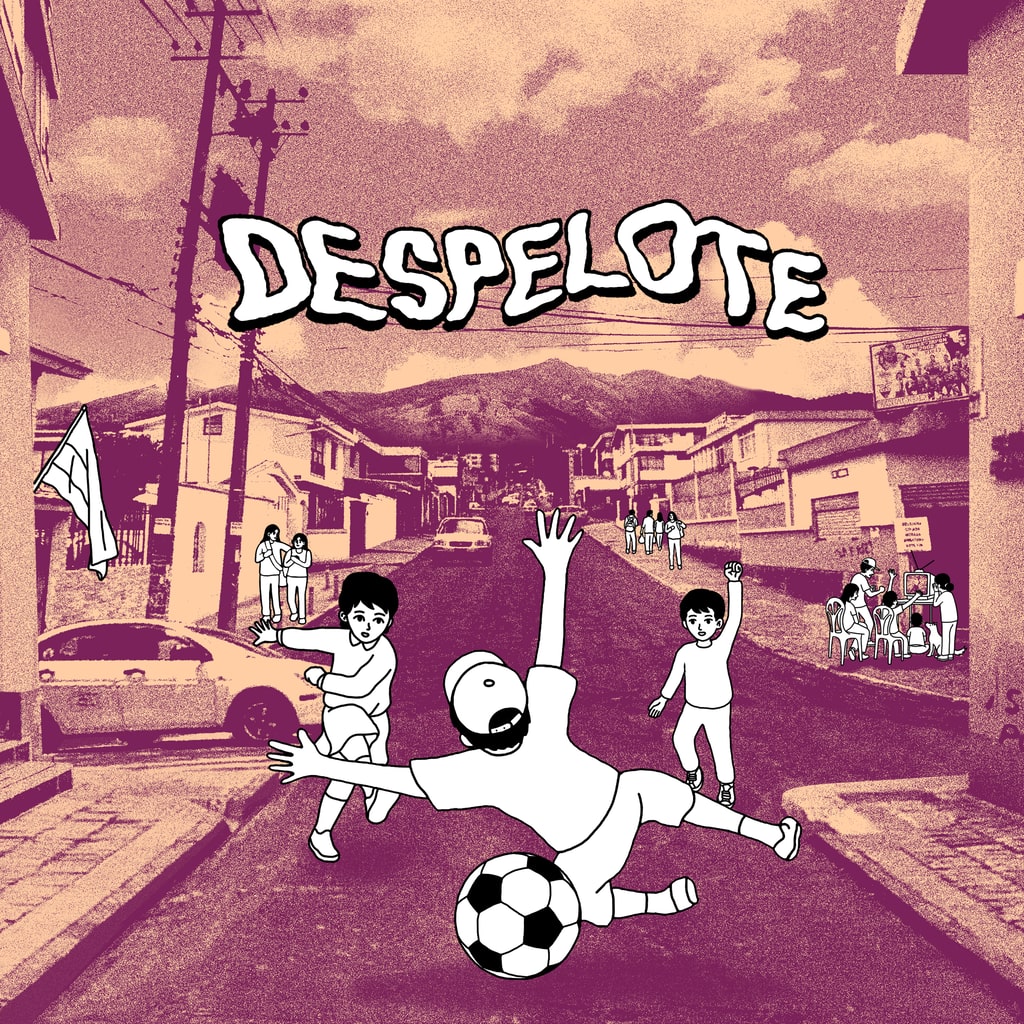
Some games aim to entertain, others aim to challenge, and a rare few aim simply to remember. Despelote falls firmly into the latter category. This semi-autobiographical, slice-of-life experience is less concerned with traditional gameplay systems and more focused on evoking a specific place, time, and emotional state. Set in Quito, Ecuador, during the build-up to the country’s historic qualification for the 2002 FIFA World Cup, despelote is a quiet, thoughtful exploration of childhood, community, and the way football seeps into everyday life.
Rather than presenting football as a competitive sport, despelote treats it as a cultural undercurrent — something that exists everywhere at once. It is played in the streets, discussed in whispers and arguments, heard through radios and televisions, and felt in the collective mood of a nation. The result is a game that feels deeply personal, intimate, and refreshingly unconcerned with conventional genre expectations.
A Story Told Through Memory
At the centre of despelote is Julián, a young boy navigating daily life while the country collectively holds its breath for footballing glory. The story unfolds episodically, with each chapter representing moments from Julián’s childhood. There is no overarching plot in the traditional sense. Instead, the game stitches together fragments of memory — afternoons kicking a ball, conversations overheard from adults, boredom, curiosity, and fleeting joy.
This approach works remarkably well. despelote understands that childhood memories are rarely linear or neatly structured. Scenes drift in and out, sometimes abruptly, sometimes lingering longer than expected. The narrative trusts the player to piece together meaning from tone, context, and repetition rather than exposition.
The writing is understated and naturalistic, capturing the way children observe the world without fully understanding it. Adult conversations fade into the background, humour emerges unexpectedly, and moments of frustration or wonder feel entirely authentic. It’s a story that gains strength from its restraint.
Gameplay: Minimalist by Design
From a mechanical standpoint, despelote is intentionally sparse. Players can walk around neighbourhoods, interact lightly with objects and people, and — most notably — kick a football. The act of kicking the ball is central, but not in the way football games traditionally frame it. There are no matches, no scores, and no objectives tied to winning or losing.
Instead, kicking the ball is about presence. You kick it against walls, down streets, into crowds, sometimes accidentally hitting people or objects and receiving mild reactions. The ball behaves realistically, bouncing unpredictably and rolling away if neglected, mirroring the chaotic joy of street football.
The lack of explicit goals may frustrate players expecting direction or challenge, but this is by design. despelote isn’t interested in mastery or progression. It wants you to exist in the space, to feel the rhythms of daily life, and to notice how football connects disparate moments together.
Interactions are deliberately limited. Dialogue choices are rare, puzzles are minimal, and failure states are practically non-existent. This won’t appeal to everyone, but it aligns perfectly with the game’s thematic goals.
A Distinctive Audio-Visual Identity
Visually, despelote is striking in its simplicity. Characters are rendered in a rough, sketch-like style, while environments often appear more grounded and realistic. This contrast creates a dreamlike quality, reinforcing the idea that we are seeing the world through memory rather than objective reality.
The animation is intentionally loose. Movements feel slightly awkward, occasionally stiff, but this only adds to the sense of authenticity. It feels like recalling moments rather than replaying them.
The sound design is one of the game’s greatest strengths. Ambient noise — distant conversations, traffic, radios, televisions — constantly fills the space. Football commentary drifts in and out, often in Spanish, grounding the experience firmly in its cultural context. The audio never demands attention, but it quietly reinforces mood and setting at every turn.
Music is used sparingly, allowing silence and environmental sound to do most of the emotional heavy lifting. When music does appear, it feels purposeful and understated.
Football as Cultural Texture
What makes despelote special is how it treats football not as a game, but as a shared language. Matches happen off-screen more often than not. You hear reactions before you understand why. Adults become distracted, moods shift, celebrations erupt unexpectedly.
For players familiar with football culture, these moments will resonate deeply. For those less invested in the sport, the game still succeeds by framing football as background noise — something omnipresent but not always understood, especially from a child’s perspective.
This approach avoids glorifying or over-explaining the sport. Instead, it captures how football becomes woven into daily life, shaping conversations, routines, and emotional landscapes without ever fully taking centre stage.
Pacing and Emotional Impact
despelote moves slowly, sometimes uncomfortably so. Scenes end abruptly, chapters are short, and momentum is deliberately fragmented. While this enhances the feeling of memory, it can also leave players feeling slightly disconnected or unsure of purpose.
However, the emotional payoff lies in accumulation rather than climax. By the end, despelote leaves a lingering impression rather than a dramatic conclusion. It feels less like finishing a game and more like closing a photo album.
Players seeking traditional catharsis or narrative resolution may be disappointed. Those open to introspection and subtlety will find the experience quietly powerful.
Who Will Appreciate despelote?
despelote is not for everyone — and it doesn’t try to be. It will resonate most strongly with players who enjoy narrative-driven experiences, experimental design, and emotionally grounded storytelling. Fans of games that prioritise mood, memory, and cultural specificity over mechanics will find a lot to admire.
Players looking for challenge, replayability, or structured gameplay may struggle to connect with it. This is a game to be felt more than played.
Final Verdict
Despelote is a delicate, thoughtful, and deeply personal experience that uses minimal interaction to explore memory, identity, and the quiet power of shared cultural moments. It may frustrate players expecting traditional gameplay systems, but for those willing to meet it on its own terms, it offers something rare: an honest reflection on childhood and community.
It’s not a game that shouts for attention — it gently asks for it, and rewards those who listen.