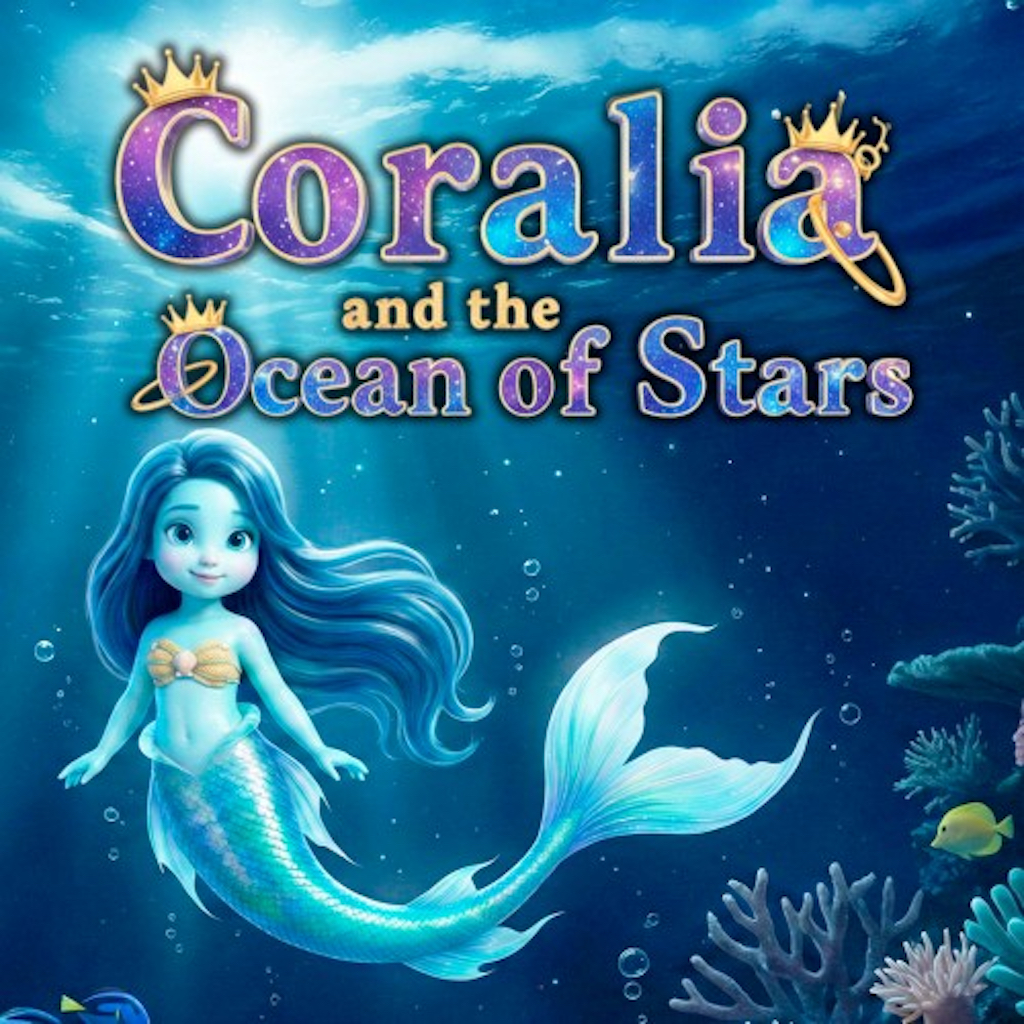
There’s a particular kind of magic in games that choose gentleness over spectacle. Coralia and the Ocean of Stars, released today by Aldora Games, doesn’t ask you to fight for survival or master intricate combat systems. Instead, it invites you to float — quite literally — through a glowing underwater world where curiosity, kindness, and quiet discovery drive the experience.
Marketed as a cozy, underwater adventure and interactive storybook, Coralia and the Ocean of Stars aims squarely at players seeking calm, wonder, and narrative warmth. It’s a small game in scope, but one with a luminous heart.
And on Nintendo Switch — particularly the OLED model — it’s undeniably beautiful.
A Mermaid, a Crab, and a Robot Among the Stars
You play as Coralia, a young mermaid who, alongside a brilliantly crafty crab companion, embarks on a journey to help Explorer 1 — a stranded robot — return home to the stars. The premise alone signals the game’s tone: whimsical, earnest, and slightly surreal.
The “Ocean of Stars” refers to mysterious glowing celestial artifacts that have fallen into the deep sea, dimming coral reefs and unsettling marine life. Your mission is to gather these fragments and restore light to the ocean floor.
The story unfolds linearly, almost like a playable bedtime tale. Dialogue is gentle and accessible, with themes of friendship, curiosity, and belonging woven throughout. It’s clearly designed with younger players in mind, but it avoids talking down to its audience.
For families or players seeking a low-pressure narrative journey, the tone lands beautifully.
Underwater Exploration Without Combat
From a gameplay perspective, Coralia embraces peaceful interaction. There is no combat. No health bars. No enemies to defeat. The tension comes instead from environmental puzzles and exploration challenges.
The ocean floor is divided into distinct zones filled with bioluminescent coral, drifting sea flora, and softly glowing ruins. Movement is fluid and forgiving — Coralia glides rather than sprints, reinforcing the relaxed pacing.
Marine creatures populate the environment, reacting subtly to your presence. Instead of attacking, they invite observation. The game emphasizes harmony over conquest, positioning you as a caretaker and documentarian rather than a warrior.
This design choice won’t appeal to players seeking mechanical complexity, but it aligns perfectly with the game’s cozy philosophy.
The Photography Mechanic
One of the core systems is photography — reminiscent of New Pokémon Snap or the meditative exploration of ABZÛ. Coralia can document rare “Starfish” species and deep-sea creatures, adding them to a beautifully illustrated journal.
Photographing creatures isn’t about speed or precision. It’s about patience. Some species only appear when certain coral is relit. Others respond to environmental cues triggered by solving small puzzles.
The journal itself is lovingly designed, filled with watercolor-style illustrations and short narrative notes. On Switch, touchscreen support makes flipping through entries and zooming into details especially intuitive in handheld mode.
It’s one of the game’s standout features — transforming observation into meaningful progression.
Bioluminescent Beauty
Visually, Coralia and the Ocean of Stars is striking.
The underwater palette leans heavily into high-contrast bioluminescence — neon blues, purples, and greens glowing against deep navy backgrounds. On the Switch OLED model, these contrasts are particularly vibrant, making darker ocean segments shimmer with life.
Character animations are simple but expressive. Coralia’s flowing hair and gentle swim cycles add fluidity, while Explorer 1’s slightly stiff mechanical movements contrast charmingly with the organic environment.
The aesthetic feels halfway between animated storybook and interactive aquarium. It’s not technically cutting-edge, but its art direction carries it far.
Puzzles and Cosmic Curiosity
Puzzle design in Coralia remains accessible. Most challenges revolve around redirecting light, activating ancient sea mechanisms, or guiding star fragments into coral formations.
They rarely demand intense logical leaps. Instead, they reinforce the narrative theme of restoring balance and illumination. Younger players will find them approachable, while older players may breeze through them quickly.
The cobbled-together ship segments — where Coralia and her companions navigate between regions — introduce light interaction variety without disrupting pacing.
The cosmic layer — bridging deep sea and outer space — adds thematic flavor more than mechanical depth. It gives the journey a sense of scale, but the gameplay remains grounded in tranquil exploration.
A Storybook Experience First
It’s important to frame expectations correctly: Coralia and the Ocean of Stars is fundamentally an interactive storybook.
The narrative is linear. Player choice does not drastically alter outcomes. The journey is carefully paced, guiding you from reef to reef as you collect star artifacts.
For some players, this linearity will feel limiting. There’s little emergent gameplay or sandbox experimentation. But for others — particularly younger audiences — the clarity of direction is reassuring.
The game respects your time. You can save freely and resume without penalty, making it well-suited for short sessions.
Where It Shines — and Where It Softens
Strengths:
- Gorgeous bioluminescent art style
- Peaceful, combat-free exploration
- Thoughtful photography and journal system
- Touchscreen integration enhances handheld play
- Family-friendly narrative tone
Weaknesses:
- Limited mechanical depth
- Linear structure reduces replay value
- Puzzles are relatively simple
- Short overall runtime
The brevity is noticeable. Most players will likely complete the story within a handful of sessions. Replayability hinges largely on collecting missed species entries.
Yet the experience doesn’t overstay its welcome. It’s designed more like a weekend read than a sprawling epic.
Who Is It For?
Coralia and the Ocean of Stars is ideal for:
- Younger players and families
- Fans of cozy, low-stress adventures
- Players who loved ABZÛ’s atmosphere but wanted more narrative guidance
- Switch OLED owners looking for a visually striking handheld title
It is less suited for:
- Players seeking deep mechanics or open-world freedom
- Combat-focused adventure fans
- Those looking for high difficulty or competitive systems
Final Verdict
Coralia and the Ocean of Stars is a gentle, luminous adventure that understands exactly what it wants to be. It doesn’t aim to compete with sprawling open-world epics or mechanically dense puzzle games. Instead, it crafts a focused, story-driven underwater journey built around wonder and restoration.
Its bioluminescent world is stunning on Switch, particularly in handheld mode. The photography system adds meaningful interaction, and touchscreen support enhances immersion. While its puzzles are simple and its structure linear, the experience feels cohesive and intentional.
Aldora Games has delivered a heartfelt debut for 2026 — a reminder that not every adventure needs peril to feel meaningful.
It’s short. It’s soft-spoken. It glows quietly in the dark.
And sometimes, that’s exactly what you need.