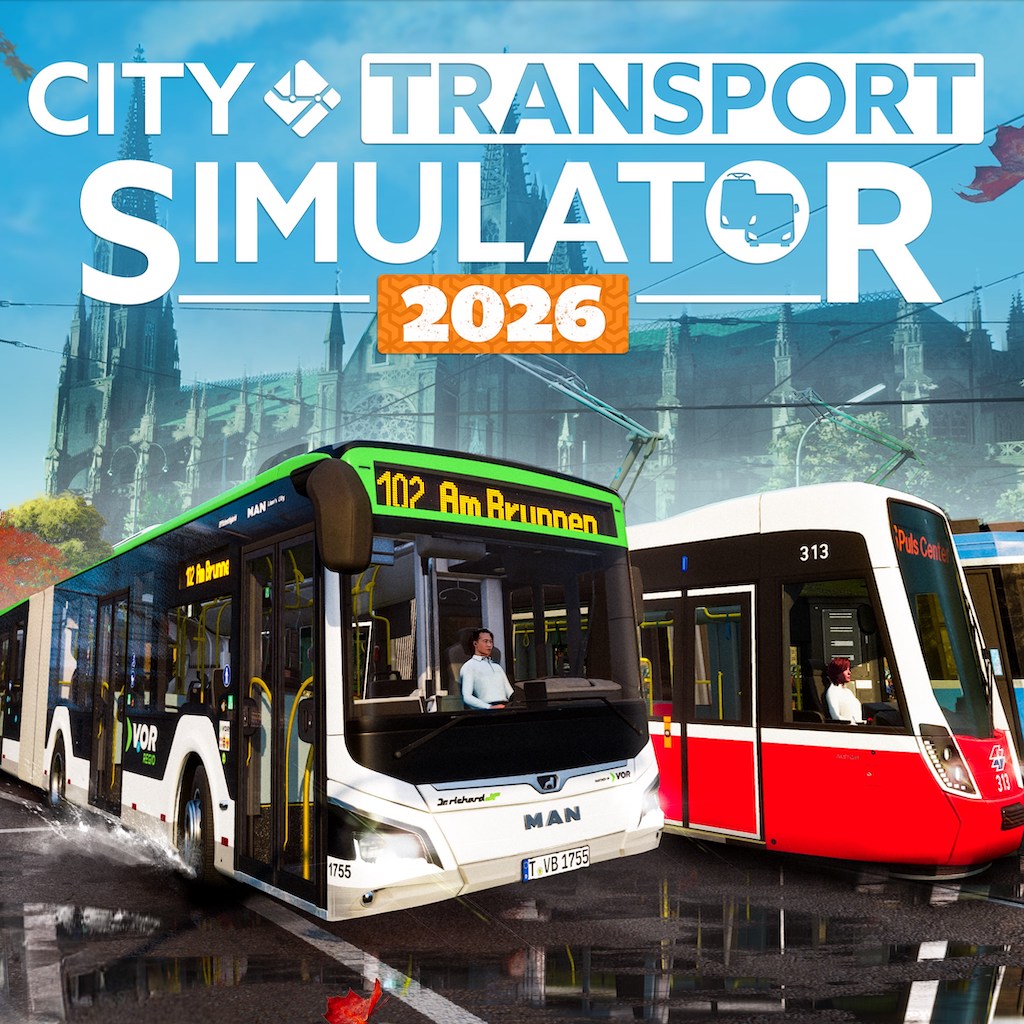
Public transport simulators have a particular rhythm that either clicks with you immediately or never really does. City Transport Simulator 2026, developed by ViewApp and published by Nplay Games, is one of the more ambitious entries in the genre and arguably the most feature-complete instalment in its series to date.
Arriving as a free upgrade for owners of earlier City Transport Simulator titles, this “Starter Edition” represents both a continuation and a consolidation. It brings together buses, trams, systems management, and a surprisingly immersive free-roam mode into a single evolving urban simulation.
The result is a game that is at its best when it leans into routine, structure, and systems. At its weakest, it exposes the limitations of its ambition.
“City Transport Simulator 2026 is not about driving a bus. It is about maintaining a city that never stops moving.”
A Living City Built on Timetables
At the heart of City Transport Simulator 2026 is a European-inspired metropolis that reacts dynamically to weather, seasons, and player-driven transport decisions. Routes evolve, passenger flows shift, and operational demands change depending on the time of day and environmental conditions.
The city feels structured around systems rather than spectacle. It is not designed to be a playground in the traditional sense. Instead, it is a working environment where efficiency and planning matter.
You are not just driving vehicles. You are managing a network.
The Line Editor and Timetable Generator are central to this experience. They allow you to design bus and tram routes, assign vehicles, and oversee AI-driven schedules that operate in real time. Watching your network function independently is one of the most satisfying aspects of the game.
When it works well, the city feels alive in a procedural sense. Buses arrive on time, passengers flow through stations, and the entire system feels like a machine operating under your supervision.
Driving as Simulation, Not Fantasy
The driving experience is deliberately methodical. Whether you are behind the wheel of a MAN Lion’s City bus or a Vienna ULF tram, the focus is on realism rather than accessibility.
Physics are weighty and grounded. Acceleration is slow and deliberate. Braking requires planning. Cornering demands awareness of vehicle length and passenger load.
Cockpits are fully interactive, with functioning ticket machines, mirrors, doors, and climate controls. Every system is designed to reinforce immersion rather than streamline it.
The ticketing system is particularly notable. You manually sell tickets, handle contactless payments, and ensure the correct change is given. It is repetitive, but intentionally so. The game wants you to feel like you are performing a job, not just driving through checkpoints.
This is where the simulator identity becomes most apparent. There is satisfaction in repetition when it feels authentic.
However, this realism will not appeal to everyone. The pace is slow, and the learning curve is steep for newcomers unfamiliar with simulation design.
Weather, Seasons, and Operational Pressure
One of the most significant additions in this entry is the dynamic weather and seasonal system. Across spring, summer, autumn, and winter, the city transforms both visually and mechanically.
Snow affects road handling. Rain reduces visibility and increases reliance on wipers. Heat impacts vehicle cooling systems, requiring attention to internal conditions. Even passengers react differently depending on environmental factors.
These systems are not just visual enhancements. They influence how you operate your routes. A simple journey becomes more complex when weather conditions affect timing, braking distance, and passenger flow.
The result is a simulation that feels less static than previous entries. The city is no longer just a backdrop. It is a variable.
Lighting improvements also enhance this effect. Day and night transitions are smoother, and interior vehicle lighting has been refined to reflect external conditions more accurately.
Free Roam and the Passenger Perspective
Perhaps the most ambitious addition is the free-roam mode. Here, you are not restricted to the driver’s seat. You can walk the city streets, board AI-controlled buses and trams as a passenger, and even take control of vehicles mid-route.
This system adds a layer of immersion that was previously absent from the series. Seeing your network from a passenger’s perspective changes how you perceive its scale and efficiency.
There is something oddly compelling about riding a bus you scheduled yourself, watching it operate exactly as intended, then stepping into the driver’s seat at the next stop to continue the route.
It is a small feature in concept, but a meaningful one in practice.
However, free-roam is not without rough edges. AI behaviour can occasionally feel inconsistent, and transitions between roles are sometimes abrupt rather than seamless.
Vehicles and Authenticity
The game features a curated selection of licensed buses and trams, including MAN Lion’s City variants, Gräf and Steyr models, and the tram systems of Vienna and Munich.
Each vehicle is meticulously recreated with attention to detail. Interiors are functional, dashboards are accurate, and the sound design reflects real-world mechanical behaviour.
Driving different vehicles genuinely changes the experience. Articulated buses feel heavier and more difficult to handle in tight city streets, while trams follow fixed routes that demand precise timing and spatial awareness.
This variety helps maintain engagement across long sessions, even if the core gameplay loop remains consistent.
Where the Simulation Struggles
Despite its ambition, City Transport Simulator 2026 is not without flaws.
The most noticeable issue is pacing. This is a slow game by design, but some systems can feel unnecessarily granular. Ticketing, while immersive, can become repetitive over long shifts. Similarly, some driving routes offer little variation in passenger events or unexpected challenges.
AI behaviour is another mixed bag. While generally functional, it occasionally produces awkward traffic interactions or timing inconsistencies that break immersion.
Performance is stable overall, but large cities with full dynamic weather can introduce minor frame-rate issues depending on the platform.
Finally, while the systems are impressive in isolation, they do not always interact in ways that feel deeply interconnected. The simulation is broad, but not always deeply emergent.
A Simulator That Knows Its Audience
What City Transport Simulator 2026 does well is clearly define the experience it offers. It is not trying to be an action game or a narrative-driven experience. It is a systems-driven simulation of routine, management, and controlled complexity.
For players who enjoy optimisation, structure, and long-form simulation gameplay, it offers a rich and rewarding experience. The game finds its identity in watching a transport network grow from a handful of routes into a fully functioning city system.
For others, its deliberate pacing and mechanical repetition may feel restrictive.
Final Verdict
City Transport Simulator 2026 – Starter Edition is a deep, methodical, and impressively detailed transport simulation that finds meaning in routine. Its expanded systems, dynamic weather, and free-roam mode add significant value to an already established formula.
It is not always elegant and can feel overly granular at times, but its ambition and consistency are undeniable.