There are indie games that succeed. There are indie games that endure. And then there are indie games that quietly reshape an entire industry.
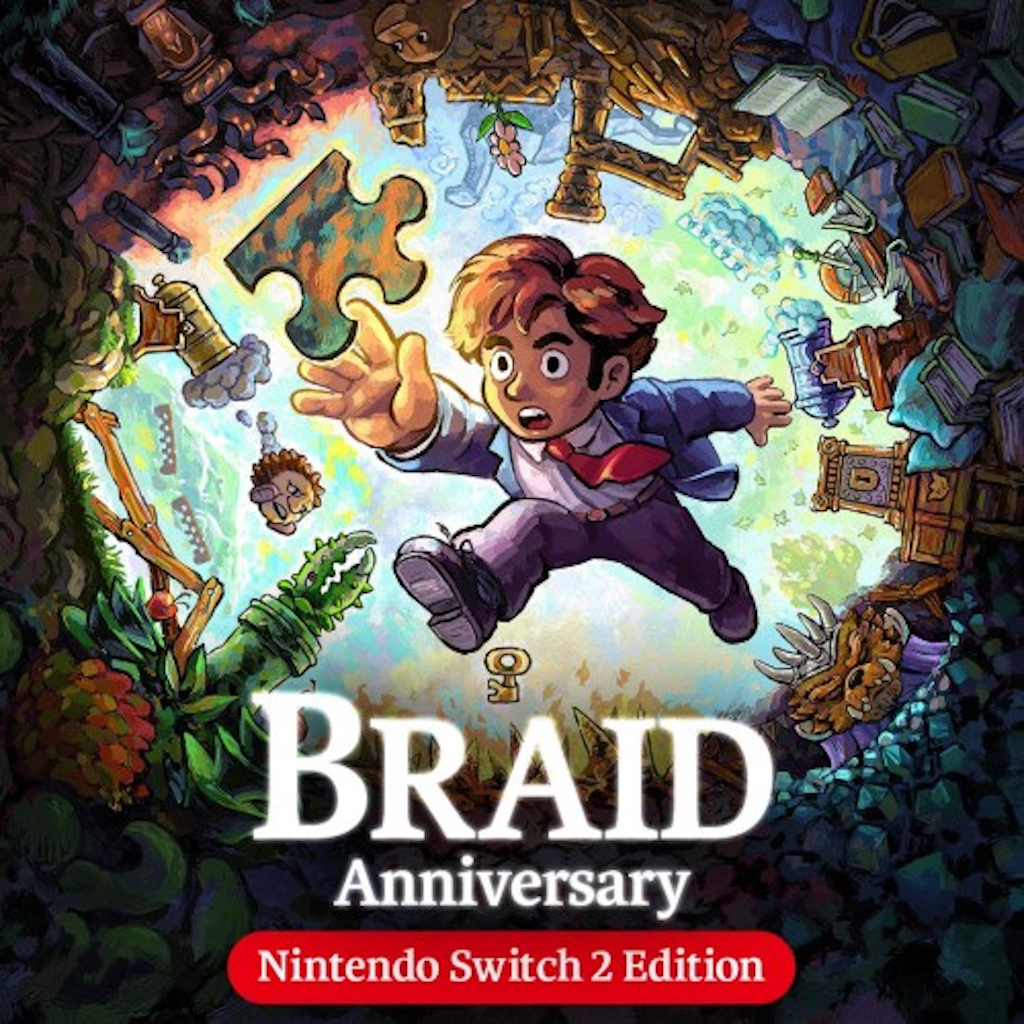
Braid, Anniversary Edition, developed and published by Thekla, Inc., falls firmly into that final category. Originally released in 2008, Braid became a lightning bolt moment for independent development — proof that smaller teams could deliver emotionally complex, mechanically daring experiences.
Now, with the Nintendo Switch 2 Edition — featuring up to 4K resolution in docked mode, 1080p handheld, 120Hz refresh rates, enhanced textures and over 12 hours of developer commentary — the question isn’t whether Braid still matters.
It’s whether it still moves us.
Time as a Puzzle, Time as a Theme
At its core, Braid is a platformer about manipulating time. But that description undersells its brilliance.
Each world introduces a different temporal rule:
- Unlimited rewind.
- Objects immune to time reversal.
- Time that flows forward only when you move.
- Shadow duplicates mimicking your past actions.
- Rings that slow the world around you.
These mechanics aren’t gimmicks — they’re philosophical tools. You don’t simply jump and run; you experiment with causality. Mistakes become lessons because failure can be undone instantly.
Rewind isn’t a safety net. It’s a design philosophy.
On Nintendo Switch 2 hardware, the increased refresh rate (up to 120Hz) gives movement a newfound fluidity. Rewinds feel buttery smooth. Platforming inputs register sharply. While the original was already precise, the added responsiveness elevates the tactile feel of puzzle-solving.
The Fresh Coat of Paint — Pixel by Pixel
The most immediate difference in the Anniversary Edition is visual.
The original game’s painterly aesthetic has been fully repainted in high resolution. Rather than simply upscaling assets, artist David Hellman and the team rebuilt the artwork pixel by pixel. Animated brushstroke effects subtly breathe life into backgrounds. Lighting carries more nuance. Environmental details feel layered rather than flat.
On Switch 2 in 4K docked mode, this matters.
Landscapes feel less like static canvases and more like living storybook illustrations. The surreal quality remains intact, but clarity enhances emotional tone. Soft cityscapes, glowing clouds and muted countryside palettes evoke nostalgia without feeling dated.
Crucially, you can toggle between old and new visuals instantly — a feature that highlights just how carefully the remaster respects the original aesthetic.
This isn’t revisionism. It’s restoration.
Sound and Silence
The haunting score — a mix of licensed classical and folk-inspired compositions — remains untouched in spirit but enhanced in fidelity. New sound effects subtly modernise environmental feedback without overwhelming the minimalist atmosphere.
Silence remains just as important as music.
Moments of quiet platforming, interrupted only by wind and footstep echoes, carry emotional weight. Braid never relied on bombast — and thankfully, the Anniversary Edition doesn’t attempt to “upgrade” it into something louder.
Developer Commentary: A Masterclass in Transparency
Perhaps the most significant addition is the developer commentary.
Over 12 hours of recorded insight from Jonathan Blow, David Hellman and collaborators is integrated directly into the game. You don’t access it through menus — you explore a new in-game world dedicated to behind-the-scenes content.
This commentary isn’t surface-level trivia. It’s deeply reflective. It covers:
- Design philosophy.
- Narrative ambiguity.
- Technical challenges.
- The emotional context of development.
- The broader indie movement of the late 2000s.
Few games have ever offered such transparent creative documentation.
For students of game design, this alone makes the Anniversary Edition essential. It’s not just commentary — it’s archival preservation of one of indie gaming’s defining creative moments.
A Story of Regret and Obsession
Braid’s narrative remains intentionally opaque.
You travel from a city apartment through interconnected worlds in search of an elusive Princess. Along the way, text passages hint at regret, guilt and fractured memory.
In 2008, this storytelling style felt radical. Today, ambiguity in indie games is common. But Braid still feels distinctive because its mechanics reinforce its themes.
Rewinding time mirrors the desire to undo mistakes.
Puzzle repetition echoes obsession.
Final revelations recontextualise everything that came before.
Without spoiling its most infamous twist, it remains one of the most quietly devastating endings in platforming history.
Does It Still Challenge?
Mechanically, Braid hasn’t changed. And that’s important.
The puzzles remain subtle and occasionally frustrating. Some solutions require lateral thinking rather than mechanical skill. Others demand precision timing layered atop conceptual insight.
If you’re stuck, you can move to another world and return later — a small but elegant design decision that prevents stagnation.
In a modern landscape filled with hint systems and overt guidance, Braid still trusts the player.
And that trust is refreshing.
Switch 2 Performance
The Nintendo Switch 2 Edition benefits meaningfully from hardware improvements:
- Crisp 1080p handheld mode.
- Up to 4K docked output.
- Smoother motion at higher refresh rates.
- Faster loading transitions between worlds.
These upgrades don’t transform the experience — but they polish it.
There’s something poetic about a game once synonymous with Xbox Live Arcade now running at 4K 120Hz on Nintendo hardware. It reinforces how far both indie development and platform ecosystems have evolved.
The Weight of Legacy
It’s impossible to review Braid in isolation from its cultural impact.
It helped legitimise indie publishing.
It demonstrated that downloadable titles could compete artistically with retail releases.
It sparked conversations about games as personal expression.
Revisiting it now, some players may find its mechanics familiar because so many later games borrowed from them.
But that familiarity is a testament to influence — not obsolescence.
Final Verdict
Braid, Anniversary Edition – Nintendo Switch 2 Edition is more than a remaster. It’s a preservation effort, a historical document and a reminder of how powerful simple ideas can be when executed with conviction.
The enhanced visuals respect rather than overwrite the original. The 4K and 120Hz support modernise without distracting. The audio upgrades remain subtle. And the 12+ hours of developer commentary transform the package into something approaching interactive scholarship.
Time manipulation still feels elegant. The puzzles still challenge. The story still lingers.
Not every classic ages gracefully. Braid does — perhaps because it was never chasing trends in the first place.