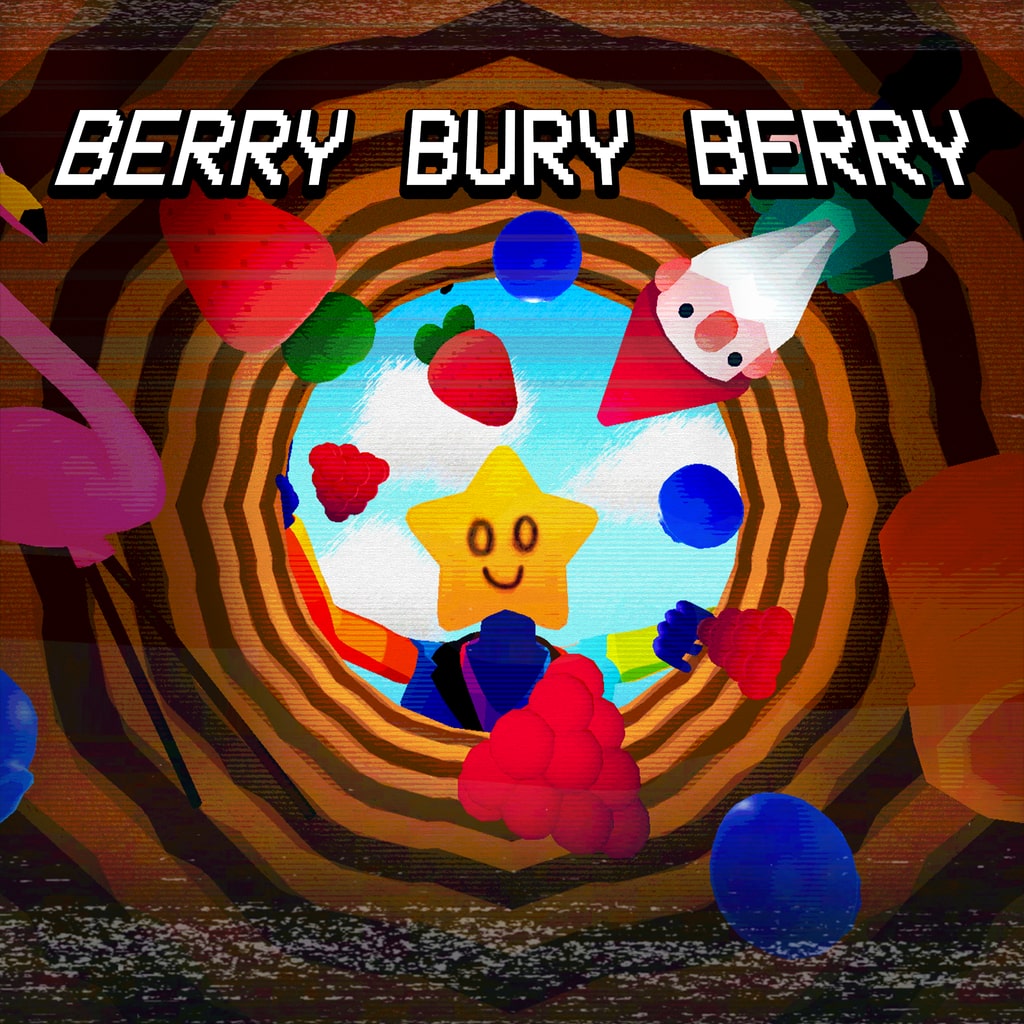
Some games arrive with a premise so wonderfully stupid that you cannot help but be curious. Berry Bury Berry is absolutely one of them. You grow berries, you collect berries, you upgrade your berry-growing operation, and then, for reasons that become increasingly hard to explain, you throw those berries into a gigantic hole. Lots of berries go into the hole. More berries go into the hole. Eventually, you start to suspect that perhaps you should stop putting things into the hole, but by then the hole has become rather difficult to ignore.
What makes Berry Bury Berry work, though, is that beneath its deliberately ridiculous presentation lies a surprisingly clever incremental game. Developed by Get(Color) Games and published alongside Black Lantern Collective, it is the sort of indie experience that initially feels like a joke before gradually revealing that there is considerably more going on beneath its bright, squishy exterior. It is cheerful, strange, occasionally unsettling, and remarkably difficult to put down once the numbers start getting bigger.
Welcome to the Garden
The opening hours are wonderfully straightforward. You arrive in a colourful garden, start growing berries, and begin harvesting your crops. Your first few upgrades are modest, but each one makes the next batch a little more productive, which means you can afford something else, which makes the following harvest even more lucrative. It is the familiar incremental game treadmill, but Berry Bury Berry gives it enough personality to make the process considerably more entertaining than watching numbers simply tick upwards.
The big difference is what happens to those berries once you’ve collected them. There is a hole in the garden, and the game really does want you to put your harvest into it. Not sell them at a market, not feed them to livestock, and not turn them into delicious jam. You throw them down the hole. The more you put in, the more money you receive, and the more money you have, the more ridiculous your operation becomes.
It sounds absurd because it is absurd, but there is something wonderfully satisfying about the whole process. Watching a modest berry patch develop into a frantic production line has the same hypnotic quality that makes the best incremental games so addictive. You are always just a few coins away from the next upgrade, and that next upgrade is invariably enough to make you want to keep playing for another ten minutes. Of course, ten minutes quickly becomes an hour.
Bigger Berries, Bigger Profits
Progression is the real engine driving Berry Bury Berry. Your garden gradually becomes more productive as you unlock new tools, gadgets and improvements, allowing you to cultivate better berries and generate larger profits. The upgrade tree gives you plenty of reasons to keep experimenting, especially as you consider how different improvements can work together.
There is a pleasing sense of escalation here. What begins as a simple process of growing and collecting eventually becomes a much more elaborate operation, with increasingly strange equipment helping you squeeze more value from every harvest. The game understands that incremental progression works best when every upgrade feels tangible, and there is always something satisfying about returning to your garden and realising just how far your little berry empire has come.
The game also avoids making everything feel too serious. Berry Bury Berry has a playful attitude that runs through practically every part of its design, helping prevent the repetitive nature of the core loop from becoming tedious. You are never under the impression that this is supposed to be a serious farming simulator. This is a game about berries, money and a suspicious hole, and it knows exactly how ridiculous that sounds.
The Hole Knows More Than It Should
Then there is the mystery. At first, the hole is simply a glorified money machine. Put berries in, receive rewards, and keep upgrading your operation. Eventually, though, the game begins to drop subtle hints that something isn’t quite right. The garden starts to feel less like a cheerful agricultural playground and more like somewhere you probably shouldn’t have been invited in the first place.
That tonal shift is one of Berry Bury Berry’s greatest strengths. It never completely abandons its colourful aesthetic, which makes the unsettling moments even more effective. There is something inherently creepy about a bright, happy environment hiding something unpleasant beneath the surface, particularly when the game encourages you to keep feeding that mystery rather than running away from it.
The garden itself becomes a character. Its secrets encourage you to look beyond the obvious progression path and explore areas you might otherwise have ignored. There are puzzles, strange discoveries and pieces of lore scattered around, giving curious players plenty of reasons to investigate rather than simply focusing on the next upgrade.
Berries With Personality
The talking berry characters are another charming addition. They lend the garden a sense of life and inject welcome personality between harvesting sessions. Their presence also helps the game maintain its peculiar balance between wholesome silliness and increasingly strange undertones.
Some of the characters and situations genuinely made me smile because the game commits so completely to its bizarre premise. There is no embarrassment about how silly it all is. Instead, Berry Bury Berry embraces the ridiculousness and makes it part of its identity.
That personality is important because, mechanically, incremental games can become repetitive by their very nature. You are still performing variations on the same fundamental actions throughout much of the experience. Amusing characters, unexpected discoveries, and a world that continually hints at something stranger beneath give the process a little more flavour.
A Garden Worth Exploring
Visually, Berry Bury Berry is suitably colourful and tactile. Everything has a soft, almost toy-like appearance, with exaggerated shapes and bright colours that make the garden look inviting. The berries themselves have an appealing physicality, and watching them bounce around as you harvest and move them gives the whole experience a pleasingly tactile quality.
The audio design deserves credit too. The cheerful presentation is supported by playful sounds, but there is an underlying unease that gradually becomes harder to ignore. As the mystery surrounding the garden deepens, the soundscape becomes an important part of the game’s atmosphere, reminding you that perhaps this isn’t quite the wholesome farming adventure it initially appeared to be.
It is a clever contrast. The visuals tell you that everything is lovely, while the atmosphere quietly suggests that something has gone terribly wrong. Berry Bury Berry gets considerable mileage out of that tension without ever becoming unnecessarily bleak.
The Addictive Little Loop
The biggest compliment I can pay Berry Bury Berry is that I repeatedly found myself thinking, “I’ll just get one more upgrade.” That is exactly the reaction an incremental game aims for, and the developers clearly understand the appeal of constantly improving your production capabilities.
There is also a satisfying sense of freedom in deciding where to take your progression. You can focus on boosting your berry production, unlocking useful tools, or pushing further into the game’s mysterious side. The game rewards experimentation rather than demanding that you follow a single, rigid route.
Multiple endings give the experience another reason to revisit the garden. Once you have uncovered some of its secrets, you may find yourself wondering what else you missed. That gives the game a little more longevity than its simple premise might initially suggest.
A Strange Little Surprise
Berry Bury Berry could easily have been nothing more than a novelty. A game where you grow fruit and chuck it into a hole sounds like the sort of ridiculous idea that might entertain you for twenty minutes before you’ve seen everything it has to offer. Thankfully, there is much more here than the title suggests.
The incremental mechanics are satisfying, the progression is well judged, and the garden has enough secrets to keep curiosity alive. More importantly, the game’s strange sense of humour gives it a personality that many games in this genre desperately lack. You aren’t simply watching numbers rise. You are building an increasingly absurd berry operation while slowly wondering exactly what the hell is at the bottom of that hole.
There are moments when the repetition inherent in the genre can become noticeable, particularly if you concentrate solely on the optimisation side of the experience. Some players may also find the simplicity of the underlying gameplay too lightweight if they are looking for a more traditional farming or management simulator. Personally, I think the simplicity is part of its charm, because it leaves room for the game’s atmosphere, characters and increasingly bizarre story to take centre stage.
Verdict
Berry Bury Berry is gloriously odd. It takes one of gaming’s simplest concepts, wraps it in a colourful garden, fills it with cheerful berry people, and then sticks a mysterious abyss in the middle just to see what happens. Somehow, that ridiculous combination works.
What starts as a relaxing exercise in berry cultivation gradually turns into an intriguing little mystery, and the constant stream of upgrades gives you plenty of reasons to keep returning. It is not a game that is going to reinvent the incremental genre, but it doesn’t need to. Its charm comes from how it combines familiar progression mechanics with a world that becomes increasingly difficult to explain.
Most importantly, it has personality. In a landscape filled with games that take themselves far too seriously, there is something refreshing about a title that is happy to say, “Grow berries. Make money. Put them in the hole. Don’t ask too many questions.” Naturally, you will ask questions. That’s half the fun.