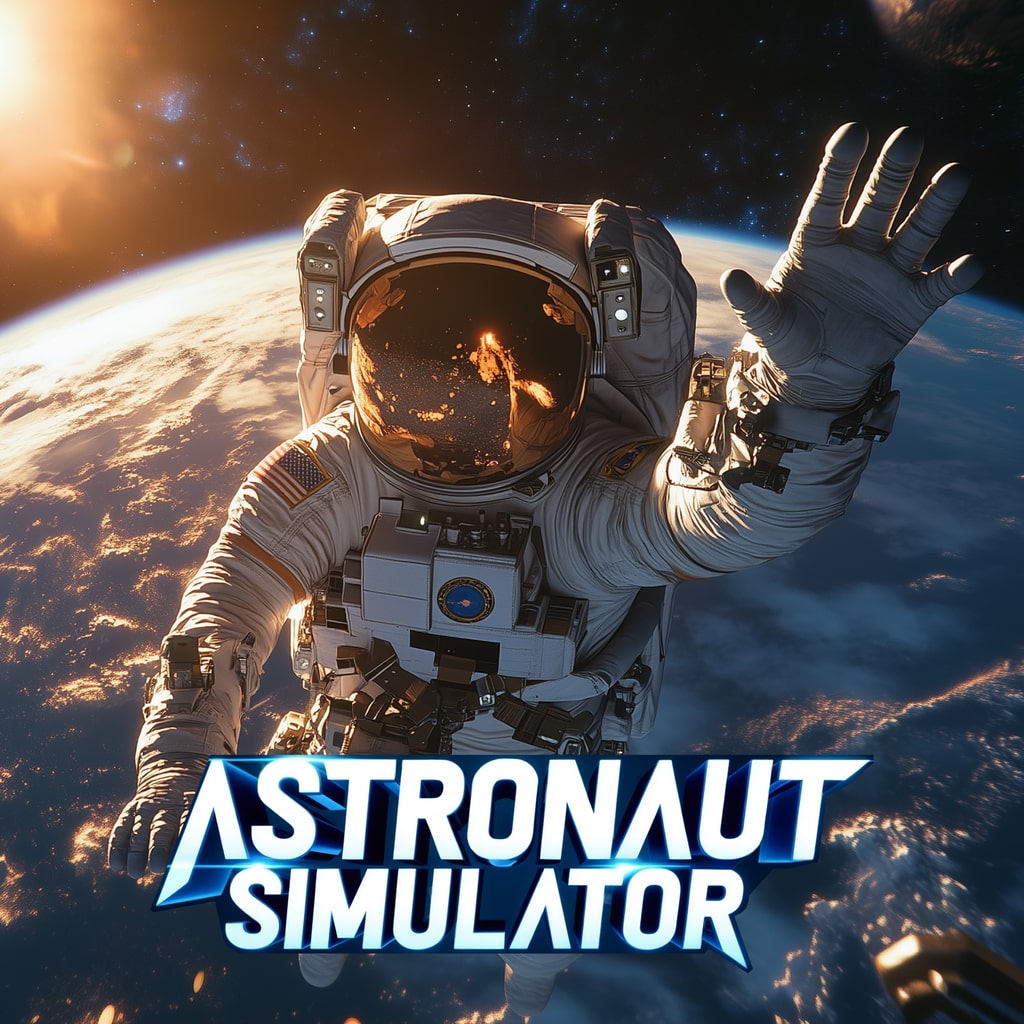
Few settings in games can evoke such awe and anxiety as outer space. It is vast, silent, indifferent, and essentially hostile to human survival. Astronaut Simulator, published by GOOSE GAME LTD, fully embraces that discomfort, removing cinematic grandeur in favour of something much more rooted: the slow, deliberate struggle to survive inside a broken orbital station where every breath is rationed and every move counts.
Originally a PC-style survival experiment, the 2026 console release—coming to PS4 and fully enhanced for PS5—sharpens its focus into something tougher, slower, and more punishing. This is not a power fantasy about space exploration. It is a simulation of fragility, disorientation, and isolation.
And it often feels exhausting in the very way it aims to.
The Cold Logic of Survival
You awaken aboard a damaged orbital station. Systems are failing, oxygen is depleting, and communication is fractured. The game quickly establishes its core philosophy: you are not here to thrive but to persist.
All systems are interconnected. Oxygen levels influence visibility and stamina, while power distribution determines which modules remain accessible. Even simple movement becomes a logistical challenge when governed by zero-gravity physics.
The central loop is deceptively straightforward: explore, repair, survive. Yet within that simplicity lies a complex web of interdependent systems that constantly demand your attention.
A broken power conduit isn’t just a visual issue — it could disable life support elsewhere. A failed oxygen recycler isn’t merely an inconvenience — it can serve as a countdown to your next objective. The game constantly reminds you that everything is linked, and nothing remains stable.
Movement as a Source of Tension
The standout feature—and arguably the defining element of Astronaut Simulator—is its zero-gravity movement system.
Unlike more forgiving interpretations of space traversal, this system is intentionally awkward. Movement feels weightless, but not in a smooth or cinematic way. Instead, it is precise, deliberate, and often disorienting.
Pushing off surfaces sends you drifting in long, uncontrollable arcs. Stopping requires careful counter-momentum. Even turning around becomes a conscious act rather than an instinctive one.
This design choice will likely divide players. For some, it is immersive in the truest sense—forcing you to think like someone untethered in space. For others, it may feel deliberately unresponsive or frustratingly slow.
But there is no denying its effectiveness. The system creates a constant sense of vulnerability. You are never fully in control. You are always negotiating with inertia.
Repairing the Broken
Much of the gameplay focuses on restoring the station’s functionality. This involves fixing pipelines, rebooting systems, repairing modules, and stabilising life support infrastructure.
These tasks are often presented as interactive mini-games, requiring precision and focus rather than brute force. Reconnecting circuits, calibrating systems, and rerouting power all demand careful attention under pressure.
What makes these sequences engaging is their timing. You seldom perform repairs in safe conditions. Instead, you are often balancing them against dwindling oxygen, limited visibility, or unstable surroundings.
This turns even simple actions into high-stakes decisions. Do you attempt a complex repair now, or retreat to conserve oxygen and try again later? The game rarely provides ideal conditions, and that unpredictability maintains high tension.
However, repetition can creep in over time. While the variety of systems initially feels stimulating, later hours may become familiar, with similar repair tasks cycling through different parts of the station.
The Weight of Isolation
If there is one aspect where Astronaut Simulator excels without question, it is atmosphere.
The station feels genuinely abandoned. Corridors stretch into silence, broken only by the hum of malfunctioning machinery or the faint echo of your own footsteps. There is no traditional soundtrack driving you forward—only ambient soundscapes that emphasise emptiness.
The inclusion of a small AI drone companion provides the only consistent form of interaction. It offers guidance, occasional commentary, and subtle narrative cues, but never enough to break the sense of solitude. It is present, but not comforting.
This careful balance ensures that the emotional tone remains intact. You are not accompanied—you are monitored.
The result is a persistent feeling of psychological pressure. Even when nothing is actively threatening you, the environment itself feels like a slow-moving hazard.
Difficulty as Design Philosophy
The Astronaut Simulator has gained recognition for its steep difficulty curve, and that reputation is well deserved.
This is not a game that gradually introduces its systems. From the very beginning, you are expected to manage multiple survival factors at the same time while mastering complex movement and repair mechanics.
Mistakes are severely punished. Running out of oxygen is rarely recoverable. Mishandling power can lead to failures across the entire system. Even small navigation errors can prove fatal in zero gravity.
There is a deliberate choice here not to soften the challenge. The game assumes you are competent and forces you to learn through failure.
This approach may not appeal to everyone. But for players who enjoy systemic survival challenges, it delivers a deeply satisfying sense of mastery over time. Every successful repair or stabilised system feels truly earned, not simply given.
Visual and Technical Presentation
On PS5, the enhanced version of Astronaut Simulator benefits from improved lighting, sharper textures, and more stable performance compared to its original release.
The station’s interiors are functional rather than spectacular, but they support the game’s tone effectively. Cold metallic corridors, flickering control panels, and damaged infrastructure all reinforce a sense of decay and abandonment.
Visual clarity is especially important given the complexity of the systems involved, and the game generally maintains good readability even during high-pressure moments.
Performance is solid, with minimal frame drops and relatively quick load times. The PS4 foundation is still evident in some asset reuse and animation stiffness, but the PS5 upgrade ensures a smoother overall experience.
Narrative Minimalism
Storytelling in Astronaut Simulator is deliberately restrained. There is no grand exposition or dramatic unfolding plot. Instead, narrative unfolds through environmental clues, AI interactions, and fragments of recovered data.
The emphasis is less on explaining what happened, and more on reinforcing your current state: isolation in a failing structure far from any hope of immediate rescue.
This minimalist approach suits the game’s tone, but it may leave players longing for more context or emotional connection. The experience is intentionally procedural rather than narrative-driven.
Final Verdict
Astronaut Simulator is a demanding, often unforgiving survival experience that prioritises authenticity of feeling over accessibility. Its zero-gravity movement system is one of its most distinctive achievements, creating a constant sense of instability that permeates every action.
Combined with its interconnected survival systems and oppressive atmosphere, it delivers a uniquely tense interpretation of life in space—one that is less about exploration and more about endurance.
However, its rigidity, repetition, and steep difficulty curve may alienate players who prefer more guided or forgiving experiences. It is a game that asks for patience, precision, and a willingness to fail repeatedly before progress is made.
For those willing to engage with it on its own terms, Astronaut Simulator offers a rare kind of immersion: not the fantasy of being an astronaut, but the reality of being alone, drifting, and trying—against all odds—to stay alive.