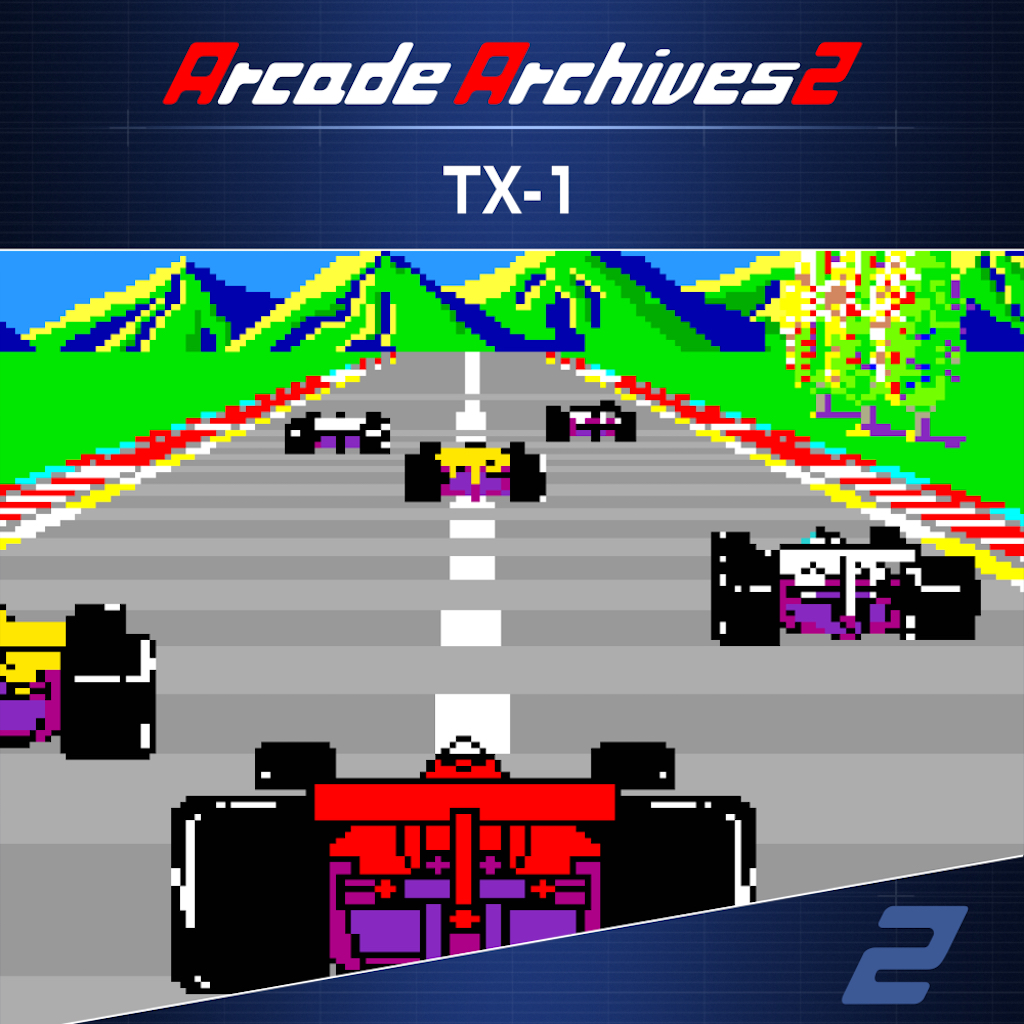
Looking back at racing games from the early 1980s can be a fascinating exercise. Long before realistic physics, licensed supercars and sprawling open worlds became standard, developers were seeking ways to convey speed on incredibly limited hardware. Some games simply asked players to avoid traffic until the timer expired. Others dared to think much bigger. TX-1 was one of those games.
Originally released by Tatsumi in 1983, TX-1 was nothing short of revolutionary. Its enormous triple-screen arcade cabinet offered an astonishing panoramic view that few players had experienced before, while its branching routes gave racers genuine choices about where their journey would take them. It wasn’t just another arcade racer. It was an ambitious glimpse of what the genre’s future could be.
Arcade Archives 2: TX-1 faithfully preserves that experience while adding enough modern conveniences to make revisiting this landmark title far more comfortable than hunting down an increasingly rare original cabinet. More importantly, it reminds us that innovation does not always lose its shine with age.
Gameplay
At first glance, TX-1 appears deceptively simple. The objective is straightforward enough. Reach each checkpoint before the timer expires, avoid crashes, and maintain as much momentum as possible. Like many arcade racers of its era, it is unforgiving, and hesitation is often punished more severely than outright mistakes.
Once you settle into the rhythm, however, the game’s deeper ideas begin to emerge. Unlike many of its contemporaries, TX-1 does not send every player down the same sequence of tracks. At various points during your journey, the road splits, allowing you to choose between different routes. Those decisions eventually lead to one of several unique destinations, creating a surprising amount of replay value for such an early racing game.
It is easy to overlook how groundbreaking this was in 1983. Today, branching paths are commonplace across countless genres, but at the time they gave TX-1 an adventurous spirit rarely seen in arcade racing. Rather than simply chasing a better lap time, players had genuine reasons to keep returning to discover every possible route.
Driving itself demands concentration. Steering feels heavier than in modern racers, requiring deliberate inputs rather than quick corrections. Corners punish overconfidence, while traffic constantly threatens to disrupt a perfect run. Success depends less on reckless speed and more on maintaining smooth, controlled driving throughout each stage.
The gearbox adds another welcome layer of engagement. Shifting between high and low gears requires good judgement, particularly when approaching tighter sections of road. Choosing the wrong gear at the wrong moment can cost valuable seconds, turning what seemed a comfortable lead into a desperate race against the checkpoint timer.
Despite its age, there is an undeniable satisfaction in mastering these systems. Every successful corner feels earned, and every clean stretch of road encourages you to push just a little harder towards the next checkpoint.
A Landmark in Racing History
Perhaps the most remarkable aspect of TX-1 is how much of its original ambition still shines through today. Even on a modern television, it is immediately obvious that this was never intended to be an ordinary racing game.
The original arcade cabinet famously used three separate monitors positioned side by side to create an enormous panoramic view of the road ahead. While few players will ever experience that hardware today, Arcade Archives 2 does an admirable job of recreating the effect on contemporary displays. The exceptionally wide field of view provides a stronger sense of speed than many arcade racers released years later.
Watching deserts give way to coastal highways before eventually racing through illuminated city streets creates a surprisingly convincing sense of embarking on a genuine journey. Instead of endlessly repeating the same scenery, TX-1 continually introduces fresh environments that help each route develop its own identity.
Visually, expectations naturally need to be kept in check. This remains a forty-year-old arcade game built with technology that now seems almost prehistoric. Cars are represented by simple sprites, environments lack detailed textures, and distant objects often appear as little more than coloured shapes. Yet there is a timeless elegance to the presentation that continues to work remarkably well.
Rather than chasing realism, TX-1 focuses entirely on readability and momentum. Every visual element exists to support the sensation of speed, and that design philosophy remains effective decades later.
Arcade Archives 2 Adds Welcome Modern Touches
As impressive as TX-1 remains historically, it is the Arcade Archives 2 package that makes returning to it so enjoyable. The new Time Attack Mode is arguably the standout addition. Rather than focusing purely on score, players compete to complete the adventure as quickly as possible. It offers experienced drivers a fresh way to approach familiar courses while encouraging constant refinement of racing lines and route choices.
The traditional Original Mode, Hi Score Mode and Caravan Mode also return, ensuring there are plenty of options whether you simply want to experience the game or compete against the global community.
Online leaderboards remain one of the Arcade Archives series’ greatest strengths. Arcade games have always thrived on competition, and seeing your name gradually climb the worldwide rankings captures the same spirit once found around crowded arcade cabinets.
Save states and rewind functionality also deserve equal praise. Purists may choose not to use them, but they dramatically lower the barrier for newcomers interested in exploring gaming history without enduring the harsher frustrations of classic arcade design. Likewise, configurable controls and display options allow players to tailor the experience to their preferences.
VRR support is another thoughtful addition. While not something every player will immediately notice, enthusiasts seeking the closest possible recreation of the original hardware will appreciate the additional effort HAMSTER has invested in preserving the game’s authenticity.
Where Time Has Left Its Mark
For all its historical importance, TX-1 inevitably shows its age in several areas. The handling, while rewarding once mastered, initially feels stiff compared with virtually every modern racer. New players may struggle with the deliberate steering and unforgiving collisions, particularly in the opening sessions. Patience is required before the controls feel natural.
The checkpoint system can also feel relentless. A single significant mistake often snowballs into a failed run, especially as traffic density increases. This demanding structure reflects the arcade philosophy of encouraging repeat plays rather than offering lengthy progression.
Content is naturally limited by contemporary standards. Although branching routes create welcome variety, players expecting deep career modes, vehicle customisation or expansive progression systems will not find them here. TX-1 remains fundamentally an arcade experience designed to improve skill rather than unlock rewards.
Fortunately, these limitations are largely historical rather than design failures. Understanding the context in which TX-1 was created makes it easier to appreciate what it accomplished rather than focusing solely on what later generations would add.
Final Verdict
Arcade Archives 2: TX-1 is more than another retro re-release. It is the preservation of one of racing history’s genuine innovators, presented with the respect and care it deserves. While countless games have refined its ideas over the decades, revisiting the original reveals how remarkably forward-thinking Tatsumi’s design truly was.
The branching routes remain surprisingly engaging, the sensation of speed still impresses, and the wide panoramic presentation continues to give the game a unique personality that sets it apart from many of its contemporaries. Combined with HAMSTER’s excellent suite of modern features, this makes it one of the strongest entries in the Arcade Archives collection.
Not every aspect has aged gracefully, and newcomers accustomed to forgiving modern racers may need time to adjust to its demanding nature. Yet for players with even a passing interest in arcade history, TX-1 remains an essential experience. Sometimes the most enjoyable journey is not towards the newest destination, but back to the roads that helped shape everything that followed.