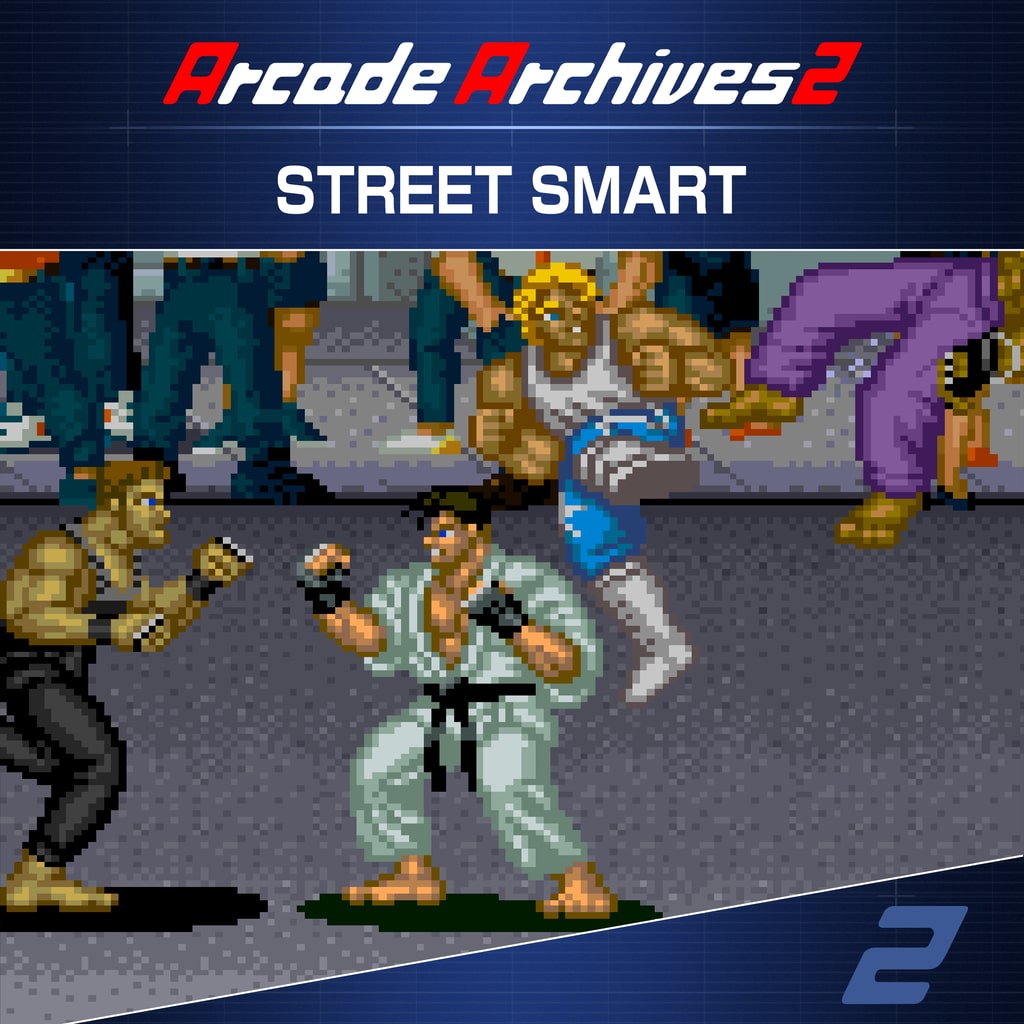
There’s something almost defiant about the way Arcade Archives 2: STREET SMART presents itself. In an era when even retro revivals often come with a layer of polish, rebalancing, or quality-of-life tweaks, this release feels as if it has been pulled straight out of 1989 and dropped onto your console with minimal compromise. That is both its greatest strength and its most obvious limitation.
Originally developed by SNK, STREET SMART was never the most celebrated brawler of its time. It lived in the shadow of heavier hitters, arriving before the genre truly found its rhythm in the early 90s. Yet there is something undeniably fascinating about revisiting it now, especially in this carefully preserved form.
HAMSTER Corporation has built its reputation on authenticity, and with the Arcade Archives 2 label it doubles down on that philosophy. This is not a remake. It is not a reimagining. It is preservation, almost to a fault.
A Brawler from a Different Time
STREET SMART is a curious blend of one-on-one combat mechanics and side-scrolling progression. You choose between two fighters, a karate master and a professional wrestler, and set out across a stylised version of America to prove your strength. The premise is simple, almost primitive, yet it has a certain charm.
Combat is where things become more interesting, and also more awkward. Unlike the fluid, combo-heavy systems that would later define the genre, STREET SMART feels stiff and deliberate. Attacks have weight, but they also carry hesitation. Movement lacks the snap modern players expect.
At first, this can feel frustrating. Inputs do not always translate as cleanly as you would like. Timing is everything, and the game demands precision in a way that can feel unforgiving. But spend enough time with it, and a rhythm begins to emerge. It is not smooth. It is not elegant. But it is consistent. And that consistency becomes its own kind of language.
The Value of Authenticity
What elevates this release is not just the game itself, but how it is presented. HAMSTER’s work here is meticulous. The inclusion of Variable Refresh Rate support might sound like a technical footnote, but in practice it makes a noticeable difference. Input latency feels tight and responsive, mirroring the original arcade hardware as closely as modern systems allow. For purists, this matters.
The standard suite of Arcade Archives features is present and accounted for. Rewind, save states, difficulty adjustments, and online leaderboards all make a return. These tools act as a bridge between eras, allowing modern players to engage with an older, harsher design without being completely overwhelmed.
The new Time Attack mode is a welcome addition. It reframes the experience, shifting the focus from survival to efficiency. Instead of simply making it to the end, you are encouraged to optimise your route, shave seconds off encounters, and approach each fight with a sense of urgency. It does not transform the game, but it gives it a second life. A reason to return after the initial curiosity fades.
Rough Edges That Never Quite Fade
For all its historical value, STREET SMART is not a game that has aged gracefully. Its design is rooted in an era when difficulty often stemmed from limitations rather than intention. Enemy patterns can feel rigid, and hit detection occasionally feels off. The balance between challenge and fairness is not always where you want it to be.
This is where authenticity becomes a double-edged sword. HAMSTER has chosen not to “fix” these elements, and there is an argument to be made that they shouldn’t. This is the game as it was. Preserving its quirks is part of preserving its identity.
But that does not mean those quirks are enjoyable. There will be moments when frustration outweighs appreciation. Moments when you wish for just a little more modern refinement. And the game offers no apologies for that.
A Snapshot of Arcade Culture
What STREET SMART captures, perhaps better than many of its contemporaries, is a sense of arcade culture at a very specific moment in time. This was a period of experimentation, with developers still figuring out what a fighting game or brawler could be. You can see those ideas in motion here. The blend of styles. The focus on one-on-one encounters within a broader journey. The attempt to create personality through limited means. It is not fully realised, but it is undeniably interesting.
There is also a certain raw energy to the presentation. The character designs, the exaggerated animations, the slightly odd pacing. It all feels like a product of a different creative mindset, one less concerned with polish and more focused on impact. That energy carries the experience further than you might expect.
Who This Is Really For
Arcade Archives 2: STREET SMART is not for everyone. That is worth stating clearly. If you are looking for a refined, modern brawler, this is not it. If you want something that feels immediately satisfying and rewards casual play, you will likely bounce off it.
But if you have an appreciation for arcade history and the evolution of game design, there is value here. This is a piece of that history, preserved with care and presented without compromise.
It is also a reminder of how far the genre has come. Playing STREET SMART today highlights the advancements that followed, including improvements in responsiveness, balance, and player feedback. In that sense, it is as educational as it is entertaining.
Final Thoughts
There is a quiet honesty to Arcade Archives 2: STREET SMART. It does not try to be more than it is. It does not attempt to modernise itself to meet current expectations. It simply exists, exactly as it once did, with a few thoughtful additions to make it more accessible. That approach will not resonate with everyone. It asks for patience. It asks for curiosity. It asks you to meet it halfway.
But for those willing to do so, there is something rewarding here. Not in the traditional sense of mastery or progression, but in the act of engaging with a piece of gaming history on its own terms. It is rough. It is dated. It is occasionally frustrating. And yet it is also sincere.