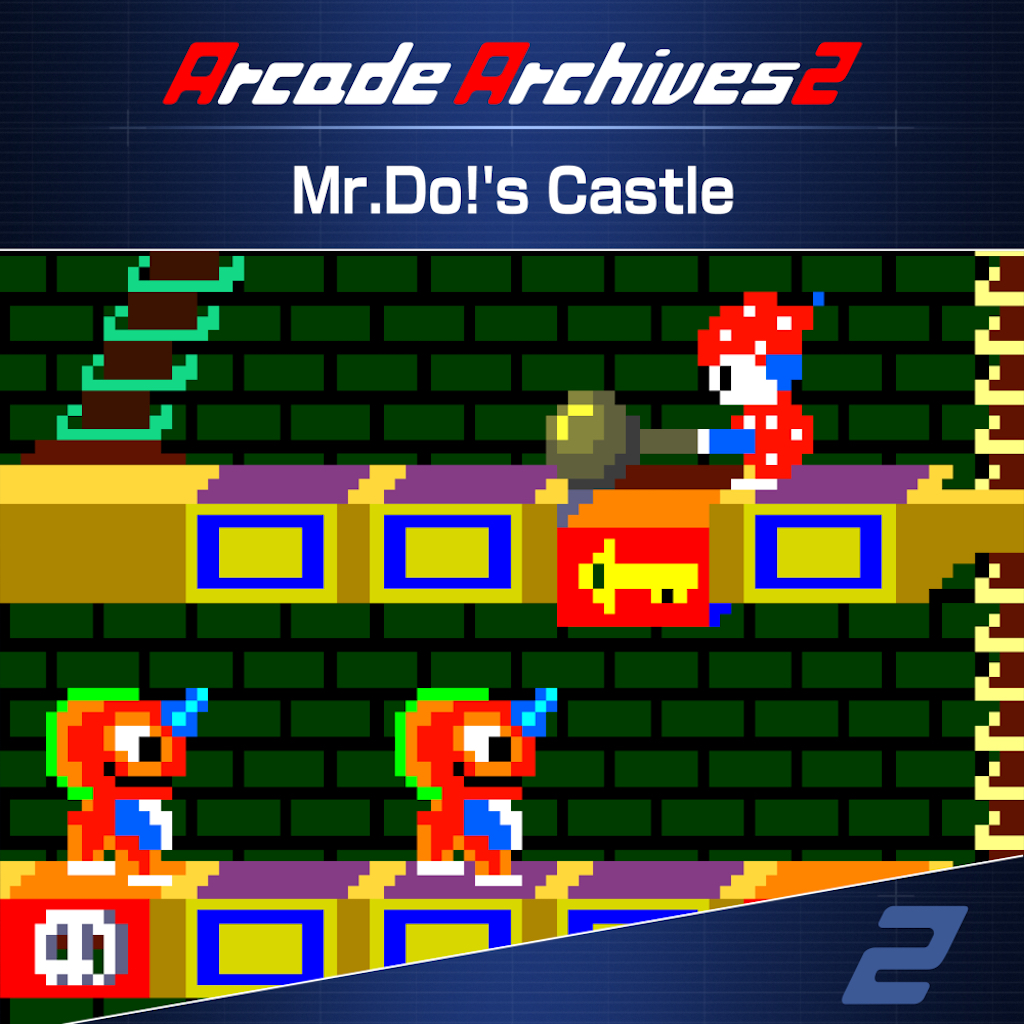
There is something wonderfully charming about the arcade games of the early 1980s. They did not need sprawling worlds, elaborate cutscenes or an enormous cast of characters to keep you coming back. Give a player a colourful screen, a simple objective, a handful of increasingly troublesome enemies and a cabinet that happily swallowed your spare change, and you had everything you needed for an afternoon of entertainment. Arcades Archives 2 Mr.Do!’s Castle takes one of those wonderfully simple ideas from 1983 and brings it back with all the character of the original, while adding modern conveniences that make revisiting old arcade games considerably more enjoyable.
Originally released by Universal, Mr.Do!’s Castle, also known as Mr. Do! vs. Unicorns, is a curious little action puzzle game that puts the famous clown in a castle filled with rather unfriendly unicorns. Armed with nothing more than a hammer, Mr. Do has to knock away sections of flooring, manipulate ladders and find clever ways to trap or crush his colourful enemies. It sounds simple, and in the opening stages it certainly feels that way, but there is considerably more thought involved once the castle becomes a dangerous place to be.
Welcome To The Castle
At first glance, Mr. Do!’s Castle looks like the sort of game you could understand in seconds. You move Mr. Do around a series of platforms, climb ladders and use your hammer to smash blocks beneath your feet. The obvious objective is to deal with the unicorns wandering around the castle, but simply charging towards them is usually the quickest way to realise that Mr. Do is not particularly interested in fighting fair. Instead, the game encourages you to manipulate the environment and turn the castle itself into your greatest weapon.
That is where the charm of Mr. Do!’s Castle really begins to show. Every floor is made of destructible blocks, meaning the layout is not quite as permanent as it first appears. A well-placed swing of the hammer can create a hole for a unicorn to fall into, remove part of the floor beneath an enemy, or open up a new route for Mr. Do himself. The moment you realise that the level is something you can actively reshape, the game becomes much more interesting than its wonderfully basic presentation initially suggests.
Hammer Time
The hammer is obviously the star of the show, but using it effectively requires far more thought than simply hitting everything in sight. Mr. Do can knock blocks out of the castle floor, and those missing blocks can completely change how enemies move around the stage. Catch a unicorn in the wrong position, and you can drop it into a hole, temporarily immobilising it and giving yourself a precious few seconds to get away or line up another attack.
There is a lovely sense of satisfaction when everything comes together. You might spend several seconds watching a unicorn patrol back and forth, waiting for exactly the right moment to remove the block beneath it. When the timing works and the creature drops neatly into the gap, it feels less like defeating an enemy and more like solving a tiny mechanical puzzle. The game constantly asks you to think about where you are standing, where the unicorn is heading, and what the castle will look like after your next swing.
Ladders Are More Important Than They Look
The ladder system is another deceptively clever part of the game. Rather than simply providing fixed routes between floors, ladders can be repositioned to change the direction in which they connect. This means the route through the castle can be manipulated just as much as the floors themselves, and an apparently straightforward escape can suddenly become a carefully planned piece of positioning.
It is particularly satisfying to use the ladder system to influence the movement of the unicorns. An enemy that seemed to have you trapped can suddenly be sent elsewhere because you have changed the route it needs to follow. Conversely, getting your own escape route wrong can leave you staring at an angry unicorn with nowhere sensible to go. There is a wonderfully old-fashioned lesson here: the game gives you the tools, but it expects you to learn how to use them.
More Than One Way To Win
One of the things I appreciate about Mr. Do!’s Castle is that it does not reduce every stage to simply eliminating every unicorn. There are multiple ways to clear a level, including defeating enemies, collecting the letters required for the EXTRA sequence, and destroying the appropriate cherry-marked blocks. That variety gives the player a reason to pay attention to what is happening across the entire stage rather than simply hunting down anything that moves.
It also gives the game a little more personality than its straightforward arcade presentation might suggest. Sometimes the safest option is not necessarily the fastest, and sometimes chasing a particular objective can put Mr. Do in considerably more danger than expected. This is a game where a few seconds of planning can save a run, while a moment of impatience can send everything tumbling towards disaster. It is classic arcade design in its purest form, where understanding the rules is just as important as having quick reactions.
That Wonderful Arcade Feel
Visually, Arcade Archives 2 Mr.Do!’s Castle does exactly what a preservation-focused release should. The colourful sprites, bright backgrounds and unmistakable 1980s presentation remain intact, giving the game an authentic period feel rather than attempting to modernise something that never needed it. Mr. Do himself remains wonderfully expressive in that simple arcade character kind of way, while the unicorns have just enough personality to make repeatedly trapping them surprisingly satisfying.
The audio is equally nostalgic. There is a distinct charm to the little melodies, sound effects and rhythmic hammer strikes that accompany your progress through the castle. None of it is trying to be cinematic, and that is precisely the point. These are sounds designed to communicate what is happening immediately and keep the player moving, and hearing them again after so many years is enough to transport you straight back to the golden age of the arcade.
Arcade Archives 2 Does The Rest
Of course, the real attraction here is not simply getting an old game running on modern hardware. HAMSTER’s Arcade Archives 2 package adds a collection of features that make these classics much easier to enjoy today. Original Mode lets you experience the game in its traditional form, while High Score Mode and Caravan Mode provide plenty of reasons for dedicated players to keep chasing better performances.
The new Time Attack Mode is particularly welcome. Instead of worrying about your score, the emphasis is on clearing the game as quickly as possible, which gives a familiar arcade experience a completely different rhythm. There are also rewind functions, multiple save slots and rapid-fire options, while VRR support helps provide a smoother presentation on compatible displays. For anyone who enjoys old arcade games but does not necessarily have the patience to live with every limitation of the original hardware, these additions make a substantial difference.
A Game Built For One More Go
The greatest compliment I can pay Mr.Do!’s Castle is that it still understands the magic of the arcade. A game like this does not need hundreds of hours of content because the entire point is to improve your understanding, sharpen your reactions, and see how far you can get next time. You fail, you learn, you try again, and suddenly you are looking at the clock wondering where the last hour went.
There is also something refreshingly honest about its design. The rules are simple enough to grasp almost immediately, but mastering them is another matter entirely. The castle becomes increasingly dangerous, the unicorns increasingly difficult to manage, and the margin for error smaller. That balance between accessibility and mastery is something modern games often struggle to reproduce, yet here it feels completely natural.
A Charming Piece Of Arcade History
Arcade Archives 2 Mr.Do!’s Castle will obviously appeal most strongly to players with an affection for classic arcade games, but I think there is enough clever design here for newcomers to appreciate it too. Beneath the colourful presentation and wonderfully silly premise lies a surprisingly thoughtful little puzzle platformer that rewards planning, experimentation and patience. It is easy to assume that hammering blocks and trapping unicorns will become repetitive, but the changing layouts and enemy behaviour give the basic mechanics considerably more depth than expected.
The modern additions also make this a particularly comfortable way to experience the game. Being able to rewind a mistake, save your progress, experiment with display settings and then compete on online leaderboards gives a 1983 arcade game a new lease of life without compromising what made it special in the first place. Most importantly, the original personality remains completely intact. It still feels like Mr.Do!’s Castle, just one that has been carefully looked after for more than four decades.
Final Verdict
There is a particular joy in discovering that a game released in 1983 can still make you think, react and mutter “just one more go” under your breath. Arcade Archives 2 Mr.Do!’s Castle is a wonderfully preserved piece of arcade history, and beneath its cheerful clown and unicorns lies a clever little puzzle game built around environmental manipulation. The hammer, destructible floors and adjustable ladders work together beautifully, creating situations where a few seconds of careful planning can be the difference between escaping safely and becoming unicorn food.
HAMSTER has done exactly what you would hope with the Arcade Archives 2 treatment. The new Time Attack Mode, rewind functionality, save slots, display options, rapid fire and online rankings give the game plenty of modern flexibility while keeping the original experience firmly at its heart. It may not have the complexity or scale of today’s games, but that is not really the point. Sometimes all you need is a hammer, a castle full of trouble and the determination to beat the score you achieved five minutes ago.