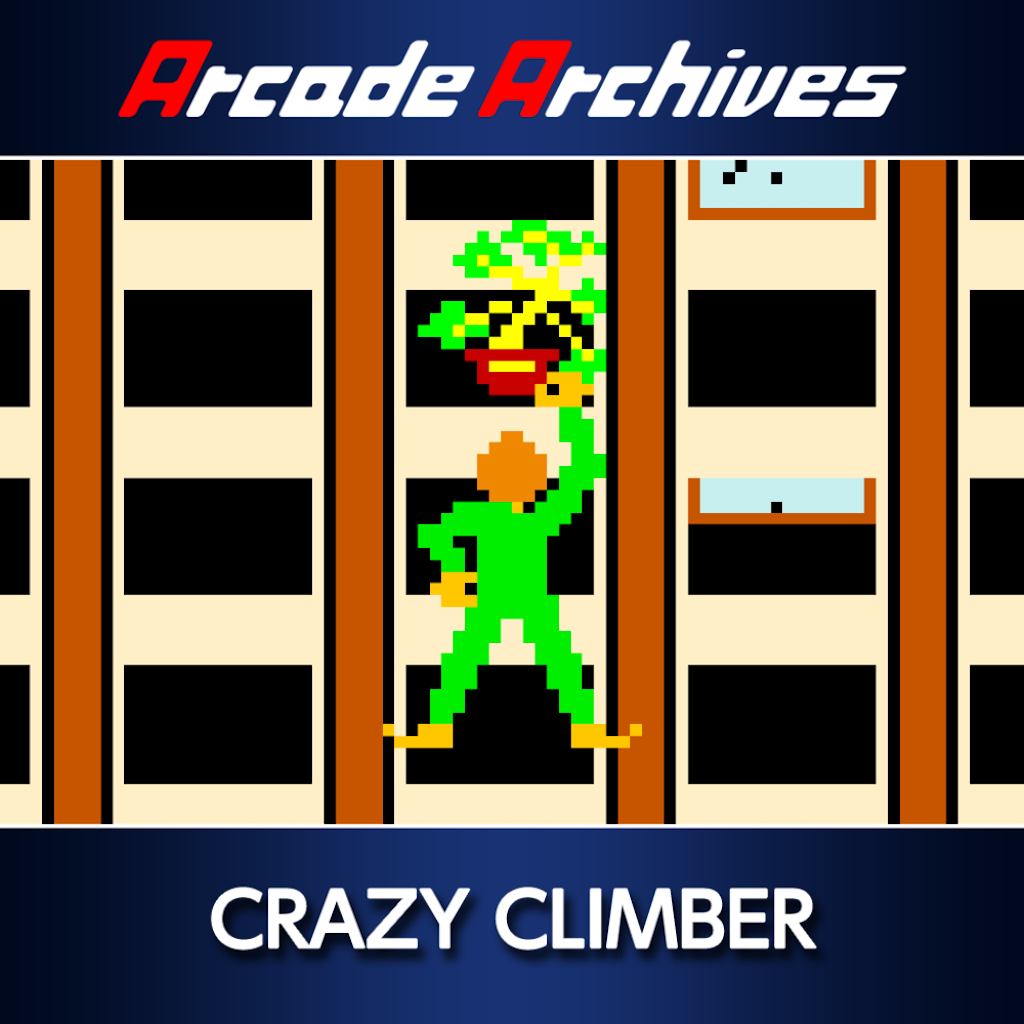
There are few gaming objectives more straightforward than climbing a building. You find the bottom, start going up, and eventually you reach the roof. Simple, right? Well, CRAZY CLIMBER has always had a rather different idea of what skyscraper climbing should involve, apparently treating the scaling of several hundred floors while dodging flower pots, closing windows, birds, falling girders, and assorted other bits of architectural nonsense as perfectly reasonable. Console Archives CRAZY CLIMBER brings Nichibutsu’s 1986 home console version back to modern hardware, and it remains every bit as wonderfully awkward, challenging, and addictive as you might hope.
For anyone unfamiliar with the series, CRAZY CLIMBER is a vertical action game built around one wonderfully simple idea: get to the top without falling to your doom. Your character clings to the outside of a skyscraper and works their way upwards by grabbing window frames, carefully moving from one position to another as the building throws increasingly ridiculous hazards at them. The original arcade version is famous for its unusual twin-stick control system, but this particular release preserves the 8-bit home console adaptation, giving the experience a slightly different feel. That difference is important, but rather than making this version feel lesser, it makes it a fascinating snapshot of how arcade games were being translated for home players in the 1980s.
Welcome To The Building
The basic objective could hardly be easier to understand. Your climber starts at the bottom of a towering building and needs to make their way upwards, one window at a time, until they finally reach the rooftop. The problem is that the building is very much not on your side, and almost everything above you seems determined to knock you back down again. Windows slam shut without warning, objects come tumbling from above, and enemies make the already awkward business of climbing considerably more dangerous.
What makes the game immediately entertaining is how much attention you have to pay to your character’s small movements. You cannot simply hold a direction and expect to reach the top, because every movement needs to be considered. One hand might be safely positioned while the other needs to reach for the next window, and moving too quickly can leave you hanging in precisely the wrong place when a hazard arrives. It is a wonderfully simple concept that quickly turns into a test of timing, concentration and patience.
Going Up
There is something strangely satisfying about watching your climber slowly work their way up the side of the building. Every successful move feels like a tiny victory, because you know the next one could go horribly wrong. The further you climb, the more valuable those moments become, especially after you have survived a particularly nasty sequence of hazards and can see the next section of the building waiting above you.
The sense of progression is deliberately old-school. There is no elaborate skill tree, no equipment screen and no character progression system waiting to reward you. Your reward is simply reaching a higher point than you did before. That simplicity is part of the game’s appeal, as it puts the focus firmly on the player’s ability rather than on artificial progression systems.
The Building Wants You Dead
If the game only involved moving from window to window, it would become repetitive rather quickly. Fortunately, CRAZY CLIMBER offers an impressive array of ways to make your ascent considerably more stressful. Windows can suddenly close, flower pots can fall from above, and birds can swoop across your path, forcing you to react before they send you tumbling back towards the pavement.
Then things get even more ridiculous. Iron bars can come crashing down, electrical hazards can appear thanks to troublesome wires, and various enemies can interfere with your progress. The screen is constantly giving you something else to worry about, and because your character is already in such a precarious position, even a small mistake can have spectacular consequences. There is a lovely sense of old arcade cruelty to it all, where the game is not necessarily trying to make things impossible, but it certainly has no intention of making them comfortable.
Timing Is Everything
The real skill in CRAZY CLIMBER lies in knowing when to move, not just where. You need to watch the building, recognise patterns and understand when a hazard is about to become a problem. Sometimes the smartest decision is to stop completely and wait for something to pass, which can feel surprisingly difficult when every instinct is telling you to keep climbing.
This creates a wonderful rhythm. Move, pause, watch, react and climb again. Once you start to understand the timing, sections that initially seem almost impossible become manageable, and that is when the addictive nature of the game really kicks in. You begin to remember where hazards appear, anticipate enemies’ movements and develop your own little strategies for getting through particularly troublesome sections.
An 8 Bit Time Capsule
Visually, Console Archives CRAZY CLIMBER is an enjoyable reminder of how much personality could be packed into relatively simple 8-bit hardware. The building itself is presented through a collection of repeating windows and platforms, while colourful sprites provide the hazards and enemies that make each climb so entertainingly dangerous. It certainly is not going to compete with a modern skyscraper simulator for visual detail, but that misses the point.
There is a particular charm to the clean, bright presentation of an old home console game. Everything is clear enough to understand, the important objects stand out, and the action remains readable even when the screen becomes busy. That clarity matters in a game where reacting quickly is essential, and the preserved presentation helps maintain the feel of the original release rather than trying to disguise its age.
That Classic Arcade Sound
The audio follows much the same philosophy. There is no sweeping soundtrack trying to make your climb feel like an epic cinematic adventure. Instead, you get the familiar collection of electronic effects and simple musical cues that communicate what is happening while adding to the nostalgic atmosphere.
The sounds of movement, hazards and successful progress all have that wonderfully recognisable early-gaming quality. They are basic, but they have character, and hearing them alongside the colourful visuals makes the whole experience feel like stepping into an old games room. It is the kind of audio design that might seem primitive on paper but somehow becomes part of the game’s identity.
Console Archives Makes It Easier To Play
As with other entries in HAMSTER’s Console Archives series, the biggest advantage of this release is experiencing an older game on modern hardware without having to track down the original cartridge and a compatible console. Display options let you adjust the presentation to suit your preferences, while button customisation is particularly useful given CRAZY CLIMBER’s unusual control heritage.
The ability to save and load at any point also makes a significant difference. Classic games were designed with the expectation that you would sit down and play until you either completed them or ran out of patience, whereas modern players often want the flexibility to dip in and out. Being able to save your progress removes some of that barrier without taking away the underlying challenge. Rewind functionality is equally welcome when a perfectly good climb is ruined by one particularly annoying flower pot.
The Joy Of One More Climb
There is a reason games like CRAZY CLIMBER remain enjoyable decades after their original release. They are incredibly easy to understand but much harder to master, creating that magical arcade quality where failure does not necessarily feel like a reason to stop. Instead, it becomes a reason to try again because you know exactly where you went wrong.
The scoring system adds another layer for anyone who enjoys chasing high scores. Reaching higher sections, avoiding hazards and collecting useful items can all improve your performance, while online leaderboards provide a modern competitive element for players who want to see how their climb compares with others. Suddenly, reaching the roof is only part of the challenge. Getting there efficiently and putting together a better run gives the game another reason to stay in your collection.
A Fascinating Piece Of Console History
What I particularly like about Console Archives CRAZY CLIMBER is that it does not simply preserve a famous arcade game. It preserves a specific version of that game and, in doing so, captures a fascinating moment in gaming history. Home console ports were often compromises compared with their arcade counterparts, whether because of hardware limitations, control differences, or the practical realities of bringing a coin-operated experience into someone’s living room.
That makes this version worth experiencing in its own right. The control scheme may feel unusual at first, and anyone coming directly from the arcade original may need some time to adjust, but there is something appealing about learning how this particular adaptation works. It is not simply an inferior copy trying to imitate an arcade cabinet. It is a little piece of 1986 console history, preserved so modern players can appreciate what playing these games at home actually felt like.
Final Verdict
Console Archives CRAZY CLIMBER is a wonderfully simple game built around an idea that still works remarkably well. Climbing a skyscraper should not be this stressful, yet every open window feels like an invitation to disaster, and each successful section brings a little burst of satisfaction. The mix of careful movement, unpredictable hazards and score chasing gives the game an addictive quality that has stood the test of time.
The home console controls may take a little getting used to, particularly if you are familiar with the original arcade version, but once you settle into the rhythm, there is plenty of fun to be found. HAMSTER’s modern additions make the experience considerably more approachable, with save states, rewind, display options, button customisation and online leaderboards giving this 1986 classic the flexibility it needs on modern hardware. More importantly, none of those conveniences get in the way of the wonderfully old-fashioned challenge at the heart of the game.
Sometimes you do not need a huge open world, an elaborate story or dozens of hours of progression to make a game memorable. Sometimes all you need is a skyscraper, a determined climber and an absolutely unreasonable number of things falling on his head. Console Archives CRAZY CLIMBER is a charming and occasionally infuriating reminder of just how inventive early games could be, and reaching that rooftop still feels like an achievement worth celebrating.