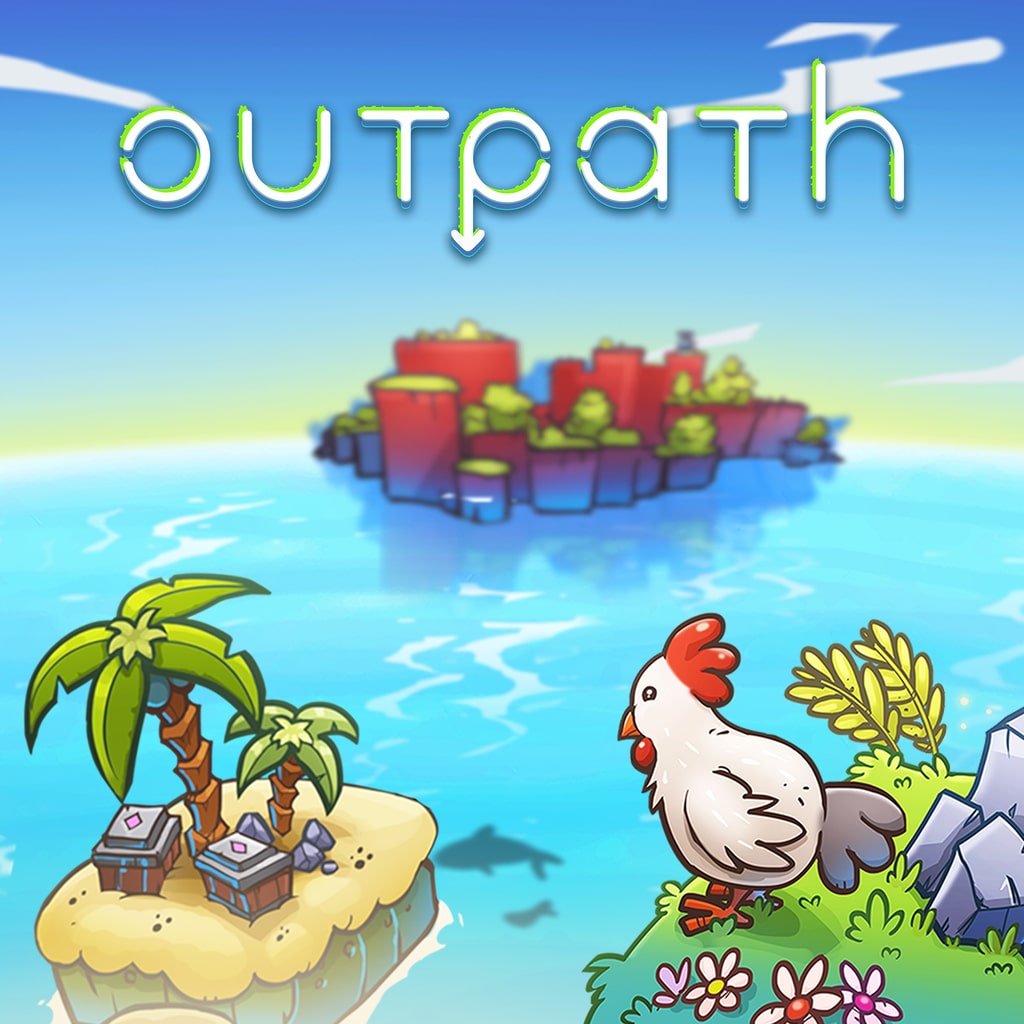
There’s a particular kind of satisfaction that comes from watching numbers go up. Resources ticking upward. Machines humming along. A once-empty field transformed into a self-sustaining industrial playground. Outpath, developed by David Moralejo Sánchez and now arriving on consoles courtesy of Silver Lining Interactive, understands that satisfaction intimately—and wraps it in a deceptively simple first-person sandbox.
Originally released on PC in October 2023, Outpath lands today on PlayStation 5, Xbox Series X|S, and Nintendo Switch, bringing its cozy, experimental clicker DNA to a wider audience. On the surface, it’s been compared to Forager and Satisfactory. In practice, it’s something gentler, stranger, and more quietly addictive.
This is not a game about survival. It’s about momentum.
Click First, Think Later
Outpath begins in the most basic way possible: you click on a tree, and wood appears. You click on a rock, and stone appears. There are no threats, no hunger bars, no looming night cycles. It’s just you, a small floating island, and a steadily growing pile of materials.
The early hours lean heavily into clicker mechanics. Manual harvesting dominates. You chop, mine, and gather through repeated input. It’s deliberately simple, almost hypnotic. And for some players, that loop will either hook them instantly or feel too basic to sustain interest.
But Outpath is patient. Beneath that click-heavy opening lies a clever progression curve.
Soon you’re crafting tools that increase yield. Then machines that harvest automatically. Then systems that refine resources into more complex materials. What starts as an active clicker slowly evolves into a base-building automation sim. The game shifts from “how fast can I click?” to “how efficiently can I design?”
It’s a transformation that feels organic rather than abrupt.
Islands as Expansion, Not Obligation
One of Outpath’s most elegant systems is its island expansion mechanic. Instead of exploring a pre-built open world, you purchase new islands using earned credits. These islands simply appear—manifested in the sky around your starting hub.
Each biome introduces new resources, materials, and discovery tomes that unlock additional blueprints. Autumn forests, tropical beaches, and rocky outcrops all bring fresh crafting possibilities. There’s no combat gating your progress. No boss to defeat. Your only barrier is production.
This structure turns progression into a tangible reward loop. Every new island feels like an earned expansion of your personal sandbox. You’re not conquering territory—you’re cultivating it.
The Synergy Puzzle
For a game that calls itself cozy, Outpath hides surprising depth in its “Synergy” mechanic.
Advanced crafting stations gain bonuses when placed adjacent to specific complementary benches. It’s a subtle system, but it introduces a light puzzle layer to base design. Suddenly, layout matters. Efficiency isn’t just about volume; it’s about proximity.
This mechanic elevates Outpath beyond idle game territory. It nudges players toward thoughtful organization. You start to redesign entire sections of your base to optimize output. It becomes spatial problem-solving wrapped in pastel pixel minimalism.
It’s not Factorio-level complexity—but it doesn’t want to be. Outpath thrives in accessibility, not micromanagement overload.
Active or Idle – Your Choice
What makes Outpath stand out most is its flexibility.
You can play actively—manually gathering, fishing, parkouring across islands to collect stray materials. Or you can let your machines do the heavy lifting while you reorganize your layout. The game never punishes either approach.
There’s no death. No failure state. No time pressure. It is, quite intentionally, a “podcast game.” Something to play while listening to music, watching a stream, or decompressing after a long day.
Even the soundtrack reflects this philosophy. Music subtly reacts to your actions, swelling as production ramps up and softening when you’re idle. It reinforces the rhythm of productivity without demanding your attention.
This design choice won’t thrill adrenaline seekers—but for players craving a stress-free loop, it’s ideal.
First-Person Cozy
Outpath’s first-person perspective gives it a sense of immersion most clicker-inspired titles lack. You’re not hovering over a spreadsheet of numbers. You’re physically moving through your base.
There’s light parkour, too—jumping between platforms, hopping across resource nodes, scaling vertical constructions. It’s not mechanically demanding, but it adds physicality to what could otherwise feel abstract.
Visually, the game leans into stylized pixel graphics rendered in 3D space. Clean edges. Soft lighting. Bright, readable environments. It’s not pushing graphical boundaries, but it’s crisp and consistent.
On consoles, performance holds steady. Load times are short, and controller optimization is thoughtful. The “Hold-to-Click” accessibility option is particularly welcome, preventing hand fatigue during early-game harvesting. It’s a small feature, but one that demonstrates awareness of player comfort.
Where It Stumbles
Outpath’s biggest weakness is its opening stretch. The early game can feel repetitive if you’re not immediately invested in incremental progression. The click-heavy phase may test patience before automation truly takes over.
There’s also a lack of long-term narrative or dramatic payoff. You expand, automate, optimize—but the game doesn’t push toward a climactic conclusion. Standard completion may take 15–20 hours, but you can continue indefinitely. Whether that’s a strength or a weakness depends entirely on the player.
Those looking for high-stakes survival, combat encounters, or dramatic twists will find none of that here. Outpath is intentionally frictionless.
The Console Value Proposition
At £12.79 on consoles, Outpath sits comfortably in the mid-budget range. For that price, you’re getting a substantial sandbox that can easily stretch into dozens of relaxed hours.
It’s not revolutionary. It’s not explosive. But it’s quietly compelling.
For fans of Forager-style loops, light automation, and peaceful base building, this is one of the more approachable entries in the genre. It strips away stress while keeping the satisfaction.
Sometimes that’s exactly what you need.
Final Verdict
Outpath is a soothing, cleverly layered evolution of the clicker genre that blossoms into a rewarding automation sandbox. It won’t satisfy those craving tension or spectacle, but for players seeking a zero-pressure, first-person productivity playground, it’s a deeply relaxing loop machine.
Accessible, cozy, and surprisingly strategic in its layout systems, Outpath proves that sometimes growth itself is the reward.