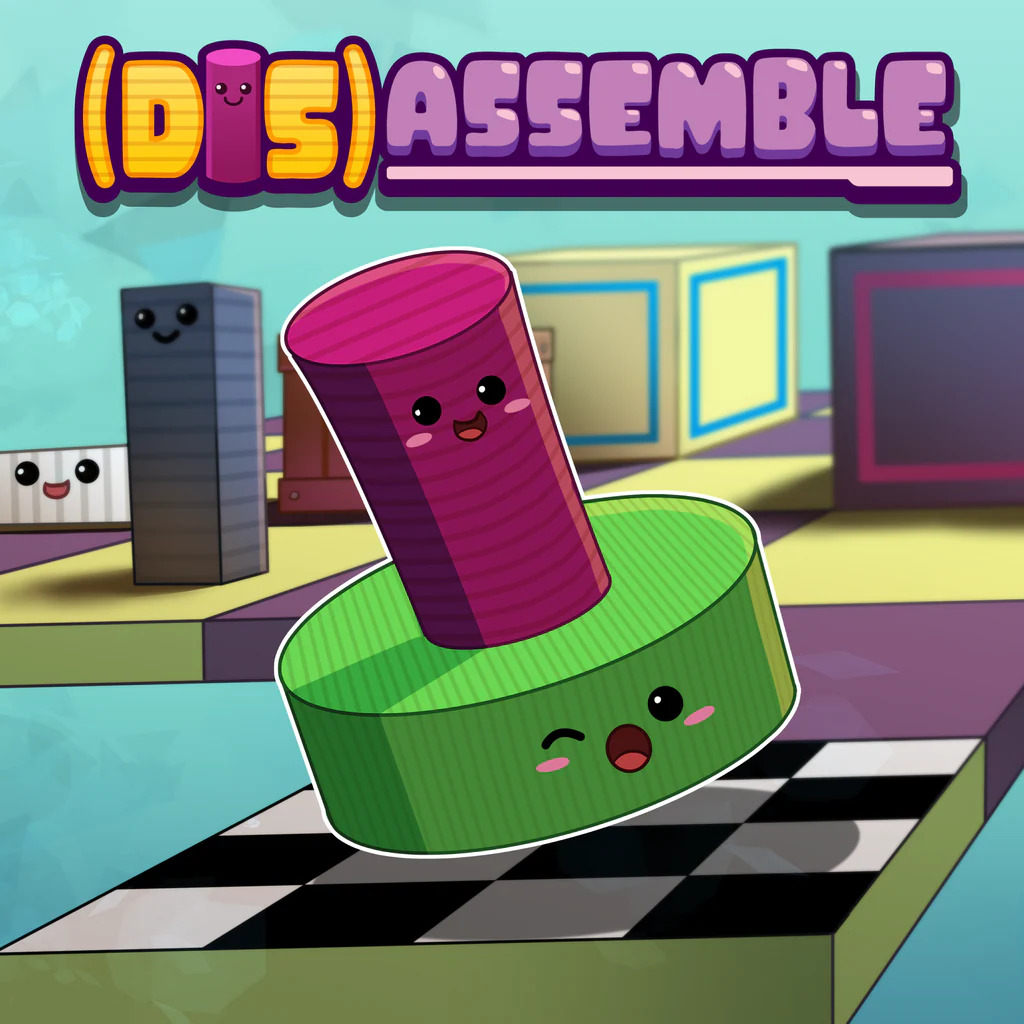
Minimalist puzzle games often sell themselves on a single hook. Rotate the world. Shift gravity. Swap dimensions. (Dis)Assemble, developed by Dragon Fruit Studio and published on consoles by AFIL Games, builds its entire identity around a deceptively simple premise: you control two geometric shapes at the same time—one with each hand.
Originally released on PC and Xbox in July 2025 (with a PlayStation 5 version arriving earlier this year), the game made its Nintendo Switch and Switch 2 debut on February 12, 2026. Optimized for dual Joy-Con play, it’s arguably the most natural home for its dual-control design.
Because (Dis)Assemble doesn’t just test your logic.
It tests your coordination, patience, and sometimes your sanity.
The Core Mechanic: Split Focus
At its heart, (Dis)Assemble is about synchronized movement.
You control two shapes simultaneously—typically mapped to each Joy-Con analog stick. Each shape has its own path, its own obstacles, and its own destination. Your objective is to guide both to their respective goals at the same time.
It sounds manageable.
Until the level design begins to twist.
One shape may need to push a block to clear the other’s path. One must dodge rotating barriers while the other navigates a narrow corridor. Certain sections require one shape to “disassemble” structures—breaking apart modular architecture to create new traversal routes.
The brilliance lies in forced multitasking. You cannot pause one shape while focusing on the other. They move together—or fail together.
Architectural Surprises
Visually, (Dis)Assemble leans into a clean, high-contrast 3D aesthetic.
Levels resemble abstract architectural dioramas—floating platforms, shifting walls, rotating bridges. Color is used strategically, helping players distinguish between the two controlled shapes and their respective objectives.
The minimalist approach works in the game’s favor. There’s no visual clutter to distract from spatial reasoning. Every moving block, every obstacle, feels intentional.
As levels progress, new architectural gimmicks are introduced: sliding partitions, timed gates, mirrored layouts that invert directional thinking.
Each stage feels like a self-contained puzzle box.
The Mental Tug-of-War
What makes (Dis)Assemble special is the cognitive strain it induces.
Most puzzle games challenge either logic or reflexes. Here, both are intertwined.
You must mentally map two routes simultaneously. You must predict how moving an obstacle for one shape affects the other’s timing. In some stages, the shapes’ paths intersect in ways that require near-perfect synchronization.
There’s a unique frustration that arises when one shape reaches safety—only for the other to collide with a rotating hazard because your focus drifted for half a second.
But when both shapes glide into their goal zones in flawless harmony?
It’s deeply satisfying.
Switch Performance and Joy-Con Design
On Nintendo Switch and Switch 2, (Dis)Assemble feels at home.
The dual Joy-Con configuration reinforces the two-hand concept naturally. Each controller becomes a literal extension of its respective shape.
Performance is smooth, with consistent frame rates and crisp visuals. Load times are brief, even on base Switch hardware.
Switch 2 optimization enhances resolution and responsiveness slightly, though the core experience remains unchanged.
The control scheme, however, may take adjustment. Players unaccustomed to simultaneous dual-stick coordination may initially feel overwhelmed.
The game doesn’t ease you in for long.
Difficulty Curve
(Dis)Assemble begins gently, introducing basic push-block puzzles and obstacle timing.
But it escalates quickly.
Mid-game stages demand near-constant attention shifts. Late-game levels introduce multi-layered architecture requiring precise path planning and micro-adjustments.
The difficulty spike is deliberate.
This is not a casual “pick up and relax” puzzle experience. It demands mental stamina.
Some players may find the steep curve discouraging. Others will relish the challenge.
Importantly, the game avoids feeling unfair. Failure stems from coordination breakdown—not hidden mechanics or ambiguous design.
Sound and Atmosphere
Sound design is subtle and effective.
Soft ambient tones underscore the minimalist aesthetic. Audio cues signal successful interactions or imminent hazards.
There’s no bombastic soundtrack competing for attention. The quiet reinforces concentration.
In extended sessions, the restrained audio becomes part of the meditative rhythm—until you inevitably break it with a frustrated sigh.
Where It Struggles
For all its strengths, (Dis)Assemble is niche.
Its central mechanic is clever—but singular. There’s little variation beyond architectural permutations. No narrative framing. No character progression.
Replay value primarily comes from chasing cleaner, more efficient runs rather than discovering new content.
Additionally, prolonged play sessions can become mentally exhausting. This is a game best experienced in focused bursts rather than marathon sessions.
The lack of cooperative modes is also a missed opportunity. Given its dual-control nature, a two-player split-control mode might have introduced chaotic but entertaining dynamics.
A Precision Puzzle for the Patient
(Dis)Assemble doesn’t attempt to appeal to everyone.
It is a precision puzzle game for players who enjoy mastering mechanics through repetition and discipline. It thrives on the tension between two simultaneous objectives.
In an era where many puzzle games lean heavily on narrative charm or whimsical aesthetics, (Dis)Assemble stands apart with its almost clinical focus on coordination.
It’s clean. It’s clever. It’s uncompromising.
Final Verdict
(Dis)Assemble is a brain-racking minimalist puzzle game that turns dual control into a mechanical art form. Its synchronized two-shape mechanic is both its defining strength and its limiting factor. Architectural level design remains inventive throughout, and performance on Switch platforms is smooth and well-optimized.
However, its steep difficulty curve and singular focus may narrow its appeal. For players who crave coordination-heavy logic challenges, (Dis)Assemble is a uniquely rewarding experience. For others, it may feel more like an endurance test than entertainment. But for those willing to commit both hands—and full attention—it delivers something refreshingly different.